
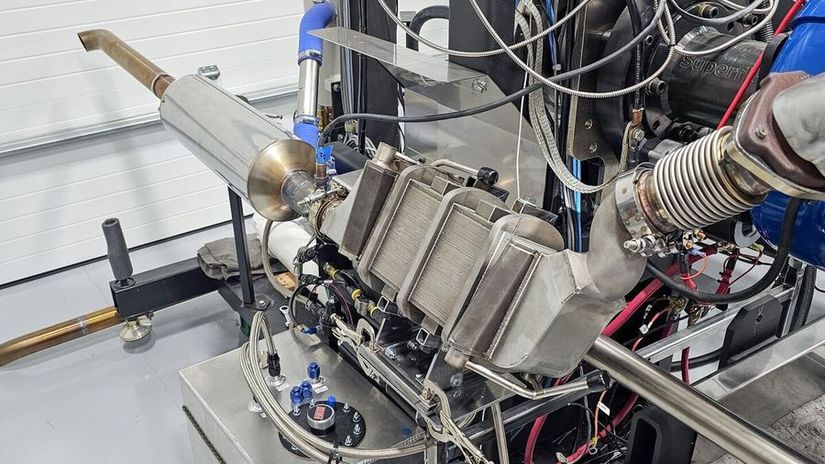
German researchers at the Fraunhofer Institute have developed an internal combustion engine that produces no CO2 emissions, potentially offering a new lifeline for traditional engine technology in an era of decarbonization.
The breakthrough centers on the replacement of carbon-based gasoline with ammonia (NH3). Because ammonia consists of one nitrogen atom and three hydrogen atoms—and contains no carbon—its combustion does not release carbon dioxide into the atmosphere. This development suggests that the primary environmental issue may not be the internal combustion engine itself, but rather the hydrocarbon fuels typically used to power them.
In practical terms, an ammonia-powered engine essentially runs on hydrogen. However, ammonia serves as a far more efficient carrier than pure hydrogen, which requires specialized high-pressure tanks for storage. Ammonia is significantly easier to handle and refuel, making it a more viable option for widespread infrastructure.
Despite its environmental advantages, the fuel presents specific engineering challenges. Ammonia is more difficult to ignite than gasoline and possesses only half the energy value, meaning more fuel is required to achieve the same power output.
While the technology may seem novel, the use of ammonia as a fossil fuel alternative has a long history. During World War II, buses in Belgium were powered by ammonia, and the U.S. Army explored its utility throughout the 1960s. In the aerospace sector, the North American X-15 experimental rocket plane utilized ammonia in its rocket engines.
The move toward ammonia is not limited to German research. Global automotive players, including Toyota and GAC, are also exploring the potential of ammonia to preserve the viability of the internal combustion engine.
This shift toward carbon-free synthetic fuels could fundamentally alter the global transition to green energy, providing a sustainable alternative for heavy transport and machinery where battery electrification remains a challenge.
