
Lithuania’s housing market, like many across Europe, is a notable financial consideration for residents. A recent analysis reveals that Lithuanians typically allocate 30-40% of their income to housing costs, a benchmark crucial for budgeting and financial planning. Examining income data alongside rental rates provides a clearer picture of affordability and current market trends across the country.
Most People Allocate 30-40% of Income to Housing Costs
The amount someone is willing to spend on rent is directly tied to their income, the city they live in, and their expectations for the property. As housing costs continue to be a significant financial burden for many, understanding these benchmarks is crucial for budgeting and financial planning.
Typically, individuals or couples allocate 30-40% of their income to housing, according to real estate development and services group “Inreal” expert Tomas Sovijus Kvainickas.
However, there are nuances to consider. Kvainickas offered a simple example: “If you earn 10,000 euros and rent for 1,500, that represents 15% of your income. But if you earn 1,000 euros, paying 150 euros for rent won’t be feasible. Generally, people aim for 30-40%, and try not to exceed that limit,” he explained.
Looking at current income data from the State Data Agency, the average monthly gross salary is currently 2,427.6 euros, while the net amount received is 1,484.4 euros.
Therefore, theoretically, someone earning that salary could allocate between 445 euros (dedicating 30%) and 594 euros (dedicating 40%) to monthly housing costs.
Kvainickas also pointed out that income and housing costs can be further complicated by location. “Someone might earn a higher salary working for a company based in Vilnius while living in Kaunas, or another smaller city. This allows for the possibility of better housing, but at the prices of that city,” he said.
Analyzing data effectively requires considering the age of the building. According to the analyst, buildings constructed before 1940 are generally the most expensive in Vilnius, Kaunas, and Klaipėda. Buildings constructed before 1990 typically represent the most affordable options, often located in Soviet-era residential areas. Those built between 1990 and 2010 are generally of better quality than Soviet-era housing, but are more spread out across the city. Buildings constructed after 2010 represent relatively new construction throughout the city.
For example, two-room apartments built before 1940 can cost between 500 and 600 euros, depending on location. However, Kvainickas noted that price ranges in other segments aren’t drastically different, and the price gap isn’t typically in the thousands of euros.
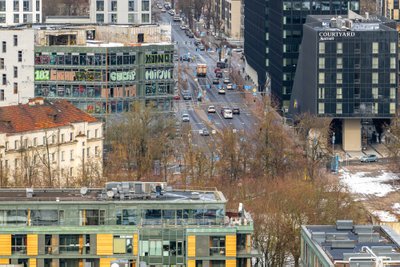
Checking the real estate listing portal Aruodas.lt, two-room apartments in Vilnius range in price from 190 euros to 2,400 euros in the city’s most prestigious areas. In Kaunas, the lowest price is 170 euros, with the highest reaching 1,300 euros.
Vilnius Residents Tend to Spend More
Mantas Sladkevičius, a real estate broker working in Vilnius, shared his observations on how much residents of the capital typically allocate to rent.
“A couple or single person living in Vilnius generally spends around 600-700 euros on rent, which is standard for a two-room or 1.5-room apartment,” Sladkevičius said.
“A well-maintained, modern two-room apartment – around 40-45 square meters – in the city center can cost between 800 and 1,200 euros per month. On the outskirts of the city, the same apartment might cost between 500 and 700 euros per month,” he added.
He noted that clients generally prefer to live within approximately 2.5 miles of the city center.
What I’m increasingly noticing is that with each year, clients are willing to spend more on rent, but at the same time, they increasingly value the quality of the property, the level of finishing, or the design. Currently, a tenant might be willing to spend an extra 100-150 euros on rent, but will choose a higher-quality property, more spacious, and in a better location to better meet their quality of life.
Mantas Sladkevičius
He added that tenants coming from other countries often have different standards. “In other countries, both housing rental criteria and the quality of the properties themselves are significantly lower, so it’s normal practice for them to rent less well-maintained, cheaper apartments even here in Lithuania,” he explained.
Česlovas Savickas, a real estate expert working in Kaunas, agrees that the unwritten rule of allocating 30-40% to rent applies in Kaunas as well, with that figure increasing for couples to around 700 euros.
He noted that two-room apartments are the most popular in Kaunas.
“In Kaunas’ standard residential areas, for example in Žaliakalnis, prices range from 400 to 600 euros, depending on the level of finishing. You can find simpler two-room apartments for 400 euros. If we’re talking about more compact one-room apartments, prices can range from 250 to 400 euros in residential areas,” Savickas said.
Four-room apartment prices are surprisingly close to those of two-room apartments. A modern, well-maintained two-room apartment can cost the same as a mid-range three or four-room apartment – from 450 to 600-700 euros.
This would apply to neighborhoods like Dainava, Šilainiai, and Kalniečiai.
In Žaliakalnis, the situation is different due to its contrasting nature, reminiscent of Vilnius’ Žvėrynas. It ranges from wooden houses to newly built luxury homes, something not typically found in residential areas.
In Dainava, the upper limit for rental costs is 400-500 euros, while in the more upscale Nemunaičiai district, the price can rise to 700-800 euros per month. A similar price can also be found for an apartment in the city center, in the Old Town. Savickas emphasized the importance of a good quality-price ratio, noting that tenants consider not only the price but the overall package when choosing a property.
Savickas also noted a growing trend: people want to rent apartments that are fully equipped.
“If 10 years ago, many people rented apartments and had to bring their own appliances and other household items, the trend has now shifted to the point where if an apartment doesn’t have appliances, furniture, and isn’t renovated, no one wants it,” he said.
He added that Lithuania stands out globally for having a relatively small rental market. Lithuanians are more inclined to purchase their own homes and rent them out – the percentage of homeownership is much higher than in other countries. “But this is because we historically have a very high rate of homeownership. 95% own property, and only about 5% don’t own a home,” he explained.
This is interesting because the investment return from rentals is lower than in Ireland or most of Europe, according to the real estate expert.
Rental Prices Fluctuate
The experts interviewed by Delfi were asked for their outlook on the housing rental market.
“When it comes to rental prices, there is a significant seasonality in this segment in Lithuania. Historically, the start of the student academic year marks the time when most rental agreements are concluded. But they are no longer the only tenants, and prices tend to rise towards the end of summer, then gradually decrease again. From April, they start to rise slightly. The prices draw a kind of boat shape,” said Kvainickas.
However, he has good news for tenants. “Rental prices are not expected to rise in the near future, and those apartments that are currently vacant will be rented out so that landlords don’t have to pay for heating and other expenses. If the average heating cost is 50 euros, it’s definitely worth renting it out for 50 euros less to avoid paying it yourself and earn additional income,” he explained.
Prices may rise again as summer approaches due to increased demand.
Sladkevičius confirmed that rental prices are not expected to increase drastically in 2026 and should grow at a normal rate – 5%.
“The steady stream of tenants should be maintained by rising housing prices, and a large proportion of young people find it difficult to save enough money for a down payment, and prices are rising, leading more and more people to turn to the rental market,” he said.
Although currently Lithuania is one of the countries with the highest percentage of homeowners in Europe, at 89%, this figure is expected to start decreasing as housing prices continue to rise, and more people turn to the rental market, which will gradually begin to increase rental prices.
