45 Candidates Shortlisted for Habitability
Astronomers have narrowed down a list of potentially habitable exoplanets to 45 candidates orbiting within the habitable zones of their stars and exhibiting Earth-like characteristics. Of these, 24 are located in the central region of the habitable zone, and ten are considered particularly Earth-like, receiving roughly the same amount of radiation and heat from their star as our planet, according to recent findings.
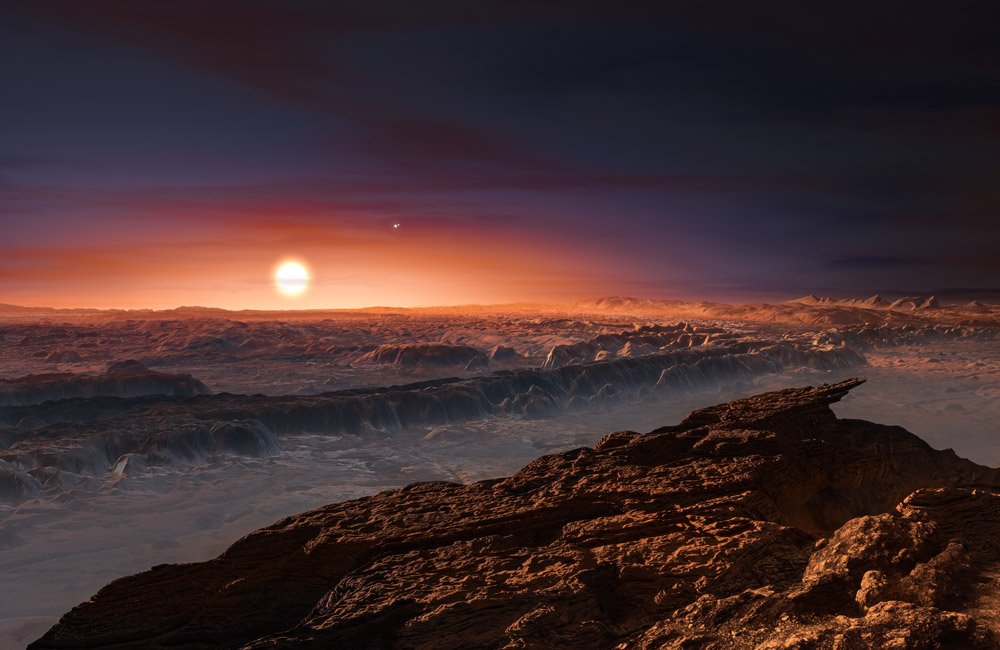
Among these ten top contenders is the innermost planet of our nearest stellar neighbor, Proxima Centauri, and TRAPPIST-1e, one of seven rocky planets orbiting a red dwarf star just 40 light-years away. Recent observations suggest this Earth twin may possess an atmosphere, though not necessarily one similar to Earth’s. The list also includes Wolf 1069b, located 31 light-years away, and GJ 1061d, a planet only twelve light-years from Earth.
The search for life beyond Earth is increasingly focused on identifying planets with the right conditions, and this research provides a crucial step in prioritizing targets for further investigation. Some additional exoplanets on the 45-planet shortlist offer particularly favorable conditions for closer observation. “A goal of our project was to be able to say, ‘Here are the best observation targets,’” explains Gillis Lowry of San Francisco State University, a co-author of the study.

The astronomers determined which Earth twins could be directly imaged or whose atmospheres could be well-studied through spectral analysis. Prioritized observation targets include four of the seven Earth twins around TRAPPIST-1 and the planet LHS 1140b, also approximately 40 light-years away. These planets pass directly in front of their stars, leaving spectral signatures in the star’s light, enabling a more detailed characterization of their atmospheres and the potential detection of biosignatures.
The research also considers planets orbiting on the inner or outer edges of the habitable zone. “Observing these planets can help us understand when habitability is lost, how much energy is too much, and which planets remain habitable – or perhaps never were,” explains Abigail Bohl of Cornell University, the study’s lead author. “The same applies to eccentric planets: how much orbital eccentricity can a planet have and still retain surface water and habitable conditions?”
The list of 45 Earth twins also includes some planets whose habitability is debatable despite potentially habitable conditions. Red dwarfs, like Proxima Centauri, are prone to powerful radiation flares, which can expose nearby planets to high doses of energetic radiation potentially lethal to organisms. The astronomers emphasize that this factor also warrants further investigation. (Monthly Notices of the Royal Astronomical Society, 2026; doi: 10.1093/mnras/stag028)
Source: Royal Astronomical Society
23. March 2026
– Nadja Podbregar