
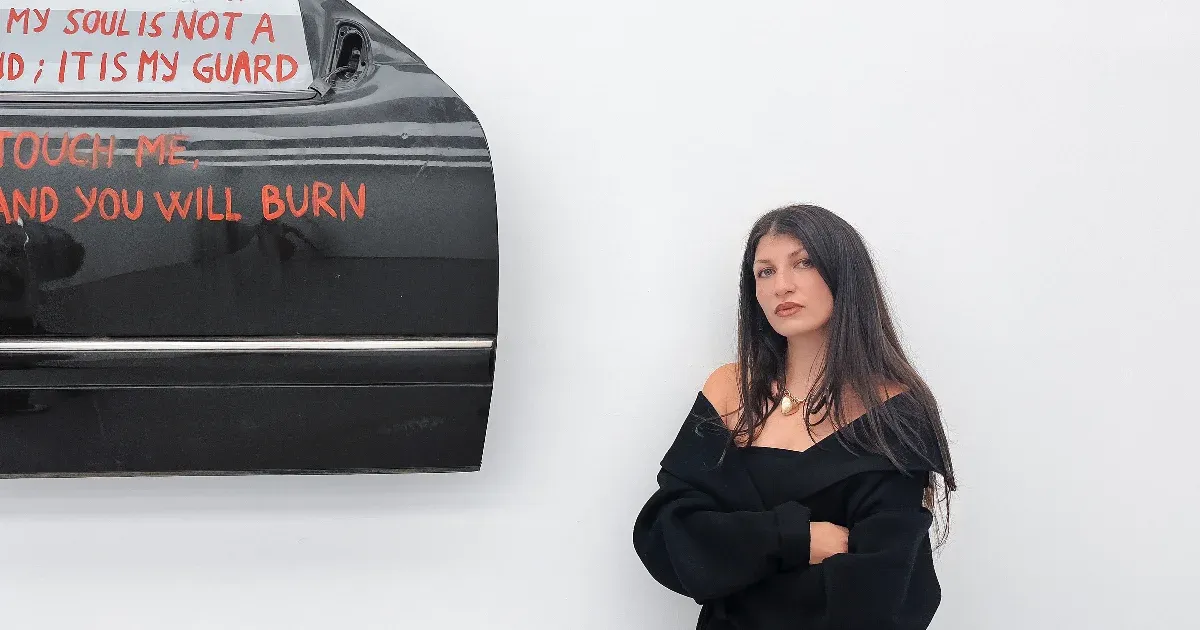
Bosnian-Roma artist Selma Selman is presenting a new exhibition, “Fana,” at the acb Gallery in Budapest, exploring themes of identity, trauma, and rebirth through a visceral and unconventional body of work. The exhibition, on view through December 4, features paintings, performance art documentation, and sculptures created from found materials-ofen metal-reflecting both personal history and broader societal forces. Selman’s work has gained increasing international recognition, with upcoming appearances planned at the Lyon Biennale, the Qatar Triennale, and london’s Tate modern.
Selma Selman’s art defies easy categorization, a deliberate act of breaking free from the boxes others try to place her in. Born in a village near Bihać, Bosnia, to Roma parents, her upbringing was marked by her father’s work as a carpet and metalworker, and her mother becoming a young parent. Selman began creating commissioned paintings as a teenager, which her father then sold. She went on to study painting at the University of Banja Luka’s Academy of Fine Arts, later earning a master’s degree in New York state.
Her work—which increasingly encompasses performance art alongside painting—draws from her family history, her heritage, and the experience of the Yugoslav Wars. Selman’s pieces are often striking and visceral, including:
- Dismantling a Mercedes with her father, brother, and cousin (Mercedes Matrix);
- Destroying a pile of vacuum cleaners (Self Portraits);
- Taking apart motherboards to extract gold, which she then used to create a golden nail (Motherboards);
- Selling her hair and clothes to raise the amount her family would have received had she been married off as a child (Sold For Parts);
- Building a dedicated room for her mother, something she never had due to her marriage (The Pink Room of Her Own);
- Shouting the phrase “You have no idea!” repeatedly on the streets of New York City (You Have No Idea);
- Addressing messages to an imaginary, sometimes oppressive, sometimes romantic man (Letters To Omer);
- Transforming scrap metal excavators into giant flowers (Flowers Of Life);
- Recreating and filming a wartime memory of her mother crossing a bridge filled with corpses to reach the market (Crossing The Blue Bridge);
- Establishing a school for disadvantaged Roma children in her home village – a project born not of art, but of necessity; and
- Painting on metal surfaces, pipes, spoons, car parts, doors, metal sheets, and hoods.
Pieces from her recent work were previously shown in a group exhibition at Ludwig, but a larger collection, including her drawings, is now on display at the acb Gallery in Budapest, which has represented the artist since 2017. Selman spoke with us about her exhibition, titled “Fana,” her increasingly ambitious plans, and the potential for a breakthrough in Eastern Europe.
Forrás: Tóth Dávid / acb Galéria
“Fana,” an Arabic-derived term, broadly means to destroy one’s ego, to detach from oneself in order to be reborn and understand oneself better. “I didn’t have a specific concept when I was planning the exhibition; it came about after I took stock of what I could exhibit,” Selman explained. “At the planning stage, I was interested in Sufism, the poetry of Rumi. I was inspired by a quote from Simone de Beauvoir, that a woman’s ‘wings are clipped and she is lamented for not being able to fly.’ I was interested in what makes a human being whole. Are you whole if your ego is gone? Is it possible to die before you actually die? These figures in the paintings are all full of life, but there’s a black hole in their souls. How do you come back from that?”
Selman describes finding a sense of clarity while working. “In my studio, alone, when I’m creating. As soon as my art leaves there, it’s no longer entirely mine, but belongs to the people, which is, of course, the essence of art. When I’m alone in the studio, I’m aware of every feeling and thought. But after that, it’s all theirs. I like it when people buy my art, I like it when it goes into a good collection, or when it’s simply appreciated. But no one can take the act of creation away from me.”
Her performances, however, take a toll. “Yes, then I give my body and my voice. Many artists say they feel great after a performance. Well, I feel terrible, and I always ask myself why I do this. I’m so vulnerable, I go through so many emotions just because I believe in the power of art.”
Selman’s unconventional choice of canvas—metal—stemmed from practical necessity. “When I was studying painting in Bosnia, it was always a big concern how to get canvases. A canvas is very expensive, and as a student, you feel like you can’t make mistakes, because if you ruin it, you have to buy a new one for six hundred euros. I didn’t start painting on metal because I thought it was a great idea, but because my father said, ‘Here’s an aluminum sheet, maybe you can paint on that too.’ That’s how it started. In my third year, Mladen Miljanović began teaching, and the acb Gallery also represents him. He saw something in me and encouraged me. The whole academy started talking about me, and I was completely shocked, because I was doing this because I didn’t have money. That’s how I became someone by painting on car bodies.”
Before being accepted into university, Selman painted on canvas, with her father acting as her manager. “By the age of seventeen, I had a solo exhibition, I was on the front pages of newspapers, and I sold ten paintings a day. I painted on commission: horses, donkeys, cemeteries, flowers. Whatever people asked me to paint, I painted. Someone asked me to paint a portrait of his deceased sister in two hours, and we said okay, it will be twenty euros, and I did it on the spot. I was a working artist before I was an artist.”
“At first, I thought people would laugh at me. I thought everyone would realize how poor I was. That’s why it was so important to have a teacher who didn’t judge, but encouraged me. He told me that if I was comfortable with it, and if I had the money, I should do it. So I painted on everything, on spoons, on my mother’s kitchen utensils. I stole from the communal kitchen in the dorm to paint on them. I dismantled dishwashers, any metal surface I found, I painted on it. I became obsessed with creating. At the academy, I never understood how students could put the brush down at the end of the day. How could they stop painting? I didn’t understand why I had this urge to constantly paint.”
“My dorm was two minutes from the university, but I didn’t go back there in the evenings. I realized that everyone went home at six o’clock, but after that, the studio was all mine. I often stayed until midnight. While others went out drinking or dancing, or doing drugs, I stayed in the studio, watching famous artists on YouTube, and listening to them talk about art and how they create. I tried to understand myself, and I managed to be reborn as an artist who paints on metal.”
Selman’s materials hold their own history. “I love these objects as they are. Sometimes I have to polish them, or apply a new layer of paint with a spray gun, but other than that, I don’t like to add much to them. They already have their own story. Many people are crazy about nature, but I love objects, components, industrial structures. Especially when I see them in the junkyard. I wash them, clean them, and give them a new meaning in their life. It’s like bringing inanimate bodies back to life. And when they go up on the gallery or museum wall, they are reborn again. Essentially, that’s the essence of my art.”
Eyes are a recurring motif in her work. “You can read a lot from a person’s eyes, but there’s also a quasi-religious interpretation, that I’m trying to protect the artwork from curses, or even the entire exhibition. ”
Despite her success, Selman remains grounded. “I no longer feel like I need to paint so much, but the need to create is still there. I understand those artists who complete one or two works a year. That’s perfectly okay, but I can’t do that. Today, for example, I decide I want to draw three pictures, tomorrow I decide I need to film a team of running women. It’s hard to explain, but there’s a visual war going on in my head. Lately, it’s been getting harder and harder to create, because I travel a lot, and I have to do things I like less, like attending panel discussions and giving lectures, but as an artist, that’s part of my job too, to talk about it.”
“I’m not sure if the size is important. With these projects, there was always a goal. With the computers, I extracted the gold, and with dismantling the car, it was more about luxury. I also have a personal connection to the brand, and what it represents. In my village, many people’s life’s purpose is to drive a Mercedes. There are people who don’t eat, don’t drink, don’t have a roof over their heads, yet they have a Mercedes, because it represents something to them. If you bought a Mercedes, it means you’ve achieved something, so your life, and all the work you put into it, meant something. I think it’s incredible that a brand has managed to achieve that. In my village, they say that if there wasn’t a Mercedes, BMW would be the best car in the world. It doesn’t matter about Rolls-Royce, Bentley, any other brand. Just these two.”
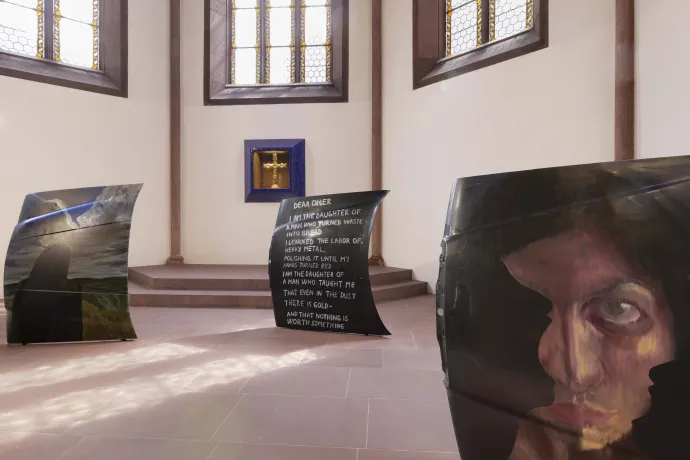
Selman kiállítása az Art Baselen – Forrás: acb Galéria
“My car at home looks like the president of Bosnia is sitting in it. I have to maintain my image in the village, I need a car that matches my social status. I’m seen as Tito at home, if I don’t have the best car, I don’t count as a role model.”
“Honestly, I would have been happy if my own country had recognized me sooner. A country only knows you when you’ve been recognized elsewhere. I only had a solo exhibition in Bosnia in 2021, that was the first and last. I think Hungary is much more developed in this regard than Serbia or Bosnia. There’s no market, no infrastructure, no interest in supporting the arts in those countries. So yes, the question is a cliché, but it’s true, because the West has created the system that supports artists. I alternate between living in Berlin, Amsterdam, and New York. I went to university in the latter two. I stayed there, saw the exhibitions I needed to see, and met the people I needed to meet, the people who support the arts. There needs to be change in Eastern Europe, Serbia is falling apart. ”
“I like that my last exhibition of the year is about the death of the ego, because then next year will be something completely different. I’m working on the ‘Letters to Omer’ project, which will finally become a book. I’ll be participating in the Lyon Biennale, the Qatar Triennale, at the Tate Modern in London, and the Moderna Museet in Stockholm. I have a performance coming up in Germany in collaboration with the Mercedes factory. I’m working on a lot of things, dealing with my foundation, and planning a vacation, because I really need one.”
“Fana” is on view at the acb Gallery through December 4. More information about the exhibition can be found here.
