
Our brains work tirelessly to create a seamless and reliable perception of teh world, constantly integrating sensory data to determine what’s real and what isn’t.New research published in Nature Communications sheds light on how the brain distinguishes between our own bodies and the external habitat, revealing a link between brainwave frequency and our susceptibility to illusions of body ownership. A team at the Karolinska Institute used a “fake hand illusion” – and even a bit of deception – to explore the neurological basis of self-perception, offering new insights into conditions where this sense of bodily awareness is disrupted.
The brain prefers a logical and coherent world. When it detects an action, it anticipates a reaction based on past experience, even if the stimuli are received through different senses. For example, when we see someone strike a massive gong, we expect to be immediately enveloped in a deafening sound. Or, when we finally manage to peel open the plastic wrap of a wedge of cheese, we anticipate our nostrils being flooded with the aroma of the dairy product. Even when stimuli are separated by several seconds – like the time between a lightning flash and thunder – our brain finds it reassuring to hear the thunder, because it’s anticipating what’s about to happen.
This phenomenon is called sensory integration, and it helps reduce uncertainty in the world around us. However, our brain doesn’t constantly integrate every signal it receives. Over millions of years of evolution, it has specialized in determining which signals to integrate and which to separate. This selective processing is crucial for navigating a complex environment.
Consider a prehistoric human. If that human integrated every signal – the murmur of a stream, the chirping of every bird species, the tickle of a blade of grass – they would be less likely to focus on the snap of a branch under a large paw, or the scent that signals a massive cave bear might be looking for its next meal. Our brains prioritize information vital for survival.
Therefore, our brain, in a fraction of a second, focuses on the most important information and integrates sensory signals that likely originate from the same object, while separating those that don’t. If the snap and the scent occur within what’s known as the ‘temporal binding window’, the brain goes on alert. If everything happened at the same time, there’s a good chance a bear is present – a more urgent concern than listening to birdsong.
When Stimuli Come From Within
But things get more complicated when stimuli originate from inside our own bodies. Relatively recently, neuroscientists have discovered that our brain is constantly integrating and discriminating stimuli to determine what is part of our body and what isn’t. It combines visual, tactile, and even our ‘sixth sense’: proprioception. But it was by deceiving these senses that a team at the Karolinska Institute was able to investigate how these key brain processes function.
Specifically, they studied how 106 people reacted to the ‘fake hand illusion’ while measuring their brainwaves. In this illusion, participants place their arms on a table, one is hidden, and then swapped with a realistic prosthetic hand. The real hand is then stroked while the prosthetic is touched, leading the participant to feel as though the prosthetic is their own. At that point, the researcher (or magician, or both) strikes the fake hand with a hammer, and the person will typically try to withdraw their hand, or even experience pain.
However, some people are more susceptible to the illusion than others. To account for this, the subjects in this research wore instruments to measure their brainwaves. These waves – alpha, beta, gamma, delta, and theta – reflect the frequency of neuronal activation, and vary from person to person. Some individuals produce faster waves, while others produce slower ones.
More Brain Activity for a Reliable Reality Check
Researchers discovered that people with faster alpha waves were more difficult to deceive. To convince these individuals that the prosthetic was their own, researchers had to brush both hands simultaneously and be very precise with their movements; otherwise, the illusion would break. Those with slower alpha waves were easier to fool, requiring less precise stimulation.
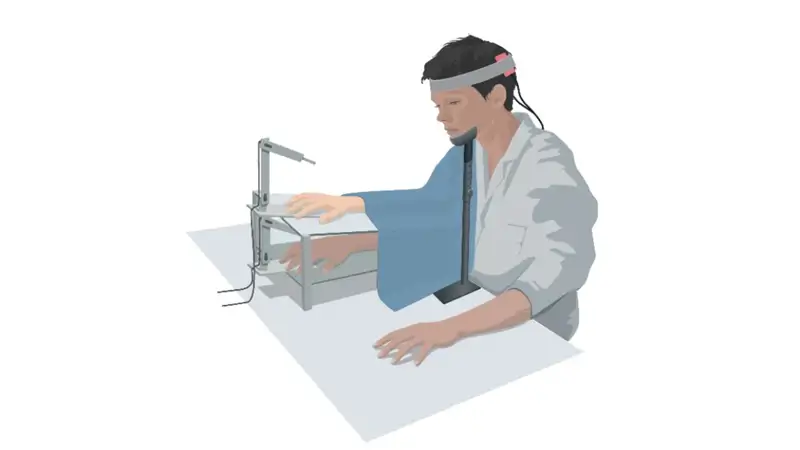
Experimental setup and procedure for alternating current transcranial stimulation (tACS). D’Angelo, M., Lanfranco, R.C., Chancel, M. et al. Parietal alpha frequency shapes own-body perception by modulating the temporal integration of bodily signals. Nat Commun 17, 53 (2026). https://doi.org/10.1038/s41467-025-67657-w
To strengthen the hypothesis, researchers conducted a second experiment where they non-invasively stimulated the brains of those more easily fooled. They used a headband with electrodes capable of emitting electrical pulses, increasing the frequency of the participants’ brainwaves. Suddenly, these individuals became much harder to deceive.
With this second experiment, the researchers demonstrated that brainwaves are indeed related to how our brain understands our body and defines the boundaries of ‘self’ – a brain rhythm capable of drawing where the body begins and ends. This research offers new insights into the complex mechanisms underlying body ownership and perception.
