
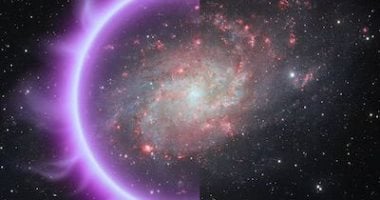
Recent scientific studies suggest that dark matter—believed to outweigh ordinary matter in the universe—may not exist at all. Physicist Naman Kumar proposes an alternative explanation: that the force of gravity itself changes depending on distance, and doesn’t behave the same way throughout the universe.
Traditionally understood as a force that keeps planets in orbit and prevents galaxies from tearing apart, gravity is typically considered a force that decreases with the square of the distance. However, the new model suggests this assumption may not be accurate on the immense cosmic scale.
This research challenges long-held assumptions about the fundamental forces governing the universe, potentially impacting our understanding of galactic formation and cosmic structure.
Newton’s Constancy Isn’t Entirely Constant
In Kumar’s model, the value of Newton’s gravitational constant isn’t a fixed number as commonly understood, but rather a variable dependent on distance. According to his equations, this constant “runs” with distance in a way that makes the force of gravity decrease according to a relationship of 1/r instead of 1/r² at very large distances.
This change means that gravity becomes stronger than expected at the edges of galaxies, potentially explaining why stars rotate at high speeds without needing to assume the existence of invisible dark matter surrounding the galaxy.
The findings offer a potential alternative to the widely accepted dark matter hypothesis, which has been a cornerstone of cosmological models for decades.
A New Gravity Model Based on Quantum Physics
This approach is based on principles from quantum field theory, where Kumar introduced what’s known as an “infrared running” model. In this framework, the weakening of gravity slows down as distance increases, allowing it to maintain the cohesion of galaxies.
The researcher applied this model to real data from spiral galaxies, and was surprised to locate that galactic rotation curves—which have long been used as strong evidence for dark matter—could be fully explained using only visible matter.
“These results suggest that the infrared running scenario may be sufficient to explain galactic rotation without having to assume the existence of dark matter,” Kumar explained.
What About the Early Universe?
The researcher emphasizes that any modification to the laws of gravity must be extremely precise, so as not to conflict with what we know about the early universe and the cosmic microwave background. According to his model, the change in gravity occurs very slowly, maintaining its compatibility with cosmological observations in the early stages of the universe’s age, before beginning to deviate significantly in later stages.
This balance allows the model to be a potential theoretical alternative, without directly clashing with currently approved observational data.
Testing the Model Against Gravitational Lensing and Galaxy Clusters
The results of this research were published in the journal Physics Letters B in 2025. Kumar confirms that the work is not yet complete. The next step involves comparing the model’s predictions with phenomena of gravitational lensing, in addition to the behavior of galaxy clusters, which are among the strongest pieces of evidence currently used to support the dark matter hypothesis.
Although the model “does not completely rule out dark matter yet,” the researcher believes it highlights a potential hidden complexity in the nature of gravity itself, and opens the door to rethinking one of the most established concepts in cosmology.
