
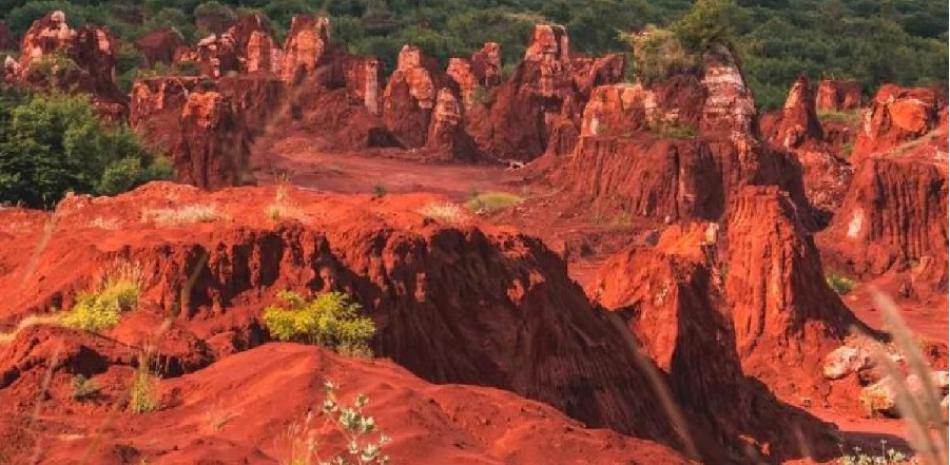
The Dominican Republic is accelerating exploration for rare earth minerals in the Pedernales province, with initial assessments suggesting a relatively low environmental impact compared to mining operations in China and California. The discovery could position the country as a new source for these critical materials, essential for a range of modern technologies.
Government officials indicate that prospecting has yielded promising results, with data collected from two to three explored deposits suggesting the presence of all minerals considered rare earths. The current assessment points to a “secondary” deposit, meaning the minerals are concentrated through erosion, making them potentially easier to process.
Work is progressing rapidly with assistance from the United States, as the Dominican Republic seeks to capitalize on the growing global demand for rare earth elements. These elements are vital components in everything from mobile phones and computers to hybrid vehicles, weapons systems, and renewable energy technologies like wind turbines.
Exploration has identified an area of approximately 14,876.045 hectares spanning from Ávila and Las Mercedes, near the northern Cabo Rojo region, to the Loma de Los Arroyos, containing little deposits of rare earth minerals. Samples collected from these sites are currently undergoing analysis in Canada.
Reserva fiscal Ávila.
The government plans to begin infrastructure development by the end of 2026, following a phase of study and the implementation of a mining plan. Located approximately 250 kilometers from Santo Domingo, the exploration area, known as the Ávila Fiscal Mining Reserve, encompasses both inhabited and uninhabited zones.
Approximately 35 people are currently working directly on the project, but experts anticipate a significant increase in personnel, potentially requiring specialized training abroad. Officials are aiming to establish a local processing facility, avoiding the export of raw materials.
The Dominican Republic has adopted the standard mining norm NI 43-101, which establishes quality standards and guidelines for mineral exploration. This standard, also used in Canada, ensures transparency and provides investors with scientific and technical information about mining projects. The NI 43-101 standard was created in response to the Bre-X scandal to protect investors from misleading project disclosures.
Currently, information is being gathered to initiate a study phase this month, followed by the implementation of the mining plan. This initial phase will involve baseline studies to assess the existing conditions.
Rare earth elements consist of 17 lanthanide elements, along with yttrium and scandium. Primary deposits are found in igneous, metamorphic, or hydrothermal rocks, while secondary deposits, like those found in Pedernales, form through erosion and are concentrated in clays, sands, or gravels.
The potential for rare earth minerals in Pedernales was first identified in a 2016 investigation by economist Luis Vargas, along with experts Scarlet García Caro and Roberto Mallén Brea, and published in Barómetro de Energía y Minas. Their study, conducted for the Directorate of Data and Research of the Ministry of Energy and Mines, highlighted the mineral potential of the Dominican-Haitian border region.
Specialist Roberto Mallén Brea explained that the border region has the best solar regime in the country, with the highest levels of global horizontal radiation and direct horizontal radiation nationwide. Despite these advantages, the area also contains proven deposits of gold, bauxite, limestone, gypsum, coal, copper, salt, travertine, alluvial fan aggregates, industrial clays, silica, feldspars, mica, barite, and materials for cement production.
Significant bauxite deposits have been identified in Aceitillar and Las Mercedes, Pedernales, and were exploited from 1959 to 1982 by the American company Alcoa Exploration Company, the third-largest aluminum producer in the world. Some of the proven bauxite reserves are located within Jaragua National Park, precluding their exploitation.
The Dominican Republic’s decree 430-18, establishing the “Ávila Fiscal Mining Reserve,” confirms the presence of rare earth minerals in Pedernales, as identified through sampling conducted by a World Bank mission in 2015. Further geochemical studies conducted in 2021 under the Sysmin II cooperation program, sponsored by the European Union, detected geochemical anomalies of rare earth elements – praseodymium, neodymium, and europium – in the province.
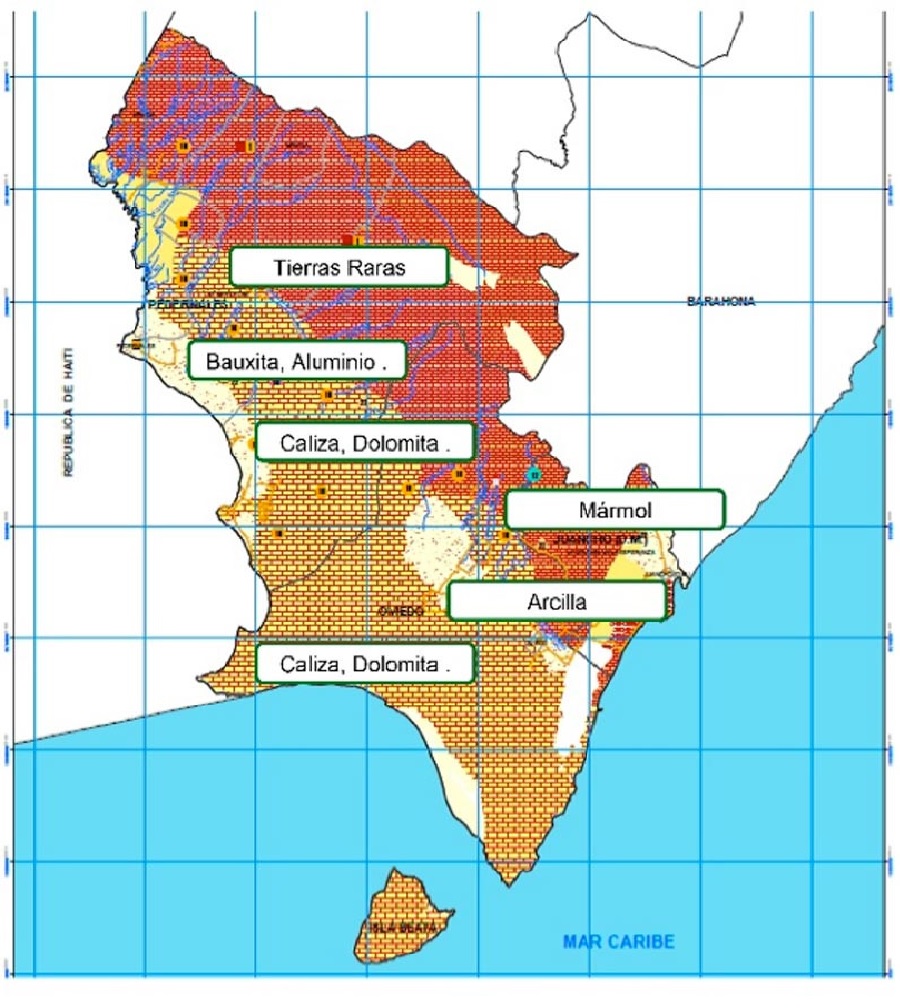
Grágica tierras raras. 2016.
The decree mandates exploration in the areas of Las Mercedes, La Altagracia, and Aguas Negras, including the parajes of Ávila, Bella Vista, Boca tajón, Cabeza de Agua, Cabo Duarte, Canta la Rana, Colonia de los Arroyos, Colonia de Mencía, Don Juna, El bambú, and El Mogote. The investigation area covers 14,876.045 hectares, starting at the Don Juan paraje, 300 meters from the Bonito River.
The elements that make up rare earths are scandium, yttrium, and 15 others from the lanthanide group, such as lanthanum, cerium, praseodymium, neodymium, promethium, samarium, europium, gadolinium, terbium, dysprosium, holmium, erbium, thulium, ytterbium, and lutetium. These materials are used in mobile phones, computers, hybrid cars, weapons, medical equipment, and renewable energy technologies like wind turbines.
Currently, China is the world’s largest producer of rare earths, followed by Australia, India, Brazil, Canada, Myanmar, Burundi, the United States, Vietnam, Thailand, and Greenland. Experts indicate their use “from mobile phones and computers to hybrid cars, weapons and medical equipment” and in renewable energies such as wind turbines.
They explain that the key is partly in their large magnetic capacities, due to the increasingly reduced size of electronic devices, and that elements such as ytterbium and terbium, with high electrical conductivity, allow for greater storage. Rare earth elements are important components in high-tech devices: cell phones, electric vehicles, lasers, radars, guided missiles, flat screens, magnets, ceramic catalysts, microphones, headphones, optical fibers, among others. They have been used in agriculture to accelerate plant growth and resistance to stress without damage.
The largest deposit in the world is in Bayan Obo, northern China, and has been responsible for approximately half of the world’s production of this mineral since 2005.
Engineer Ramón Alburquerque previously revealed that the United States is collaborating with the country in the process of exploring rare earths in the border province of Pedernales. President Luis Abinader previously announced the creation of the Dominican Mining Company, S.A. (EMIDOM) through decree 453-24 to boost the sustainable extraction of strategic resources of the country, with a special focus on rare earths.
