
Israeli Prime Minister Benjamin Netanyahu is scheduled to meet with President Donald Trump at the White House on Wednesday, as the two leaders prepare to discuss ongoing negotiations between the U.S. And Iran. The meeting comes at a critical juncture, with Israel seeking to influence the talks and maintain the possibility of military intervention. The discussions are particularly significant given heightened tensions in the region and the potential for a shift in U.S. Policy toward Iran.
Netanyahu’s visit, his seventh since Trump’s second term began in January 2025, follows a period of “cautious optimism” stemming from indirect talks held in Oman last Friday. Both Tehran and Washington have expressed a degree of hope for progress in the negotiations.
Prior to his meeting with Trump, Netanyahu stated he would present the U.S. President with “Israel’s principles” regarding the negotiations. These principles include the complete dismantling of Iran’s nuclear program, its ballistic missile program, and its support for regional proxy groups.
Tehran considers these demands to be “red lines,” with the Iranian Foreign Ministry warning of the “destructive effects” of Israeli influence on the negotiation process.
During a visit to Oman, a key mediating state, Ali Larijani, Secretary of Iran’s Supreme National Security Council, expressed optimism about reaching a “strategic de-escalation” with the United States. Yet, he cautioned against Israel’s role in “fueling tensions” in the region.
Iranian Foreign Minister Abbas Araghchi participated in indirect talks with the U.S. Delegation, led by Trump’s envoys Steve Witkoff and Jared Kushner, in Muscat, aiming to create a new opportunity for diplomacy. This occurred amid increasing deployments of U.S. Naval forces near Iran and threats from Tehran of a strong response to any attack.
Both Tehran and Washington described the first round of talks in Muscat as “positive,” with Trump anticipating a follow-up round next week.
Israel’s Demands in U.S.-Iran Negotiations
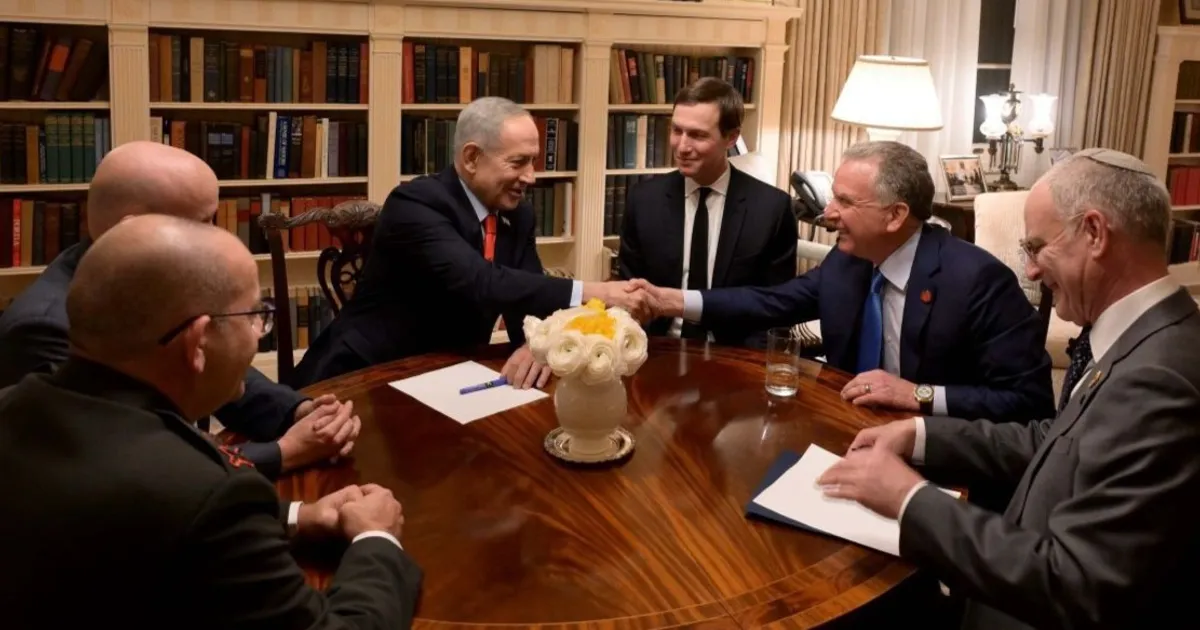
Before his White House meeting with Trump, Netanyahu met with Witkoff and Kushner in Washington on Tuesday evening. According to Netanyahu’s office, Witkoff and Kushner “provided an update on the first round of talks they held with Iran last Friday.”
The Military Option
Trump has stated that “Iran wants to reach an agreement,” while simultaneously wielding the threat of military action to pressure Iranian officials.
“We’ll see what happens,” Trump said in an interview with Fox Business. “I think they desire to make a deal. It would be foolish if they didn’t. We took away their nuclear capabilities last time, and we’ll see if we take away more this time.” He added, “It has to be a good deal, no nuclear weapons, no missiles.”
In another interview with Axios, Trump revealed he is considering sending a second aircraft carrier to the Middle East to prepare for potential military action if negotiations with Iran fail.
“Either we’re going to make a deal, or we’re going to have to do something very, very tough, like we did last time,” he said, noting that “we have a fleet heading over there, and maybe another fleet too,” and that he is “thinking about” sending an additional carrier.
According to two Israeli sources cited by CNN, Netanyahu intends to discuss potential military options against Iran with Trump, as Israel prepares for alternative scenarios should U.S.-Iran negotiations collapse.
The sources added that Israel remains skeptical about the success of negotiations between the United States and Iran, but is pushing to maintain “freedom of action” in the event of a potential agreement.
One source said Netanyahu plans to provide Trump with new intelligence regarding Iran’s military capabilities.
“Israel is concerned about Iran’s progress in rebuilding its stockpile and capabilities of ballistic missiles to what they were before the Twelve-Day War,” the source said, adding that Israeli assessments indicate that without intervention, Iran could possess between 1,800 and 2,000 ballistic missiles within weeks or months.
The Trump-Netanyahu meeting follows a series of high-level contacts in recent weeks. Israeli Chief of Staff Eyal Zamir and head of intelligence Shlomi Binder visited the Pentagon last month, while Witkoff and Kushner met with Netanyahu and senior Israeli security officials last week.
In June, a surprise Israeli attack on Iranian military and nuclear facilities disrupted a series of U.S.-Iran talks that were underway.
Potential Expansion of Negotiations
While Netanyahu seeks to pressure Washington to escalate negotiations and impose stricter conditions on Tehran, Larijani warned in an interview with Oman Television of Israel’s “prominent role in fueling tensions and creating crises in the region.” He noted that recent statements regarding Netanyahu’s visit to the United States and attempts to “impose time constraints on Tehran” could create additional complications.
Larijani expressed optimism that the next phase could hold “opportunities for strategic de-escalation, or at least a repositioning of policy, depending on the outcome of the dialogue.”
He indicated that “if the negotiations on the nuclear issue are successful, they can be expanded later to include other areas,” but stressed that “it is still too early to determine the possibility of moving on to discuss other disputes.”
Larijani emphasized that “Iran has always believed that war is not a solution to disputes between the two countries, and that regional conflicts between Iran and the United States should be resolved through dialogue and negotiations.” He noted that “relying on the language of force was a mistake by some parties and contributed to complicating the negotiation paths and creating many problems in the dialogue.”
Iran is still recovering from a 12-day war with Israel in June. The airstrikes, which included U.S. Bombing of Iranian nuclear facilities, killed approximately 1,000 people in Iran, while Iranian missiles killed about 40 in Israel.
Trump stated at the time that the United States had “completely destroyed” Iran’s nuclear capabilities, though the extent of the damage remains unclear. Recent satellite imagery has shown activity at some sites, raising Western concerns that Iran may be attempting to assess damage or salvage what remains.
Before the June war, Iran was enriching uranium to a level of up to 60%, a level technologically close to that needed for weapons-grade material. Tehran denies seeking to acquire such weapons, insisting its program is for peaceful purposes.
The International Atomic Energy Agency has noted that Iran is the only non-nuclear-weapon state to have reached this level of enrichment.
Iran has also refused, since the war, requests from the IAEA to inspect sites that were bombed, and had restricted inspection operations since Trump withdrew from the 2015 nuclear agreement in 2018.
