
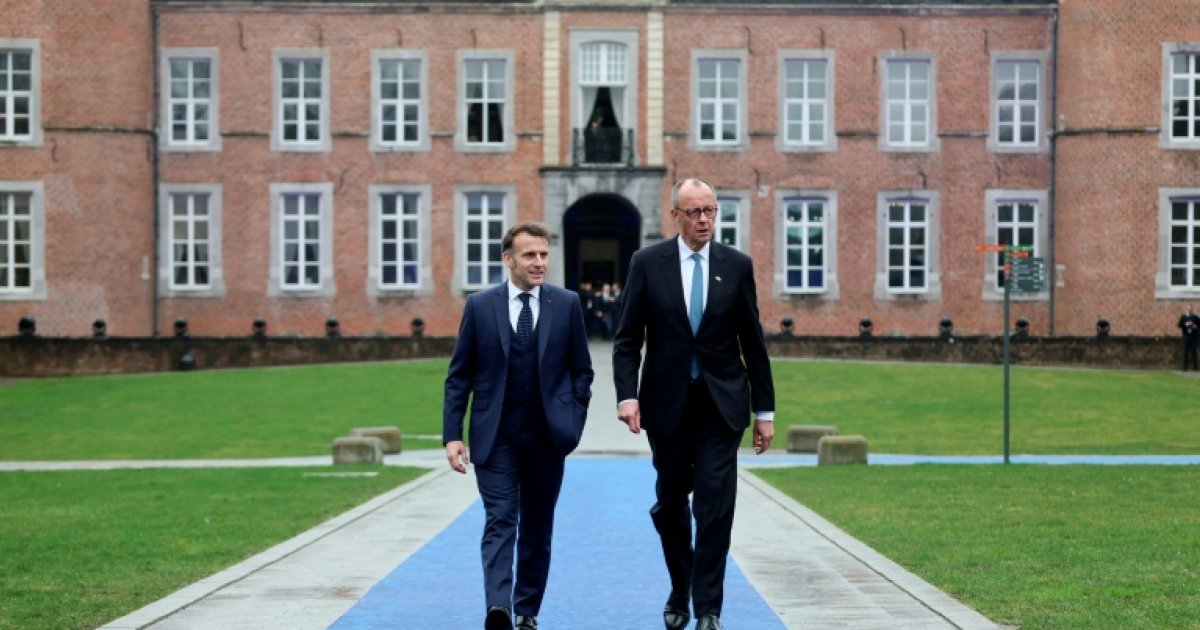
European Union leaders committed on Thursday to accelerate economic reforms aimed at bolstering the bloc’s competitiveness in the face of growing pressure from China and the United States.
“We all share the same sense of urgency. We demand to move quickly and accelerate, because we are being challenged by international competition,” French President Emmanuel Macron said following discussions with his European counterparts. The statement underscores the increasing concern among EU leaders about maintaining economic leadership on the global stage.
However, disagreements persist regarding the best course of action, as German Chancellor Friedrich Merz ruled out the possibility of joint borrowing – or “eurobonds” – proposed by Macron, stating that such a solution should be reserved for “exceptional situations.”
“One Europe, one market!” declared European Commission President Ursula von der Leyen, pledging to improve the integration of the single market, a vast economic area of 450 million consumers that continues to be hampered by significant internal barriers.
European Council President Antonio Costa promised “concrete measures” in March, during the next European summit.
The EU leaders convened at Alden Biesen Castle in northeastern Belgium to explore ways to expedite a series of economic reforms, including the removal of unnecessary regulations, the completion of the single market, and measures to protect strategic sectors.
Despite recent public disagreements over priorities – with France advocating for protecting industry through a “made in Europe” approach and Germany pushing for widespread deregulation – leaders from both countries sought to project unity upon arrival at the summit.
“We want a faster Europe and we want to improve it,” the German Chancellor stated.
While possessing numerous strengths, the European economy is experiencing modest growth (1.5% in 2025) and a lack of leading companies in emerging fields like artificial intelligence, fueling fears of falling behind Beijing and Washington.
Trade relations have develop into increasingly fraught, with the EU frequently finding itself on the defensive.
The bloc already faced pressure from China, which controls rare earth minerals essential to global industry, floods the continent with small parcels, and consistently expands its trade surpluses.
More recently, the United States, following the return of Donald Trump to power, has threatened to annex Greenland, imposed tariffs, and sharply criticized Brussels’ digital and environmental regulations.
Former European Central Bank President Mario Draghi, who engaged in discussions with EU leaders at Alden Biesen on Thursday, inspired an ambitious set of reforms within the EU in 2024.
– Strengthened Cooperation –
The effort centers on consolidating the single market, directing savings towards businesses, and reducing the accumulation of European and national regulations.
However, this overhaul, launched 18 months ago by the European Commission, has stalled in part due to the EU’s legislative procedures.
The summit also featured “intense discussions” regarding energy prices, according to Ursula von der Leyen.
Several countries, including Italy, are calling for a revision of the European carbon market, alleging it penalizes industries, and are demanding the abandonment of the gradual elimination of free CO2 emission allowances.
But “it would be a strategic mistake to say that competitiveness requires abandoning the climate,” Macron cautioned.
Regarding “European preference,” another point of contention, the French President clarified that the list of concerned sectors would be defined in March, as Brussels is set to unveil a draft law on the subject later this month.
This involves establishing requirements for companies receiving public aid – such as the automotive industry – to produce within Europe.
However, in an apparent concession to Germany, which sought to preserve partnerships with countries outside of Europe, Brussels now proposes that products from nations with regulations similar to Europe be considered equivalent to those “made in the EU,” according to a draft of the proposal reviewed by AFP.
The idea of a new legal framework for companies, dubbed EU Inc., which would reduce administrative burdens, garnered broad consensus, as did a loosening of merger rules to facilitate the emergence of European champions in sectors like telecommunications.
Finally, several leaders indicated openness to “enhanced cooperation” to implement certain measures, effectively applying them only to willing countries if a consensus among all 27 proves too difficult to reach.
