
Indonesia’s rich biodiversity continues to yield botanical surprises, with the recent confirmation of the “Ghost Orchid’s” wider range sparking interest among researchers. Gastrodia bambu, as it’s scientifically known, is a unique orchid species that thrives in the darkness of the rainforest floor, relying on a symbiotic relationship with fungi for sustenance rather than photosynthesis.
Initially believed to be endemic to the island of Java, the orchid’s distribution has expanded to include Vietnam, and now, surprisingly, India. Researchers in the Kalimpong region of West Bengal, India, discovered the orchid growing in similar bamboo forest habitats at an elevation of approximately 1,120 meters above sea level, according to a study published in the Journal of Japanese Botany in December 2023.

Gastrodia bambu disebut anggrek hantu karena bunga ini berasal dari kelompok holomikotropik. Foto: LIPI
The orchid, often called the “Anggrek Hantu” (Ghost Orchid) in Indonesia, gets its name from its preference for dark, humid environments and its unexpected appearances. Unlike most orchids, it lacks leaves and doesn’t perform photosynthesis. Instead, it obtains nutrients through a symbiotic relationship with mycorrhizal fungi. This unusual adaptation places it within the holomycotrophic plant group.
Visually, Gastrodia bambu features small, dark brown, glossy flowers resembling tiny bells, measuring around 1.7–2 cm in length. The blooms never fully open and emit a pungent, fish-like odor to attract pollinators. The plant’s ephemeral nature is another defining characteristic, with its physical presence lasting only two to four weeks each year before decaying and disappearing.
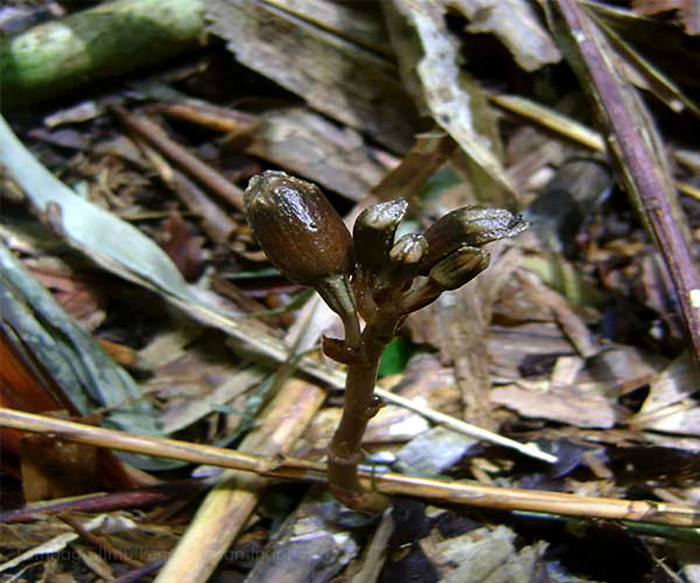
Bunga anggrek hantu ini sempat ditetapkan sebagai bunga endemik Jawa, sebab hanya ditemukan di Yogyakarta dan Jawa Barat. Foto: LIPI
The discovery of Gastrodia bambu in India highlights the orchid’s remarkable ecological range, spanning from Indonesia to Southeast Asia (Vietnam) and the foothills of the Himalayas. Despite this expanded range, the orchid remains vulnerable. Its survival is intrinsically linked to the health of old-growth bamboo ecosystems and the presence of specific soil and moisture conditions.
On Mount Merapi, conservation efforts face challenges, as many known locations fall outside of national park boundaries. Deforestation of bamboo groves and the threat of volcanic ash flows pose significant risks. Recent research emphasizes that disruption to bamboo habitats directly impacts the orchid’s lifecycle by eliminating the mycorrhizal fungi it depends on for nutrition.
Indonesia is estimated to be home to around 5,000 orchid species, with approximately 986 found on the island of Java. According to Ministerial Regulation of the Ministry of Environment and Forestry No. P.106 of 2018, dozens of orchid species are currently protected.
This discovery underscores the importance of continued botanical research and habitat preservation, particularly as climate change and human activity increasingly threaten fragile ecosystems. The unique adaptations of species like Gastrodia bambu offer valuable insights into the complex relationships within the natural world.
