
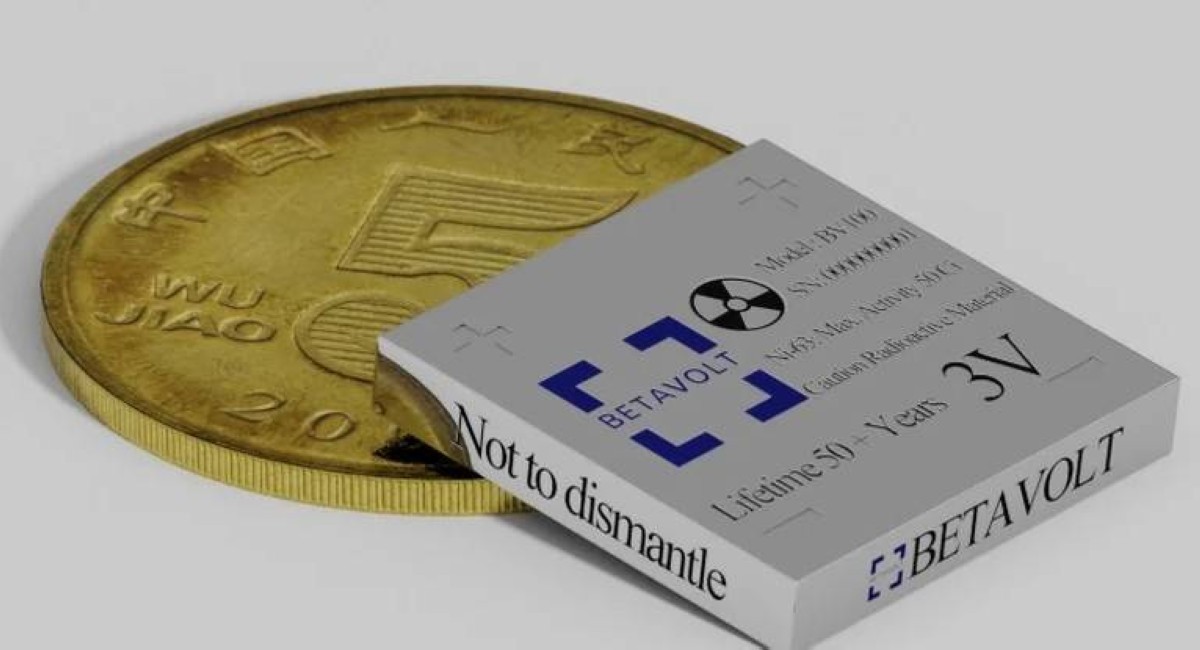
The future of battery technology may be smaller – and longer-lasting – than previously imagined. Chinese company BetaVolt announced in January 2024 the development of a nuclear battery, the BV100, which it claims can operate for 50 years without needing to be recharged.
Despite its potential, the BV100 isn’t poised to power smartphones anytime soon. The battery, which is about the size of a coin, utilizes nickel-63 to generate 100 microwatts at 3 volts. BetaVolt has plans to release a 1-watt version in 2025, with mass production reportedly beginning the same year. This development arrives as the industry searches for alternatives to lithium-ion batteries, which currently dominate the market but face limitations in lifespan and range, particularly in electric vehicles.
Nuclear batteries operate on the principle of harnessing radioactive decay and converting it into electricity. Radiothermal generators, for example, convert the heat from radioactive decay into an electrical voltage using the Seebeck effect. The BV100 utilizes beta radiation, absorbing beta particles emitted from nickel-63 with diamond semiconductors, and converting the resulting electrons into electricity. This allows for a small-sized battery that can reportedly last decades with minimal risk to living organisms.
However, the battery’s output is limited. According to materials scientist Juan Claudio Nino, the BV100 generates only 100 microwatts, a fraction of what a modern smartphone requires. “A phone can consume more than 4000 milliwatts during a video call,” he noted. To practically power a phone with a nuclear battery, a continuous current of 1.5 amps would be needed, requiring approximately 680 pounds of nickel-63 – an impractical amount for a mobile device.
The concept of nuclear batteries isn’t new. RCA developed an atomic battery as early as 1954, and nuclear batteries were used to power military satellites in the 1960s. More recently, in 2024, researchers at the University of Bristol unveiled a carbon-14 diamond battery with a potential lifespan of thousands of years, though it too faces practical limitations for portable devices.
The future applications of nuclear battery technology appear promising, particularly for drones and long-term sensors, where decades of operation without recharging are crucial. BetaVolt’s BV100 represents a significant step toward developing long-lasting and sustainable power technology, but it doesn’t yet replace traditional lithium batteries for everyday devices. The company’s innovation highlights the ongoing search for energy solutions that address the limitations of current battery technology and support the growing demand for portable power.
