

A joint military operation between the U.S. And Israel against Iran this Saturday, February 28th, has triggered a classic market response: rising oil prices, falling stock values and a flight to safe-haven assets.
The offensive—dubbed “Operation Epic Fury” by the Pentagon—targeted high-ranking Iranian officials. Sources cited by Reuters indicate that Supreme Leader Ayatollah Ali Khamenei and President Masoud Pezeshkian were among those targeted. Iran retaliated with missile launches toward Israel, escalating regional risk and raising concerns among crude oil-producing nations in the Gulf. The attack underscores Iran’s strategic importance in the global energy market.
Investors are now focused on whether this represents a temporary shock or a structural shift with broader economic implications. Historical precedent offers some insight.
Historical Patterns: Markets React to Uncertainty, Stabilize with Clarity
A review of major military conflicts over the last century reveals a recurring pattern on Wall Street: stock markets typically decline before or during the formal outbreak of conflict, but tend to stabilize once the situation becomes more defined.
Pearl Harbor (1941): Initial Shock, Eventual Recovery
1941
Following the attack on December 7, 1941, U.S. Markets initially fell. However, a bottom was reached relatively close to the formal entry of the United States into World War II, after which the market began a recovery trend.
The lesson was clear: once the worst-case scenario transitions from a hypothesis to a reality, the uncertainty premium begins to diminish.
Desert Storm (1991): Sell the Rumor, Buy the War
1991
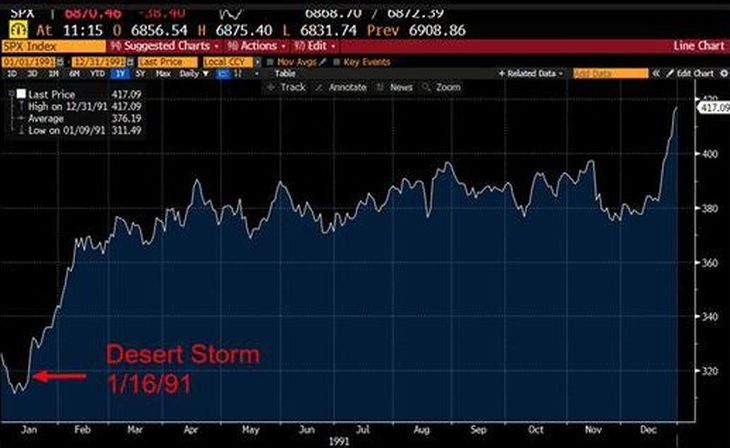
Leading up to the offensive against Iraq, the S&P 500 declined amid fears about oil supply following the invasion of Kuwait. However, when the operation formally began on January 16, 1991, the market had already priced in much of the risk. The index found a bottom near the start of the conflict and subsequently recovered.
The logic was the same: markets punish uncertainty before an event, not necessarily the event itself.
This dynamic highlights how markets often anticipate and price in geopolitical risks.
9/11 and the War in Afghanistan (2001): The Impact Was the Attack
afganistan 2001
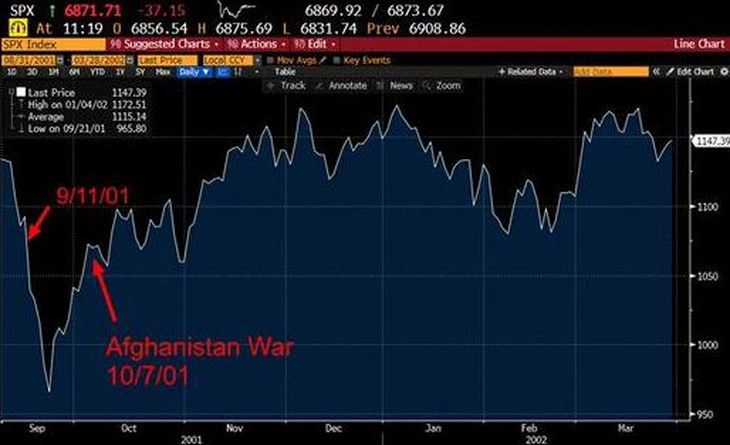
The attacks of September 11th caused a sharp decline when markets reopened. However, the start of the war in Afghanistan did not generate a new sustained downturn. The shock was concentrated in the initial event.
Again, the pattern was similar: extreme volatility was immediate, but not necessarily prolonged.
Iraq War (2003): The Start Coincided with the Bottom
irak 2003
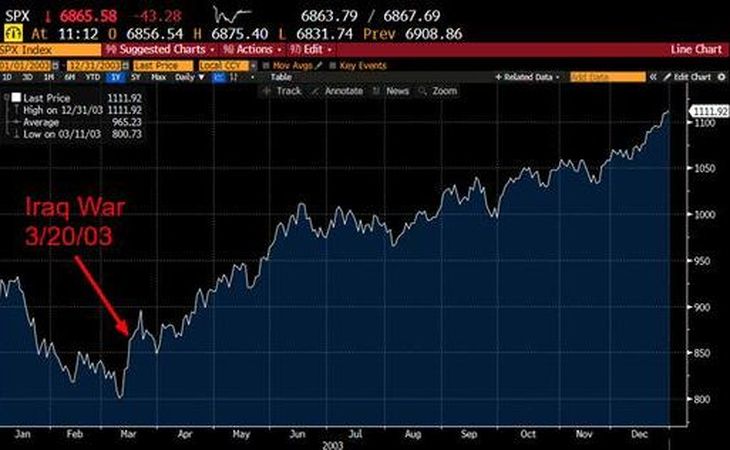
In March 2003, when the invasion of Iraq began, the S&P 500 had already weakened after months of geopolitical tension. The formal start of the conflict coincided with the bottom of that bear cycle and gave way to a rally that extended throughout the rest of the year. The market had already incorporated the war scenario.
The Key Difference: Oil as a Decisive Factor
What distinguishes the current situation with Iran is its strategic role in the global energy market. Iran is a key player in OPEC and any threat to the Strait of Hormuz—through which approximately 20% of the world’s crude oil passes—can significantly alter prices.
In past conflicts:
-
Oil prices doubled in 1990.
-
The Iranian Revolution in 1979 generated global inflationary shock.
-
In more recent episodes, increases were strong but shorter in duration.
The market is now monitoring whether the escalation affects energy infrastructure or export routes. If there is no physical disruption to supply, the impact could be temporary. If there is, the scenario changes radically, with OPEC+—the primary crude oil exporting bloc—analyzing a significant expansion of supply to avoid an uncontrolled reaction in international markets.
Iran’s energy infrastructure—the third-largest producer in OPEC and holder of the world’s largest proven natural gas reserves—makes the conflict a systemic risk factor for the global energy market.
The U.S. And Israel’s attack on Iran has reshaped the global energy landscape and raised alarms in the markets. The OPEC+ oil alliance is evaluating accelerating crude supply significantly in an emergency meeting this Sunday, aiming to prevent a price spike amid growing risk of regional war.
What Could Happen Now
In the short term, the playbook suggests:
-
Rising oil prices
-
Falling global stocks
-
Rising gold prices
-
Increased demand for Treasury bonds
-
Increase in the volatility index (VIX)
But subsequent performance will depend on the scale and duration of the conflict.
Scenario 1: Limited Conflict
Contained financial impact and relatively quick recovery after the initial reaction.
Scenario 2: Regional Escalation
Greater global inflationary pressure, increased tension in emerging markets, and a deeper correction in stocks.
Scenario 3: Oil Disruption
The most severe scenario: crude oil above $100, renewed global inflation, pressure on central banks, and deteriorating growth.
The Lesson from History
Major military conflicts over the last century demonstrate a consistent pattern: markets react strongly to the initial shock, but tend to adapt once the situation becomes clearer.
The central risk is not solely the start of the war, but its unpredictability and its impact on energy, inflation, and monetary policy.
With Iran at the center of the board, the focus will be not only on the military dimension, but on oil. Because, as Pearl Harbor, Desert Storm, 9/11, and the Iraq War teach us, war is fought on the ground, but its ripple effect is measured in the markets.
