
The Berg Orchestra is set to launch its new season Monday evening with a truly unique performance: a soprano singing a song by Elizabethan lutenist John Dowland, immediately followed by a mock commercial delivered whereas spray-painting in time with the music.
The unconventional musical collage, titled WhatsPop and created by contemporary French composer Aurélien Dumont, will be performed at the DOX+ hall in Prague. Soprano Pavla Radostová will be accompanied by a small ensemble featuring electric guitar, trumpet and bass clarinet.
Dumont developed the composition based on a book of essays about pop culture, drawing inspiration from both classical music and genres like pop and experimental rock. “There are references to Philip K. Dick’s novel, a sonnet by William Shakespeare, and the television series Dollhouse,” explained Eva Kesslová, the orchestra’s director.
The performance will also include a live conversation with music journalist Pavel Klusák about pop culture, adding another layer to the already ambitious production.
The most challenging aspect of the show falls to Radostová, whose part includes difficult microtonal passages, complex rhythms, and acting sequences requiring her to simultaneously sing and operate appliances like a toaster, hairdryer, or beer bottle. She received specific instructions from the composer. “It’s incredibly sophisticated, but also very fun, accessible, and musically quite simple compared to what we usually play,” Kesslová added.
The Berg Orchestra, which completed its 25th season last year, typically presents eight new projects annually. Like the Ostrava Days of New Music and the Brno Contemporary Orchestra, it focuses on works not commonly featured in traditional orchestral programs.
Foto: Aňa Jakš
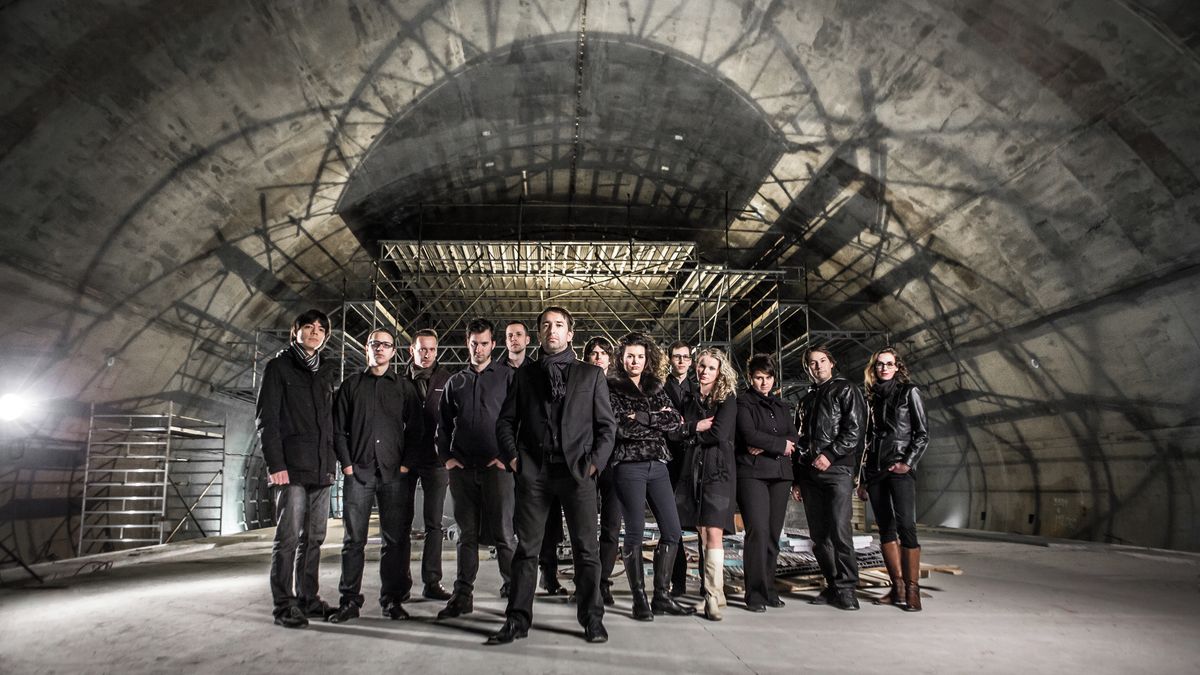
Berg performs in unconventional locations. In 2014, the orchestra presented works by Heiner Goebbels and Steve Reich in an unfinished subway station.
“Berg regularly introduces a lot of new works by domestic and foreign composers. It operates in classic subscription cycles, so the supply of music is regular, they are not festival or otherwise one-off events,” noted music critic Boris Klepal.
The orchestra often tackles challenging compositions. “It has a base of loyal fans who reach to it like their favorite band. And it has achieved this with a repertoire that you can’t just sip and relax to, moreover without a stable base,” Klepal added.

Foto: Pavel Hejný
The Berg Orchestra collaborated with the 420people dance company on a staged concert featuring the music of Jan Trojan at the New Stage of the National Theatre.
The orchestra doesn’t have a fixed repertoire and isn’t bound by convention, a key part of its identity. However, it also operates in a state of constant improvisation. This is particularly noticeable when compared to Europe’s most renowned ensembles for contemporary music, such as Klangforum Wien, Ensemble Modern, and Ensemble intercontemporain.
All of those groups can afford to invite world-class conductors and commission works from established composers. “Above all, they all have incomparably more money and their own buildings, which include rehearsal rooms, offices, and instrument storage. We’re still rehearsing at the basic art school where I used to study violin. We are incredibly grateful, but we have to bring the instruments, including percussion, to every rehearsal,” explained Kesslová. The performance of WhatsPop requires five or six rehearsals, with additional private preparation for Radostová and conductor Peter Vrábel.

Foto: Karel Šuster
Eva Kesslová (pictured with a small gong) played violin at the Berg Orchestra’s first concert and has led the ensemble for over two decades.
Fifty-seven-year-old Peter Vrábel, originally from Slovakia, founded the orchestra in 1995. It began as an experiment among students at the Prague Conservatory, filling a gap in the school’s musical offerings. Regular seasons began in 2001.
“Since then, we’ve been standing on our own two feet and creating our own programming,” says Kesslová, a conservatory graduate who played violin at the orchestra’s first concert. She eventually realized she couldn’t fully dedicate herself to both performing and managing the orchestra. “In 2002, I went on a study abroad program, didn’t take my violin, and then there was never time to play and run the orchestra at the same time.”
Kesslová then focused on arts management, completing internships at the Kennedy Center in Washington, D.C., and receiving a Fulbright scholarship in New York. She also secured funding for the Berg Orchestra.
The orchestra operates on an annual budget of just over four million Czech crowns, half of which comes from ticket sales and private donations. The remainder is provided by the Ministry of Culture and the Prague City Hall. “No, without public funding, we definitely wouldn’t be able to put together a season,” Kesslová said, as the new Minister of Culture, Oto Klempíř, announced budget cuts and urged artists to tighten their belts. The Chamber of Deputies will soon vote on the 2026 budget, which includes a projected deficit of 310 billion crowns.
“When I hear that the state wants to cut funding for non-profits and save on culture, I feel desperate. The average salary in the Czech independent cultural scene is a chimera; most of us don’t even come close to earning it, and we’re doing the work of several people. We would require someone dedicated to production, another to marketing, a third to fundraising, and a fourth to handle accounting and grant paperwork. But because we don’t have the money, evenings, weekends, and all our free time are devoted to these tasks,” Kesslová stated, noting that she and Vrábel are the only members of the orchestra working full-time.
The orchestra maintains a core group of collaborators, contacting musicians on a project-by-project basis. “For Monday’s performance, there will be eight players; sometimes there may be twenty-five. We’ve stabilized this circle a lot over the last decade. Our goal was to have two people for each position, because if we can’t employ interpreters full-time, they earn a living elsewhere and sometimes have to prioritize playing in a theater due to scheduling conflicts,” Kesslová explained.
Regular performers include violinists Anna Romanovská and David Danel, violist Kateřina Lískovcová, cellist Balázs Adorján, and composers who play instruments, such as trombonist Štěpán Janoušek, accordionist Jiří Lukeš, and guitarist Ian Mikyska. Many of them have also composed for the Berg Orchestra.
The ensemble is also attracting younger musicians, with pianists Veronika Jaklová and Pavol Praženica, both born in the new millennium, still students.

Foto: Karel Šuster
The Berg Orchestra also performs for children. Before Monday evening’s performance at DOX, two groups of children will attend a workshop and dress rehearsal.
The orchestra often pairs with singers from the world of early music, such as Pavla Radostová, who is known to audiences of the baroque Collegia 1704. “Old and contemporary music complement each other beautifully. We prefer pure, straight voices; we need singers who don’t vibrate, because in contemporary music the voice imitates an instrument and the compositions require speed and precision,” Kesslová explained.
Unlike some similar festivals, the Berg Orchestra weathered the COVID-19 pandemic. “But it wasn’t simple. Before COVID, we had 120 subscribers, which dropped to half during the pandemic and slowly recovered, and we’re now back to a similar level,” Kesslová said. Concerts typically draw an audience of around 200 people, about half of whom purchase single tickets.
Since the pandemic, the ensemble has experimented less with venue selection. This year, in addition to DOX and the Agnes of Bohemia Monastery, it will return to the New Building of the Faculty of Humanities at Charles University in Prague’s Libeň district. “There used to be a lot of industrial spaces in Prague, but they are disappearing quickly. You can only hold concerts in most of them in June and September, otherwise it’s too cold. And we’ve been using those months for staged projects in theaters, which are more available at that time,” Kesslová explained.
Even this latest venture has proven successful. In collaboration with the Alfred ve dvoře theater and the Boca Loca Lab, the orchestra created a production of Předřeč šelmy (The Beast’s Foreword) last fall, which has recently been nominated for the Theatre Critics’ Award. It will return to the Letná stage in May.
