
-
- Autor, Nick Ericcson
- Título del autor, BBC News
-
Tiempo de lectura: 8 min
Fuente de la imagen, UPI/Bettmann Archive/Getty Images
It was in the stark landscapes of the American desert that Kitty O’Neil first showed the world what she was capable of.
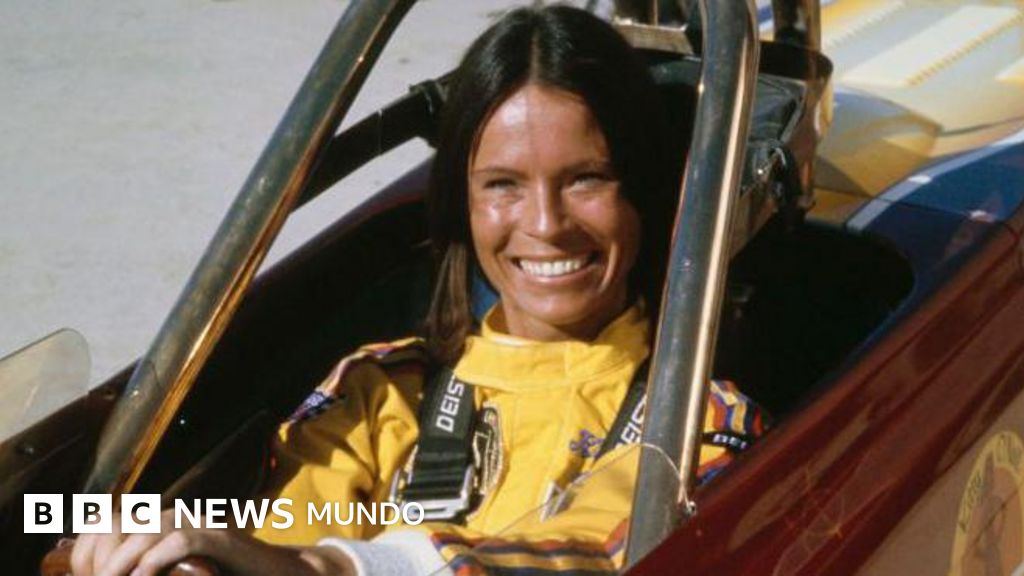
The petite figure in a yellow jumpsuit shattered the women’s land speed record, and with it, any misconceptions that her deafness was a barrier to her success.
But this was just one chapter in a life defined by O’Neil’s courage and resilience, leading her to extraordinary adventures.
She became a record-breaking stuntwoman and a Hollywood legend in the 1970s.
Even as a child, she defied expectations for those who are deaf, learning to play musical instruments.
O’Neil insisted on living life to the fullest, turning her love of speed into a successful career at a time when very few women were performing the dangerous stunts that captivated audiences.
She became one of those daring performers and was among the first women to join Stunts Unlimited, a professional group that handled some of the most challenging work in the film industry.
A film was made about her life, she appeared in television specials, and was even honored with her own action figure.

Fuente de la imagen, Getty Images
Her Mother’s Vibrations
Born in Corpus Christi, Texas in 1946, O’Neil fell seriously ill as an infant, with her temperature spiking dangerously.
Her mother placed ice around her body, potentially saving her life, but as Kitty grew and failed to speak, her parents realized the illness had left her deaf.
Patsy O’Neil refused to teach her daughter sign language, something that wasn’t widely accepted at the time.
She was determined to ensure her daughter wouldn’t be pitied and would learn to speak and communicate.
To that end, Patsy taught her a unique method of lip-reading.

Fuente de la imagen, Getty Images
“Her mother would put Kitty’s hands on her vocal cords. Then she would say words out loud, over and over, very slowly,” recounted Kai Michaelson, a fellow stunt performer and close friend of O’Neil.
“Detecting subtle changes in the frequency of the vibrations, she involved Kitty in the cello and the piano,” said Ericka Goodman-Hughey, deputy editor of ESPN’s website.
Michaelson recalled that, over time, Kitty could identify music playing on the car radio simply by recognizing the vibrations.
So much so that she could tell you she was a fan of The Beatles when their music came on.

Fuente de la imagen, CBS via Getty Images
Early Days in Stunt Work
O’Neil’s father died in a plane crash when she was just 11, but she never forgot the thrill of going fast in her lawnmower.
Later in life, she quickly excelled at competitive diving.
But, just before the trials for the 1964 Tokyo Olympics, she broke her wrist and contracted spinal meningitis.
After recovering, she felt she had lost her spark for the sport.
Soon after flipping her mother’s car at age 16, O’Neil took up skydiving, then water skiing, breaking the women’s speed record and racing motorcycles in tough and dangerous cross-country races.
The risk of dying was part of the fun.
In one serious accident, O’Neil lost control of her motorcycle and crashed.
In the process, her hand became trapped in the spokes of a wheel, which severed one of her fingers.
Friends remember that, despite this, O’Neil wanted to carry on, so she simply put a glove back on and got back on the motorcycle. She was eventually convinced to go to the hospital.

Fuente de la imagen, UPI/Bettmann Archive/Getty Images
It was another stuntman, Duffy Hambleton, who not only took her to the hospital that day but also steered her life in a different direction.
He told her about stunt work for television. O’Neil decided this was a perfect fit.
Hambleton was the first of O’Neil’s two husbands.
Armed with her two favorite books, “The Power of Positive Thinking” by Norman Vincent Peale, and the Bible, she showed up on set ready to take risks.
By the early 1970s, men in wigs were still regularly performing stunts, but that world was beginning to change.
It helped that O’Neil also refused to pay attention to anyone who said being deaf was a limitation and that she was just a “token woman.”
Instead, she said being deaf was her superpower, allowing her to remain completely focused on what she had to do.
Most Famous Stunts
Perhaps most famously, O’Neil regularly worked with actress Lynda Carter on the television series “Wonder Woman,” performing a wide variety of stunts for the show, including dangling from a helicopter in the iconic costume.
The climax of one episode involved a fall of more than 35 meters from a hotel in California.
It was a record that required such focus and courage that it became an iconic moment.
“Yes, [she was] embodying femininity… but also encapsulating what we understand as female power,” said Goodman-Hughey.
O’Neil told People magazine at the time: “I’m not trying to compete with the men. I’m just trying to do my thing.”

Fuente de la imagen, Glen Martin/The Denver Post via Getty Images
She broke another record with a fall, this time while on fire, for a television special, and once piloted a boat at a speed of 443 km/ph.
“Even when she was walking with you, she was ten steps ahead of me,” Michaelson recounted.
And, seemingly, always wanted to go a little faster, pushing the limits.
Eventually, she found the perfect outlet for all those ambitions.
In 1976, she was invited to drive an experimental car called the SMI Motivator.
It was powered by a hydrogen peroxide engine that could produce 48,000 horsepower.
O’Neil wanted to break the sound barrier, meaning going over 1,207 km/ph.
But in the agreement signed with the organizers, O’Neil would attempt to break the existing women’s speed record of 483 km/ph.
Wearing a bright yellow jumpsuit, O’Neil took the car to speeds exceeding 988 km/ph on the Alvord Desert in Oregon, decisively breaking the previous women’s speed record.

