
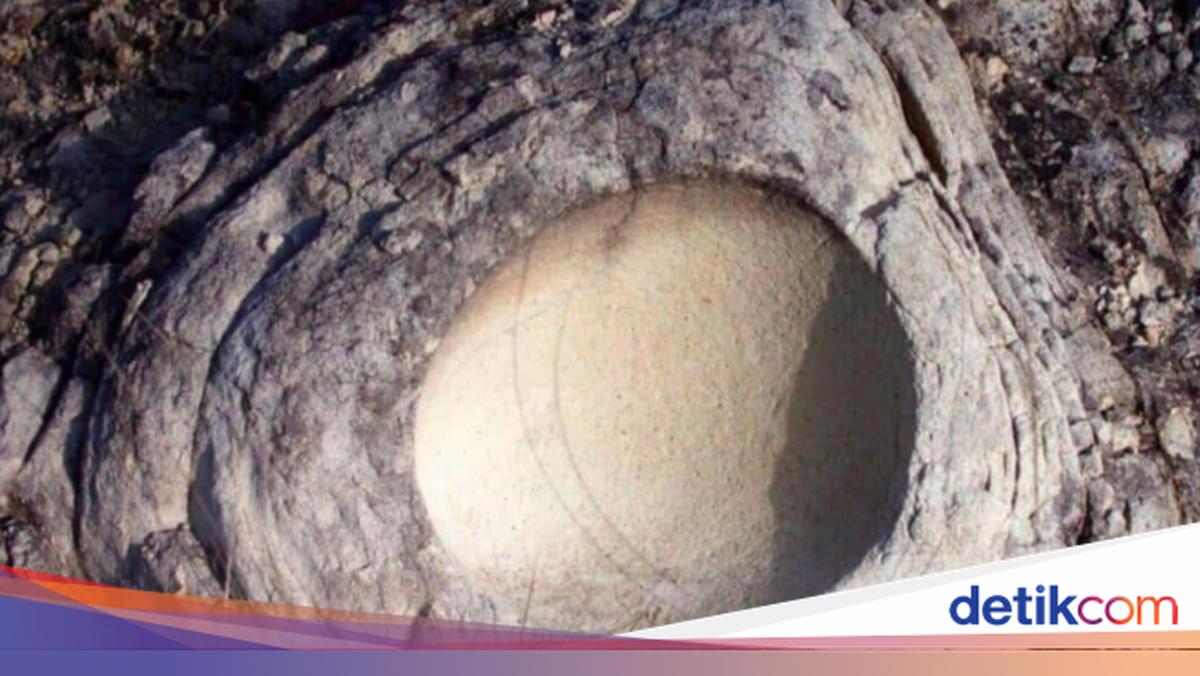
Scientists have discovered a remarkably rare, approximately 68-million-year-old dinosaur fossil containing another egg inside it – a phenomenon previously known to occur only in modern birds.
The finding originates from the Lameta Formation in Madhya Pradesh, India, a region recognized as one of the largest dinosaur nesting sites from the Late Cretaceous period. Understanding ancient reproductive processes can offer insights into the evolution of modern species and potential vulnerabilities in prehistoric populations.
The fossil is believed to be from a titanosaur, a group of massive, long-necked herbivorous dinosaurs that represent some of the largest land animals to have ever lived. The discovery began during a field survey in 2017, when researchers unearthed 11 fossilized dinosaur eggs arranged within a single soil depression.
SCROLL TO CONTINUE WITH CONTENT
Each egg measured approximately 15cm in diameter and exhibited a uniform shape. Initially, nothing appeared unusual. But, further examination of one egg using scanning technology revealed an atypical curved structure within.
The scans then uncovered two separate layers of eggshell, indicating the presence of a second egg inside. Researchers explained the structure as a case of ‘ovum-in-ovo,’ a condition where one egg forms inside another.
A Phenomenon Common in Birds
Ovum-in-ovo has previously been observed only in modern birds. The condition typically occurs when a nearly completed egg moves back into the reproductive tract and is subsequently coated with a new shell. The research team detailed the fossil’s unique characteristics in their scientific report.
“This egg shows two complete layers of shell, one inside the other,” the study authors wrote in a scientific journal, according to The Daily Galaxy.
This discovery marks the first evidence that the phenomenon could also occur in dinosaurs, offering new clues about dinosaur reproductive systems, particularly in titanosaurs.
According to Guntupalli Prasad, the lead researcher from the University of Delhi, the structure suggests dinosaurs may have had reproductive systems similar to those of birds.
“The presence of ovum-in-ovo pathology in a titanosaur nest suggests that these dinosaurs may have had reproductive anatomy similar to birds,” Prasad explained.
Previously, scientists believed many ancient reptiles had simpler reproductive systems. However, this finding suggests that some dinosaurs may have possessed more complex reproductive tracts.
Beyond its uniqueness, the fossil also strengthens the theory that modern birds are descendants of dinosaurs. The similarity in reproductive processes between titanosaurs and birds provides additional evidence of their evolutionary relationship.
The discovery also demonstrates that biological disturbances, such as those seen in modern animals, could also occur in dinosaurs millions of years ago.
For scientists, this single fossilized egg opens a new window into understanding how dinosaurs reproduced and how their evolution ultimately gave rise to the birds we see today.
(rns/rns)
