
Fuente de la imagen, Getty Images
-
- Autor, Atahualpa Amerise
- Título del autor, BBC News Mundo
-
-
Tiempo de lectura: 8 min
The International Energy Agency (IEA) will release 400 million barrels of oil to offset supply losses caused by the de facto closure of the Strait of Hormuz amid escalating tensions in the region.
The announcement came Wednesday after the Iranian government threatened to block “a single liter of crude” from passing through the vital waterway, which currently handles more than 20% of global oil transport.
IEA Executive Director Fatih Birol stated that the agency’s 32 member countries unanimously approved the largest release of oil reserves in the IEA’s history.
The IEA is an international body that coordinates energy policies and strategic oil reserves of 32 industrialized nations, primarily advanced economies in Europe, North America and Asia-Pacific.
The decision follows several days of disruption in the Strait of Hormuz, where projectiles struck three cargo ships in a series of attacks, with at least one claimed by Tehran. Simultaneously, Iraq reported attacks on two foreign oil tankers at one of its ports.
Hours after the IEA announcement, the U.S. Government said it would release 172 million barrels of oil from its emergency reserves as part of a coordinated international effort to lower global energy prices.
Deliveries from the U.S. Strategic Petroleum Reserve are expected to begin next week and take approximately 120 days to fully materialize.
An Unprecedented Measure
“The challenges we face in the oil market are unprecedented in scale; I am immensely pleased that IEA member countries have responded with an emergency collective action of unprecedented magnitude,” Birol said.
The agency specified that emergency reserves will be made available to the market at a pace appropriate to the national circumstances of each member country.

Fuente de la imagen, Getty Images
The 400 million barrels of oil are equivalent to four days of global consumption, or what normally flows through the Strait of Hormuz in 20 days.
This marks the sixth time the IEA has authorized a coordinated release of oil reserves, following previous actions in 1991, 2005, 2011, and twice in 2022.
Its members hold emergency reserves of more than 1.2 billion barrels, according to agency data, in addition to another 600 million stored by the oil industry to meet legal obligations imposed by governments.
Brent and WTI crude prices were around $60 before the conflict in Iran began on February 28, a relatively low price due to abundant supply.
The conflict drove the price of a barrel above $100, although it has moderated to the $80-$90 range in recent days.
Regardless, gasoline prices have risen in almost all countries, and many have proposed contingency measures in case the crisis worsens.

Fuente de la imagen, Reuters
Attacks on Ships in the Strait of Hormuz and Iraq
Iran’s regime previously announced Wednesday that it had ended its policy of reciprocal military attacks to focus on blocking the Strait of Hormuz.
Experts interpret this strategy as an attempt to use control over the strait to position upward pressure on prices and increase the economic cost of the war for the United States and its allies.
The policy of Tehran is now “attack after attack,” said spokesman Ebrahim Zolfaqari of the Khatam al Anbiya military command headquarters, in a statement.
He assured that Iran will not allow a single liter of oil to pass through the Strait of Hormuz for the benefit of the United States, Israel, and its partners.
“Any ship or oil cargo belonging to the United States, the Zionist regime, or its hostile partners will be considered a legitimate target.”
“Prepare yourselves for the price of oil to reach $200, because the price of oil depends on the regional security that they have destabilized,” he stated.
Three ships were targeted by projectiles in the Strait of Hormuz on Wednesday.
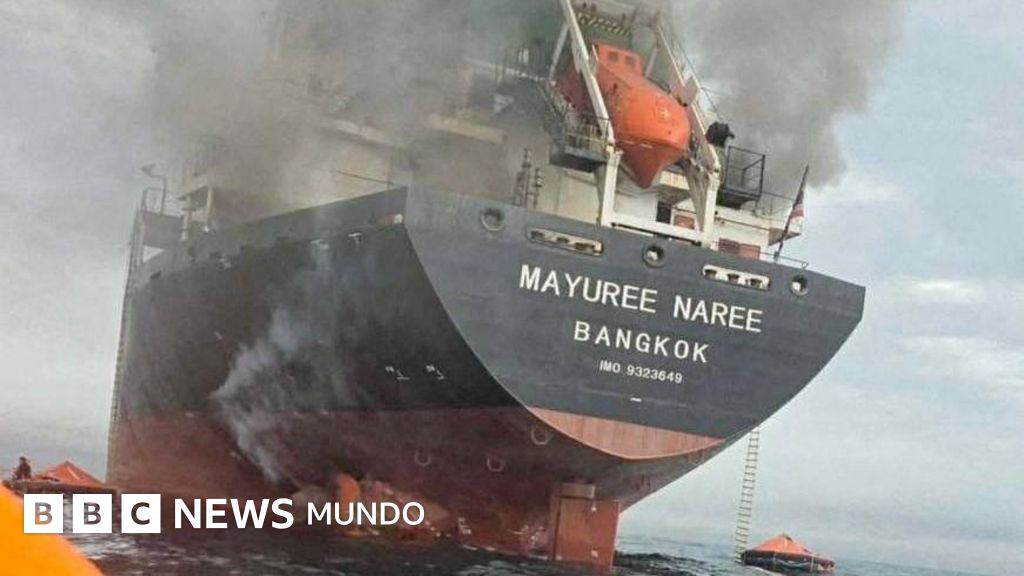
Two of the vessels sustained damage, while a third – a Thai-flagged cargo ship identified by the Thai navy as the Mayuree Naree – caught fire after being hit off the coast of Oman.
Thai naval authorities said the ship was hit by a projectile that caused a fire on board.
The Omani navy responded to assist in the rescue and evacuation of 20 crew members, all Thai nationals, three of whom were injured.
Iran’s regime claimed responsibility for the attack.
Later, an Iraqi military spokesman reported that one crew member died and 38 others were rescued after an attack on two foreign oil tankers at the port of Al Faw.
“Two tankers were the target of a cowardly act of sabotage,” said Lieutenant General Saad Maan, according to the Iraqi News Agency (INA).
He added that “the attack took place in Iraqi territorial waters” and that this “constitutes a violation of Iraqi sovereignty.”
An Iraqi security source in Basra told CNN that an Iranian ship loaded with explosives is believed to have hit the two vessels. However, the source added that the investigation is ongoing.
The United Kingdom Maritime Trade Operations (UKMTO) similarly indicated having received similar reports, while the Iraqi State Oil Marketing Organization expressed its deep regret over the incident.
Oil ports suspended operations following the attack, according to Iraqi authorities.
“War Prices,” According to Trump
U.S. President Donald Trump on Wednesday described rising oil prices as a “war issue” and said financial markets should “return to normal” soon, in remarks to the media in Cincinnati.
He claimed that his military forces have “destroyed 28 mine boats so far,” referring to Iranian ships allegedly intended to attack commercial vessels in the Strait of Hormuz.

Fuente de la imagen, Getty Images
The U.S. Central Command (Centcom) suggested the possibility of imminent attacks on ports on Iran’s southern coast.
Centcom warned civilians to “immediately” avoid all ports along the strait where Iranian naval forces operate.
Centcom stated that the Iranian regime is using civilian ports for “military operations that threaten international maritime traffic.”
“This dangerous action puts the lives of innocent people at risk,” the statement read.
It specified that civilian ports used for military purposes lose their protection status and become “legitimate military targets under international law.”
Previously, Centcom had published images of what it described as 16 Iranian mine boats destroyed near the Strait of Hormuz.
Trump also stated Wednesday, in remarks to Axios, that the war would end “soon” and that “there’s practically nothing left to hit.”
“Whenever it ends, it will end,” he assured.
Israeli Defense Minister Israel Katz, meanwhile, claimed that the war “will continue indefinitely.”
He alleged that the conflict would continue as long as necessary and until all objectives of the joint Israeli-U.S. Campaign launched on February 28 are achieved, according to Reuters and The Times of Israel.

Fuente de la imagen, Getty Images
Subscribe here to our new newsletter to receive a selection of our best content each Friday.
And remember you can receive notifications in our app. Download the latest version and activate them.
