
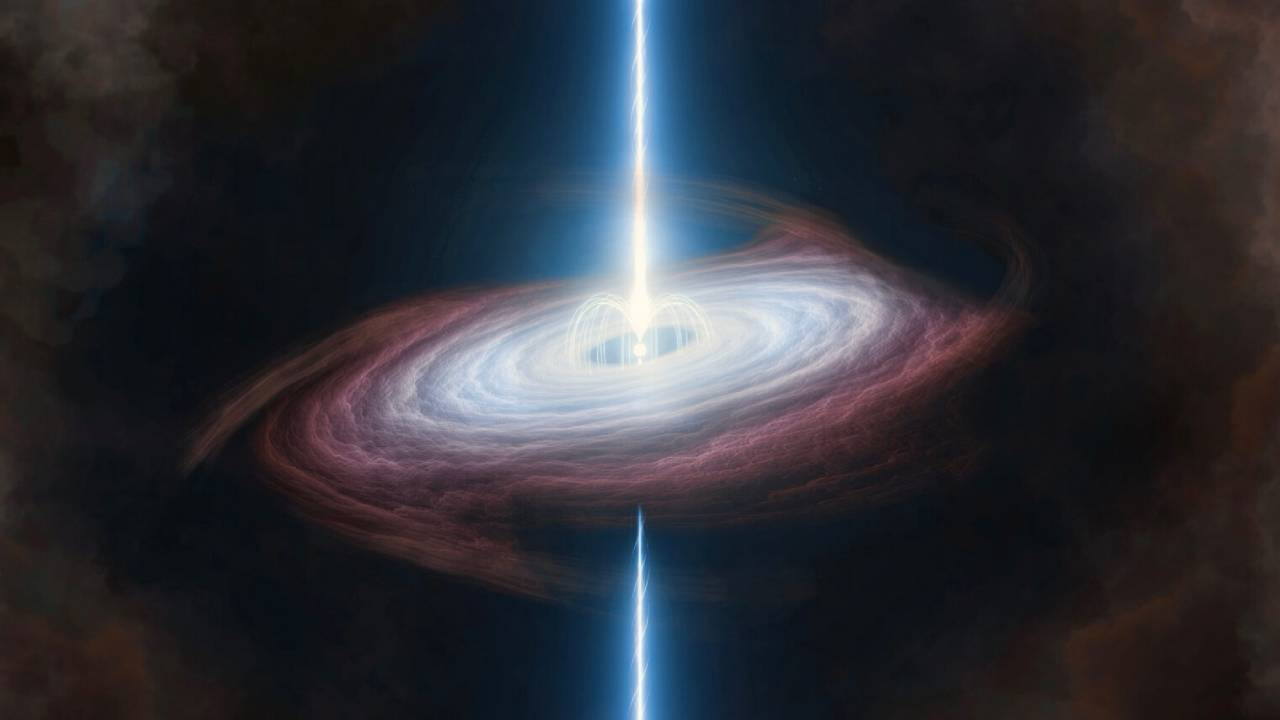
For the first time, astronomers have directly observed the birth of a magnetar, one of the most extreme and mysterious objects in the universe. The observation provides the strongest evidence yet of how these unusual celestial bodies power some of the brightest explosions in the cosmos.
Observations, reported by The Times, as well indicate that these objects can warp spacetime, consistent with Einstein’s theory of general relativity. This discovery offers a rare glimpse into the fundamental forces at play during the death of massive stars and the creation of incredibly dense objects.
Researchers monitored SN 2024afav, a remarkably bright supernova discovered in December 2024 and located approximately 1 billion light-years away, for over 200 days. This stellar explosion emitted at least 10 times more light than a typical supernova.
How does a star’s end become a magnetar?
When a massive star reaches the end of its life, its core collapses under its own gravity. This collapse triggers a supernova explosion, sending the star’s outer layers hurtling into space. What remains is an incredibly dense core.
The density of this core is so immense that a single teaspoonful of its material could weigh billions of tons. In some cases, this core begins to spin at incredible speeds and becomes enveloped by a magnetic field trillions of times stronger than Earth’s. Astronomers refer to these objects as magnetars.
Strange pulsations in the light provided a clue
Normally, the light from a supernova explosion fades steadily after reaching peak brightness. However, the light from SN 2024afav diminished with pulsating variations after its peak, exhibiting small bursts of brightness.
Researchers believe this is because some of the material ejected by the explosion didn’t fully escape into space and instead fell back towards the star, potentially forming a disk of gas around the magnetar. The observed radiation fluctuations suggest that this disk’s rotational axis is tilted.
According to Einstein’s theory of relativity, a large, rapidly rotating mass drags spacetime along with it. This effect is considered a possible explanation for the observed pulsations.
“Definitive evidence of magnetar formation”
These observations strengthen the idea that a magnetar within the expanding stellar debris is spinning and pumping energy into the explosion.
“This is definitive evidence that a magnetar formed as a result of the core collapse of a superluminous supernova,” said Alex Filippenko, astronomy professor at the University of California, Berkeley, and a co-author of the study.
“It’s always exciting to see a clear effect of Einstein’s general relativity. It’s particularly satisfying to see it for the first time in a supernova,” Filippenko added.
More discoveries expected with fresh telescopes
The research team anticipates that similar discoveries will become more frequent as new telescopes capable of scanning the sky in greater detail come online.
Joseph Farah, from UC Santa Barbara and a participant in the study, expressed the significance of the discovery: “This is the most exciting thing I’ve ever gotten to be a part of in my life. This is the science I dreamed of as a kid. The universe is telling us, loudly, that we still don’t fully understand it and is challenging us to explain it.”
Magnetic field 300 trillion times stronger than Earth’s
The discovery also confirms a theory proposed by UC Berkeley physicist Dan Kasen in 2010, known as the “magnetar star” theory, sixteen years later.
Researchers calculated the newly formed magnetar’s rotational period to be 4.2 milliseconds and determined that its magnetic field strength is 300 trillion times stronger than Earth’s.
This new phenomenon, dubbed a “chirp” in scientific literature, involves the frequency of light emitted from the explosion oscillating with an increasing tempo, similar to the sound of a bird’s chirp.
According to a statement published on Berkeley’s website, this is the first observation of the Lense-Thirring precession, a phenomenon predicted by Einstein’s general relativity where rotating masses drag spacetime, in a supernova.
Source: Gazete Oksijen
