
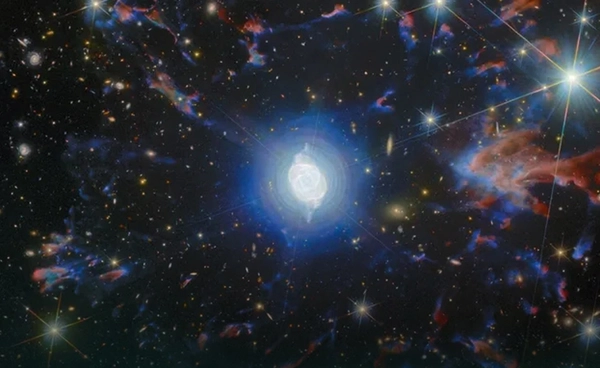
Astronomers have released a fresh image of the Cat’s Eye Nebula, revealing unprecedented detail of the dying star at its center. The image, published on March 3, 2026, combines data from NASA’s Hubble Space Telescope and the European Space Agency’s (ESA) Euclid telescope.
The Cat’s Eye Nebula, similarly known as NGC 6543, resides approximately 4,400 light-years away in the constellation Draco. For decades, the nebula has fascinated scientists with its complex, multi-layered structure. This latest view offers a fresh perspective on the processes that occur when a star reaches the end of its life. Planetary nebulae, named for their round appearance when viewed through early telescopes, are actually expanding gas ejected by stars in their final evolutionary stages.
The discovery that the Cat’s Eye Nebula is composed of gas, rather than a planet, was first made in 1864 through analysis of the light’s spectrum. This analysis revealed emissions from individual molecules, a characteristic of gas. Hubble Space Telescope has been instrumental in furthering our understanding of planetary nebulae, demonstrating that their seemingly simple circular shape often hides a much more intricate morphology.
In 1995, Hubble images of the Cat’s Eye Nebula revealed previously unseen structures, significantly expanding knowledge of how these nebulae form. The new image builds on this legacy, capturing the core of the billowing gas with Hubble’s Advanced Camera for Surveys (ACS) High Resolution Channel. Euclid’s contribution provides a broader view, situating the nebula within the context of deep space. This collaboration highlights the power of combining different observational capabilities to unlock the secrets of the universe.
Whereas designed primarily to map the distant universe, Euclid’s deep imaging surveys also captured the Cat’s Eye Nebula. Its view, encompassing near-infrared and visible light, showcases the arcs and filaments of the nebula’s bright central region within a halo of colorful gas fragments moving away from the star. NASA notes that this detailed imagery is crucial for studying stellar evolution and the lifecycle of stars.
