
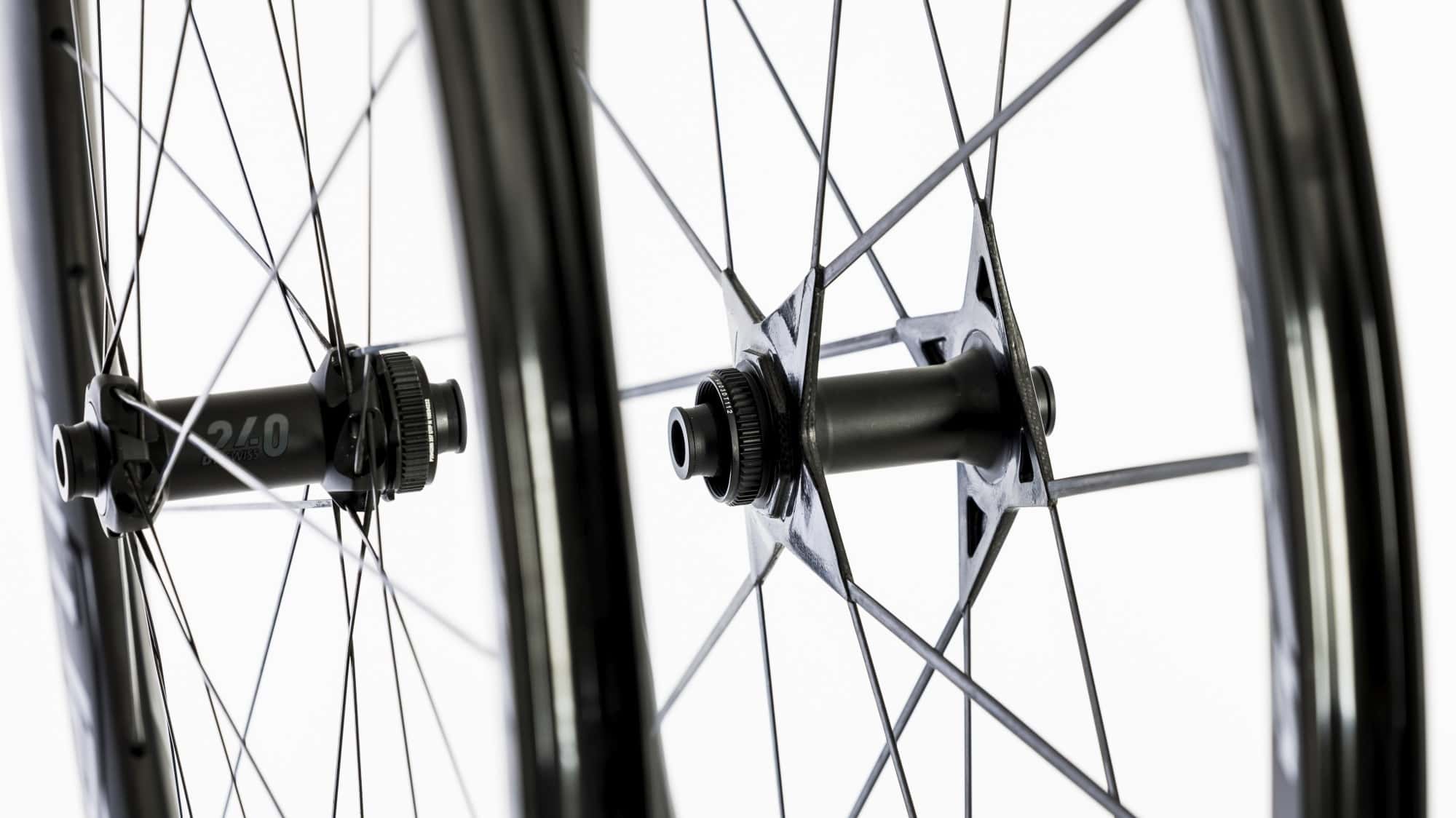
More manufacturers are bringing wheels with carbon spokes to market. Even traditionally conservative brands like DT Swiss, whose roots lie in the production of steel spokes, found themselves compelled to join the trend. The most obvious benefit of carbon spokes is enabling even lighter wheelset weights. However, they also drive up the price. But is the investment worthwhile?
The Question at Hand
We wanted to know: What happens when you test nearly identical wheelsets against each other – one with, and one without carbon spokes? What do the numbers say? And can you feel a difference in ride quality? We put it to the test with aero wheels from Aerycs: the Aero WT S with classic steel blade spokes, priced at 1399 euros, and the brand-new Aero CS with carbon spokes, costing 1799 euros.
Moritz Schwertner
The Aerycs Aero WT S and Aero CS wheelsets utilize the same carbon rim – with hooks, a 23-millimeter internal width, and Toray T1000 fibers. The rim heights available are 38, 50, and 60 millimeters.
Both wheelsets from Aerycs utilize the identical rims made from Toray T1000 carbon fiber. These are available in rim heights of 38, 50, and 60 millimeters, with a rim width of 23 millimeters across the board, and feature a traditional hooked design. Note: Even though the lowest version is 38 millimeters high, this version carries the number 40 in its name. And it’s these 40-millimeter versions we tested against each other: the Aerycs Aero WT S 40 versus the Aerycs Aero CS 40.
Aero WT S – Construction and Measurements in Detail
For the Aero WT S, Aerycs relies on proven components from Switzerland: The wheelset is built with DT Swiss 240 hubs and DT Swiss Aerolite blade spokes. Each wheel features 24 of these straight-pull spokes, laced in a 2-cross pattern on both sides.
Aerycs doesn’t compromise on wheel building: The Aero WT S 40 test wheelset arrived perfectly centered from wheel builder Robert Letzsch and his team – no lateral or radial runout outside of ROADBIKE’s tight tolerances was detectable, and both wheels were precisely aligned. This level of precision is crucial for optimal performance.

Moritz Schwertner
Aerycs’ Aero WT S wheel family is built with DT Swiss 240 hubs and DT Swiss Aerolite blade spokes. The cost of the wheelset: 1399 euros.
On the scale, the results are impressive, considering the relatively classic components: The front wheel weighs 565 grams, and the rear wheel weighs 663 grams, resulting in a wheelset weight of 1228 grams.
Aero CS – Construction and Measurements in Detail
With the Aero CS – built with the identical carbon rim – Aerycs uses blade spokes made from Toray T800 carbon fiber. Each wheel features 18 of these spokes, referred to as CarbonSpokes, laced in a 1-cross pattern on both sides.

Moritz Schwertner
Aerycs’ Aero CS wheel family comes with hubs with aluminum bodies, but a high, star-shaped carbon flange and 18 carbon spokes front and rear.
Visually striking is the high-reaching carbon hub flange, which tapers to four points on each side. This star-shaped structure results from the direction of the blade spokes. At its widest point, the “points” protrude a full four centimeters towards the rim – a completely different, more prominent look than the comparatively flat DT Swiss 240 hubs of the Aero WT S. Incidentally, the hub body, aside from the flange, is made of aluminum, and the inside features the identical DT Swiss 240 hub technology as the Aero WT S. Positively, the Aero CS wheelset is also expertly built, centered, and runs true without lateral or radial runout outside of tolerance.

Moritz Schwertner
The carbon spokes in the Aero CS are made from Toray T800 fibers, are hand-laced, and laced in a 1-cross pattern on both the front and rear wheels.
On the scale, the advantage of carbon spokes becomes apparent: The front wheel weighs 526 grams, and the rear wheel weighs 657 grams. The wheelset weight is therefore 1183 grams.
Comparison and Real-World Testing
Comparing the wheelset weights reveals: The steel-spoked wheelset is only 42 grams heavier. Is that worth a price increase of 400 euros, or almost ten euros per gram saved? Key note for athletic riders: The lower wheelset weight of the Aero CS does not mean lower stability. Aerycs specifies a maximum permissible system weight of 120 kilograms for the lighter Aero CS with carbon spokes – 10 kilograms less (!) for the Aero WT S with steel spokes, with a maximum permissible system weight of 110 kilograms.
The direct comparison in practice also shows that weight isn’t the only factor. We rode both wheelsets directly one after the other on a defined test loop, under identical external conditions, with identical tire models, tubes, and air pressure, as well as the same disc brake model and the same cassette, which was simply swapped over with a DT Swiss freehub. We also rode both wheelsets on extended tours to gather real-world impressions.

Moritz Schwertner
Thanks to the DT Swiss 240 hub technology used in both wheelsets, the freehub can be easily swapped over with the cassette.
This testing reveals clearly noticeable differences: The Aero CS with carbon spokes accelerate even faster than the Aero WT S with steel spokes. This isn’t just due to the 42-gram weight savings – it’s largely due to a plus in lateral stiffness, which you can feel when steering, climbing, and sprinting.

Moritz Pfeiffer
Visually, the two wheelsets differ primarily due to the different hub flange designs and the wider carbon spokes.
On the downside: The Aero CS ride subjectively harder – the many vibrations of the road are transmitted to the rider unfiltered compared to the Aero WT S, which feels significantly smoother overall.

Moritz Schwertner
It’s likely that the more noticeable handling in crosswinds with the Aero CS is due to the larger lateral surface area due to the high, star-shaped hub flange and the wider carbon blade spokes.
Another difference emerged off the bike: When installing and removing the wheels, the Aero CS tipped over once, with a carbon spoke colliding with the pedal of a second road bike in the basement. While similar accidents, which can always happen, with a steel-spoked wheel would likely only elicit a shrug of the shoulders, you instinctively hold your breath with carbon spokes – and breathe a sigh of relief when – as in this case – no damage occurred.
Conclusion

“If you’re looking for a very lightweight, worry-free wheelset, you’re better off with a model like the Aerycs Aero WT S with steel spokes. Weight, comfort, and lateral stiffness are excellent, the fun factor and everyday usability are high, and you save money compared to models with carbon spokes.
If you aim for to squeeze out the last marginal gains in lightweight construction, lateral stiffness, and steering precision, don’t mind some loss of comfort, and can be careful with handling and transport, you’ll opt – assuming you have the money – for a carbon-spoked model like the Aerycs Aero CS.
One thing is certain: At ROADBIKE, we will continue to test models of all price and performance levels for you.”
