
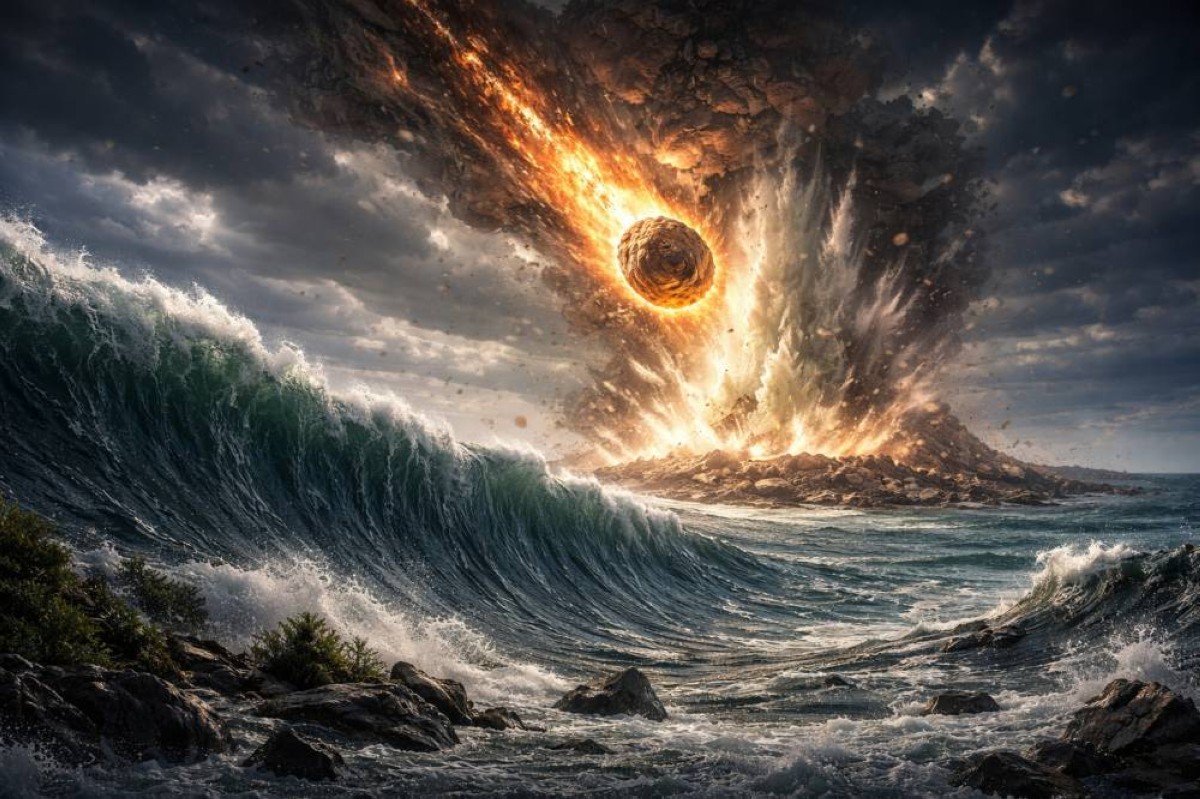
A massive asteroid impact in the North Sea approximately 43 to 46 million years ago triggered a colossal tsunami exceeding 330 feet in height, according to a new scientific study. The research, which resolves a long-standing geological mystery, confirms that the Silfra Pit crater was created by the impact of a large space rock.
The asteroid, estimated to be around 525 feet wide, struck the seabed with tremendous force, ejecting rocks and water as high as 4,900 feet into the air before collapsing back into the ocean. This generated a devastating tsunami that likely caused widespread destruction in the surrounding region, according to reports. The findings offer a rare glimpse into the geological consequences of asteroid impacts and provide valuable data for understanding similar events throughout Earth’s history.
The Silfra Pit crater, located roughly 700 meters below the seafloor, has been a subject of scientific debate since its discovery in 2002. While some researchers initially proposed an asteroid impact as the cause, alternative theories, including underground salt movement and volcanic activity, were also considered. This new study, however, provides what researchers describe as conclusive evidence supporting the impact hypothesis.
Dr. Oshidian Nicholson of the UK’s Heriot-Watt University, who led the research, explained that advancements in seismic imaging technology were crucial to the breakthrough. “Modern seismic imaging techniques allowed for a clearer view of the crater’s deep structure,” Nicholson said. The team also analyzed rock samples taken from beneath the seabed, discovering “shocked” crystals of quartz and feldspar – minerals that form only under extreme pressure, such as that generated by a high-speed collision with a celestial body.
“The discovery of these crystals was critical, as they represent direct evidence of the impact,” Nicholson stated. “The internal structure of these minerals can only be created by extremely intense shocks.”
The impact also left behind secondary craters, a distinct crater rim, and textured surface formations visible in recent seismic images, further supporting the high-speed collision scenario. The study, published in the journal Nature Communications, provides scientists with a rare opportunity to study the immediate aftermath of an asteroid impact on Earth or in the ocean.
Professor Gareth Collins of Imperial College London commented that he had always believed the impact hypothesis was the simplest and most consistent explanation. “The new evidence puts an end to the scientific debate that has been ongoing for more than two decades,” he said.
Submarine impact craters are exceptionally rare, with only around 33 confirmed impact craters beneath the world’s oceans. This makes the Silfra Pit crater a unique case, particularly given its remarkable preservation over millions of years. The scarcity of these craters is attributed to Earth’s dynamic nature, where tectonic plate movement, erosion, and crustal changes obscure most traces of ancient impacts.
Researchers suggest that comparing the Silfra Pit crater to well-known craters like the Chicxulub crater in Mexico – linked to the mass extinction event that wiped out the dinosaurs – could lead to a deeper understanding of how cosmic impacts have shaped Earth’s history. While the Silfra Pit impact was significantly smaller than the event that ended the dinosaur age, it still provides valuable insights into the long-term geological effects of asteroid collisions.
This discovery confirms that the crater beneath the North Sea is not merely a geological anomaly, but a rare geological record of a cosmic disaster that occurred tens of millions of years ago, when an asteroid struck the seabed and unleashed one of the most violent tsunamis in Earth’s ancient history. The findings underscore the ongoing need to study potential impact hazards and their potential consequences for our planet.
