
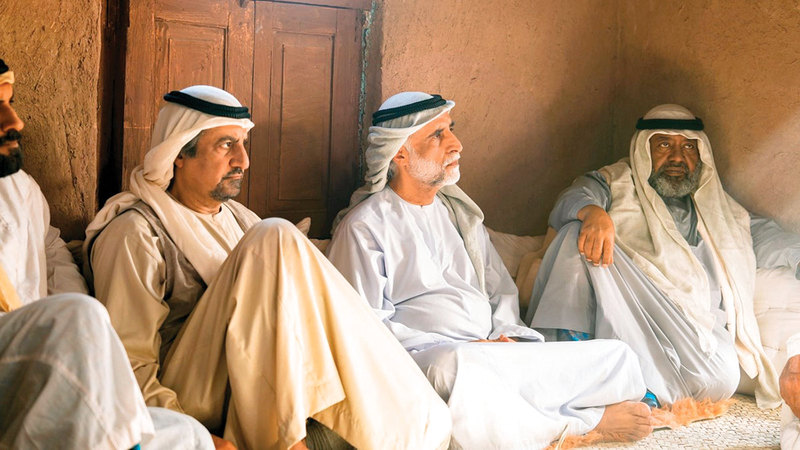
As the noise of daily life fades, and memory grows stronger, old stories shine like lanterns in the passage of time,” reflects Dr. Habib Ghloum, recalling cherished memories of Ramadan. The veteran Emirati artist remembers his childhood home, the warmth of family gatherings, and the enduring presence of his beloved mother.
In a recent conversation with “Emirates Today,” Ghloum didn’t limit himself to reminiscing. He also discussed the state of drama and theater, describing art not merely as a message, but as a complete life.
“This month symbolizes peace of mind and tranquility,” Ghloum said of Ramadan. “Its spirituality is marked by gatherings with family and friends, as well as moments of self-reflection, which are essential for everyone.” He added that Ramadan always brings his mother to mind, as she raised him and his siblings after their father’s passing. “Ramadan always reminds me of my mother, who passed away five years ago, especially since we grew up in the house under her care. My father passed away when we were young, and we spent our lives with her. Ramadan also brings the family together at the table, and the food our mothers prepare for their families.” He considers a mother to be life itself, the first embrace, and the foundation of every person.
Ghloum noted that the roles of women have evolved significantly over time. “In the past, a woman’s sole focus was her home, family, and children. Today, mothers have other commitments alongside their families. Life has changed, and women strive to prove themselves at work, playing an vital role alongside men.”
A Favorite Dish
When asked about his favorite dish during Ramadan, Dr. Ghloum revealed it’s Thareed, explaining he doesn’t particularly enjoy rice. Emirati dishes often include rice with meat or Thareed, making the latter his preference.
Regarding the intersection of art and Ramadan, Ghloum believes artists have a social and professional responsibility during this month. “The personal and artistic often intertwine during Ramadan, especially since channels and platforms focus on dramatic works during this time, unlike other times of the year. The increased viewership during the holy month encourages the presentation of drama, which places a responsibility on the artist.”
Back to the Beginning
Reflecting on his artistic beginnings, the Emirati artist shared, “My vocal talent helped me join the school radio, and my star rose from childhood. I then entered school theater, and in 1979, a delegation from the Ministry of Education and Teaching came to the school looking for talent for an operetta. I was chosen, and my career began there. I then studied in Kuwait, obtained a Master’s degree in Egypt, and a Doctorate from Britain, in addition to working in the Ministry of Culture, which contributed to shaping my experience.”
Dr. Ghloum’s experience is diverse, encompassing writing, acting, and directing. He believes these areas form his creative space, noting that a shortage of writers and directors in the Emirati art scene has led experienced professionals to work in multiple fields.
He emphasized that, with his academic background—holding both a Master’s and Doctorate—he feels obligated to research all elements of an artistic work. He also acknowledged the psychological pressure inherent in the field, particularly when committed to a specific theatrical performance or series, but that passion for the work and delivering satisfying results alleviate the stress, especially when met with positive feedback from the public, which energizes artists to give more.
“Hayer Tayer”
Dr. Ghloum specifically highlighted the series “Hayer Tayer” (“Confused and Flying”), considering it a unique work in the history of Emirati drama. He attributed this to the timing of its release, when audiences were eager for such content, and the series addressed issues relevant to them. “Through it, some behaviors were criticized and corrected, and its results are still evident today.” He added that some artists impose self-censorship, and that artists in the UAE have learned from their leaders to look at the half-full side of the glass and then work to correct mistakes. He stressed that drama leaves a significant impact on society, as five parts of the series addressed many issues, but disagreements between the main producers led to its conclusion after the fifth part, while also helping to present something different later on, such as the series “Tmasha” (“Glimpse”).
The State of Series
Regarding the position of Emirati series compared to those in the Arab world, artist Habib Ghloum said, “It’s impossible to compare local drama to what is presented in the Arab world. There are experiences that preceded the Emirates, even at the Gulf level, and there are countries that precede the Emirates.” He expressed hope that efforts would be dedicated to developing local drama.
He mentioned that the role he can’t forget is his character in the series “Bnat Adam” (“Daughters of Adam”), where he played a manipulative man. He was so averse to the character that it fueled his performance. “When portraying such a role, the actor must not show sympathy for the character, but rather ensure that the audience hates the villainous character.”
About “The Father of Arts”
Regarding “the father of arts,” Dr. Habib pointed out that theater in the Emirates moves forward based on individual efforts and will continue to do so, as the institutions concerned with it are largely absent, except for Sharjah, which cares about theater because His Highness Sheikh Dr. Sultan bin Muhammad Al Qasimi, a member of the Supreme Council and Ruler of Sharjah, loves theater and began his life by writing in it.
He called for attention to theater in all the Emirates, from the concerned institutions, starting with the Ministry of Culture, to the cultural bodies, to provide all forms of support. He added that the crisis of theater is not only in the Emirates, but is global, in addition to the challenge facing “the father of arts” today of personal attendance, unlike what we experience in the current era, which presents everything to the public through modern platforms and tools, which people have turned away from everything old and traditional because of.
A Message to the Youth
Dr. Habib Ghloum addressed young actors, advising them to be patient, noting that many of the rising generation are characterized by impatience and frustration at not achieving stardom quickly. He emphasized that success can take years, and one must be content with what they achieve, continuing to persevere with effort. He stressed that difficulties will eventually fade, and the results of hard work will appear over time. He also emphasized the importance of collective thinking, not personal, meaning thinking about how to serve society before oneself, explaining that art is life, and the loving artist sees life as colorful, far from a gray outlook.
Habib Ghloum:
. We grew up in the house under my mother’s care, as my father passed away when we were young, and we spent our lives with her.
. The role I can’t forget is my character in “Bnat Adam,” as I hated it.
. Ghloum believes the crises of theater are global, not limited to the Emirates.
. Thareed is the favorite dish of the Emirati star during the holy month.
