
The research, which involved the active participation of three young and promising researchers from the European Institute of Oncology (IEO) in Milan – Antonio Marra, Emanuela Ferraro, and Luca Boscolo Bielo – has pinpointed the precise molecular profile that drives drug resistance in certain types of breast cancer. This genetic “fingerprint” offers, for the first time, a concrete opportunity to predict which patients will develop resistance to standard therapies and which will benefit from conventional treatments for a longer period. This discovery has an immediate and profound impact on clinical practice, allowing physicians to select the most appropriate and targeted therapy for each woman from the outset, with the goal of delaying the development of resistance mechanisms and significantly improving the overall effectiveness of treatments. Understanding why breast cancers develop into resistant to medication is a critical step toward improving patient outcomes.
The Mechanism of Resistance Revealed: The Crucial Role of DNA
The crucial role of DNA: the mechanism of resistance revealed.
The research delved into how genetic alterations influence tumor evolution and its ability to resist treatments. While it’s been known that both inherited (germline) and non-inherited (somatic) mutations contribute to cancer development, how these two types of genetic alterations impact drug resistance hadn’t been fully defined. Through integrated clinical-genomic analysis of over 5,800 patients, the study demonstrated how inherited pathogenic variants can decisively influence the evolution and drug resistance of breast carcinoma. Specifically, the research found that certain inherited genetic mutations, such as those affecting the gene BRCA2, profoundly influence how the tumor develops and becomes resistant to existing therapies. Breast cancers with a germline BRCA2 mutation show a strong predisposition to losing the RB1 gene, a mechanism that destabilizes DNA. This creates a “double hit” effect: a pre-existing genetic fragility, combined with acquired DNA instability, which promotes the development of resistance during therapy. Standard treatments, such as a combination of endocrine therapy and CDK4/6 inhibitors, are often less effective against these subtypes of tumors.
New Hope: PARP Inhibitors and First-Line Therapy
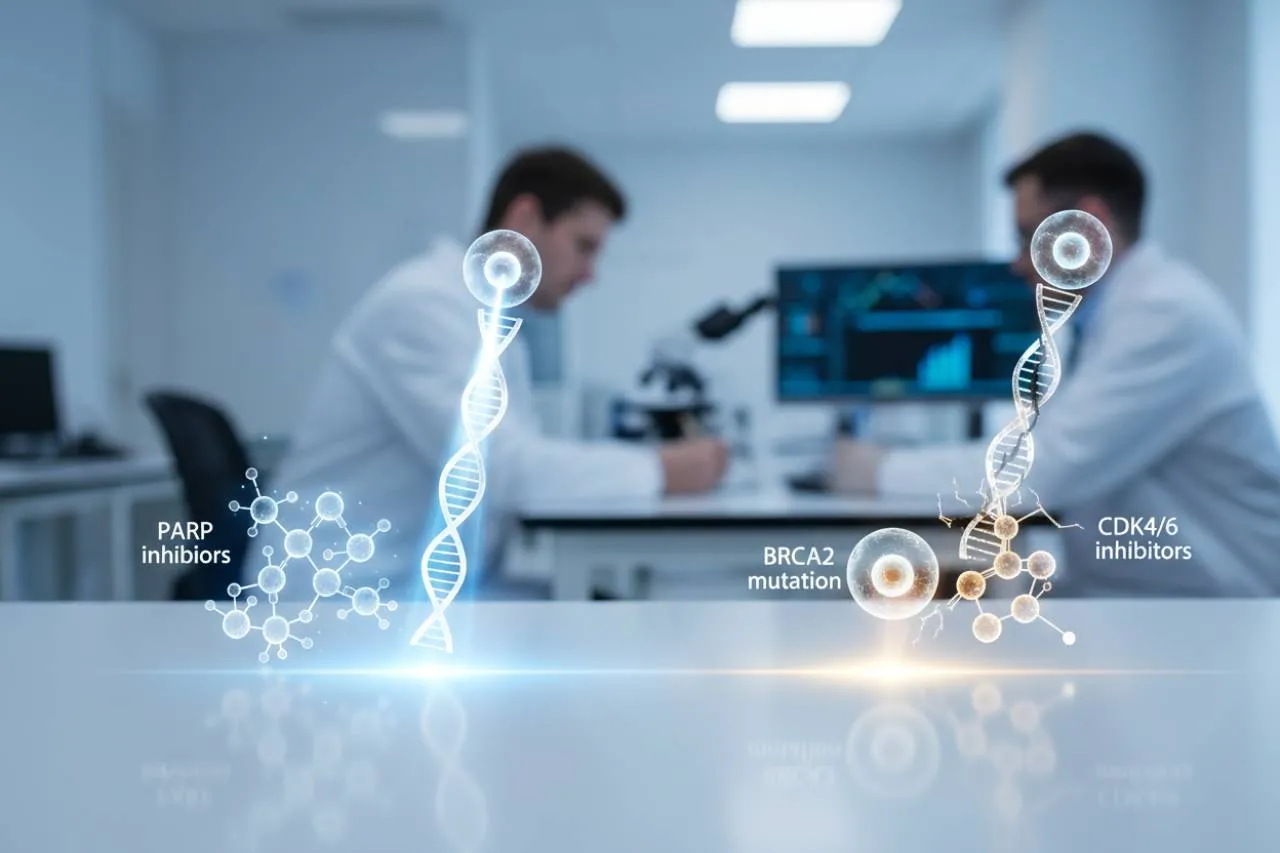
PARP inhibitors: a new hope in first-line therapy.
In light of these crucial findings, the research has opened up new and promising therapeutic avenues. Both in experimental models and in the analysis of clinical data, PARP inhibitors appear to work significantly better than CDK4/6 inhibitors in patients with a BRCA2 mutation. This discovery is of enormous importance, as it opens up new possibilities for using PARP inhibitors as a first-line therapy. Based on these results, a clinical trial has already been launched to explore this new strategy further. PARP inhibitors are drugs that have been in use for several years, with proven results against HER2-negative, BRCA1/2-mutated breast cancer, both in the metastatic and early stages. Until now, their use has been limited to the “second line,” meaning when the first drug has stopped being effective. The new data clearly indicates that prioritizing PARP inhibitors in patients carrying a BRCA2 mutation can intercept early trajectories of RB1 gene loss, thus delaying the onset of drug resistance. Beyond this specific result, which will have an immediate clinical impact, the study has established a general model for predicting resistance trajectories based on the patient’s genome configuration, reaffirming the fundamental importance of genetic profiling before any treatment, in order to ensure the most effective and personalized therapy possible for each individual.
