
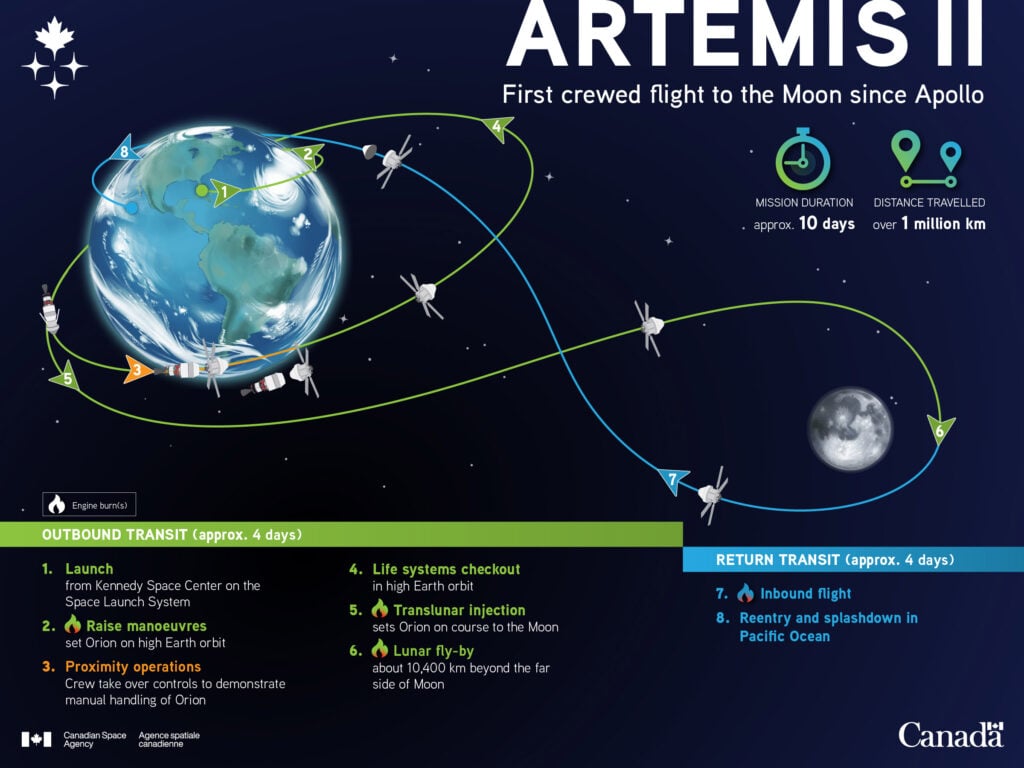
NASA’s Artemis II mission has successfully concluded its historic journey around the Moon, with the crew safely splashing down in the Pacific Ocean off the coast of San Diego on April 11, 2026, at 00:07 UTC. The mission, which served as a critical crewed test flight for the Space Launch System (SLS) and Orion spacecraft, marks a significant milestone in human space exploration and the technical validation of deep-space transit systems.
A High-Stakes Journey to the Moon
Launched from Kennedy Space Center’s Launch Complex 39B on April 1, 2026, at 22:35:12 UTC, the mission utilized an SLS-block I rocket to propel the Orion 003 capsule, named Integrity, into space. The crew—comprising Reid Wiseman, Victor Glover, Christina Koch, and Jeremy Hansen—embarked on a flight that spanned 9 days, 1 hour, 31 minutes, and 35 seconds, covering a total distance of 1,126,922 kilometers.
The mission profile differed from the uncrewed Artemis I flight, featuring a fly-by of the Moon on April 6, 2026, at 23:00:46 UTC, reaching a minimum distance of 6,544 km from the lunar surface and a maximum distance from Earth of 406,771 km. During the journey, the spacecraft reached a peak speed of 39,661 km/h.
The Perils of Re-entry
The final phase of the mission highlighted the extreme engineering challenges of returning humans from deep space. To reach Earth, the capsule entered the atmosphere at approximately 40,000 kilometers per hour, enduring intense thermal stress with temperatures reaching up to 2,700 degrees. This phase is critical for validating the heat shield and structural integrity of the Orion capsule, ensuring the safety of future missions that intend to land on the lunar surface.
Cosmic Perspectives and Crew Reflections
Following their return, the astronauts shared the emotional impact of seeing Earth from a lunar distance. One crew member reflected on the vastness of the universe, noting, “Our sun is just one of 200 billion stars in one of hundreds of billions of galaxies: such a cosmic perspective can help us.”
The crew also emphasized the unity experienced during the mission, stating, “We were a crew, but planet Earth is that too.” Despite the success, the journey was not without technical hurdles; reports indicate that the crew dealt with issues including a broken toilet, though it was noted that this was not the mission’s most significant challenge.
Beyond the primary crewed test, Artemis II also carried four CubeSats as part of a secondary mission. This successful operation reinforces NASA’s capabilities in long-duration spaceflight and paves the way for the eventual return of humans to the lunar surface.
