
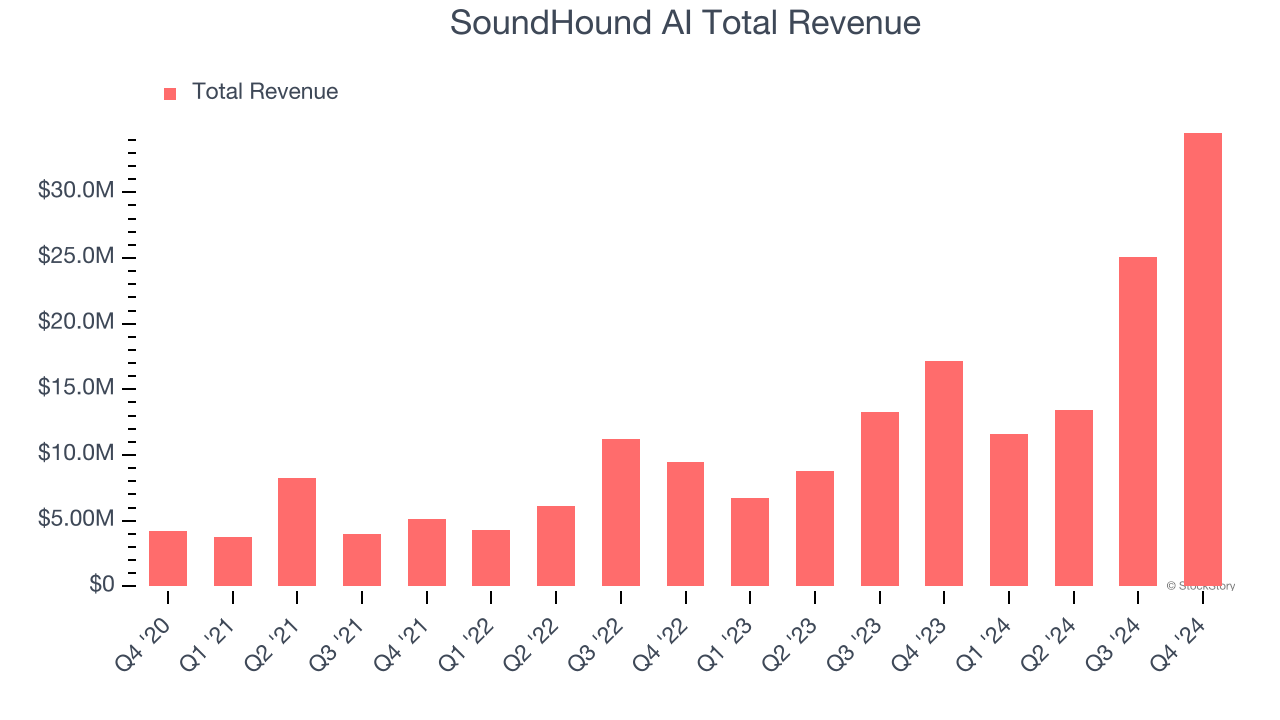
SoundHound AI reported $44.2 million in revenue for the first quarter of 2026, exceeding analyst estimates of $42.74 million. Despite achieving 51.7% year-on-year growth, the company’s stock faced negative market pressure following the earnings announcement, as investors scrutinized the firm’s non-recurring acquisition costs and a $0.02 miss on adjusted earnings per share.
Q1 Financial Performance and Market Reaction
SoundHound AI’s financial results for the first quarter of 2026 present a narrative of significant top-line expansion complicated by the integration of recent corporate acquisitions. The company posted revenue of $44.2 million, a 51.7% increase compared to the same period in the previous year. This performance outperformed the consensus analyst estimate of $42.74 million, marking a 3.4% beat.
However, the market’s response to the disclosure was markedly negative. While revenue growth remained a focal point, investors appeared concerned with the bottom-line impact of the company’s expansion strategy. SoundHound AI reported an adjusted EPS of -$0.06, failing to meet the analyst consensus of -$0.04. Furthermore, the company reported an adjusted operating income of -$22.67 million, which represented a -51.3% margin. Despite the margin contraction—down from 440% in the same quarter last year—the figure notably outperformed analyst expectations of -$41.65 million.
The company currently holds a market capitalization of $3.64 billion. Billings at the close of the quarter reached $47.22 million, reflecting a 44% increase year-on-year. This financial snapshot reflects a period of aggressive scaling, where the company’s ability to generate revenue is increasingly tethered to its capacity to successfully integrate newly acquired assets into its existing technological ecosystem. The discrepancy between the revenue beat and the EPS miss underscores the current market sensitivity toward the company’s path to profitability, particularly as it navigates the costs associated with its recent M&A activity.
Strategic Focus on Automotive and IoT
Management emphasized that the core drivers of this growth are found within the automotive and Internet of Things (IoT) sectors. CEO Keyvan Mohajer highlighted the performance of these specific segments during the earnings call, noting that the company’s automotive and IoT AI business experienced an 88% increase year-over-year, excluding the impact of recent acquisitions.
The integration of these acquisitions has become a central theme for the company. While leadership maintains that the firm is successfully capturing increased demand for AI and enterprise solutions, they acknowledged that the process has introduced both new opportunities and operational complexities. These complexities, specifically non-recurring costs related to the integration of acquired entities, were identified as primary factors impacting margins during the quarter. The company is currently reallocating resources to ensure that the technological platforms of acquired firms are synchronized with SoundHound AI’s proprietary voice and conversational AI infrastructure. This synchronization is essential to maintaining the high growth rates reported in the automotive and IoT segments, as these industries increasingly rely on seamless, high-latency-sensitive AI interfaces.
Analyst Scrutiny of M&A Strategy
The unscripted portion of the earnings call provided a window into how market analysts are evaluating SoundHound AI’s current trajectory. Among the inquiries, Gil Luria of D.A. Davidson directed focus toward the company’s specific approach to mergers and acquisitions. Luria questioned how SoundHound’s strategy differentiates itself from the standard practices typically observed in the technology sector, seeking clarity on whether the company is prioritizing market share acquisition or technological capability enhancement.
In response, CEO Keyvan Mohajer articulated the company’s philosophy regarding its growth through acquisition:
We find companies that have a great team, a great business, really strong customer relationships.
Keyvan Mohajer, CEO of SoundHound AI
This focus on target acquisition reflects the company’s ongoing effort to scale its AI capabilities while managing the inherent risks associated with rapid corporate expansion. The management team noted that the selection process for acquisitions is stringent, aimed at identifying entities that provide immediate synergistic value rather than merely expanding the company’s footprint. However, analysts remain focused on the duration of the “non-recurring” costs, questioning when the transition phase from acquisition to full operational integration will conclude.
As of May 17, 2026, the market continues to weigh these growth metrics against the costs of integration, as reflected in the company’s recent share price volatility following the Q1 results. The investor community is currently balancing the 51.7% revenue growth against the -$0.06 EPS performance. Future performance will likely depend on whether SoundHound AI can translate its top-line momentum into improved margin stability as the recent acquisitions are fully absorbed into the broader enterprise structure. The company’s ability to maintain its 88% growth rate in automotive and IoT, while simultaneously reducing the drag of integration costs on the bottom line, remains the primary metric by which institutional stakeholders are measuring the company’s long-term viability in the competitive AI landscape.
