
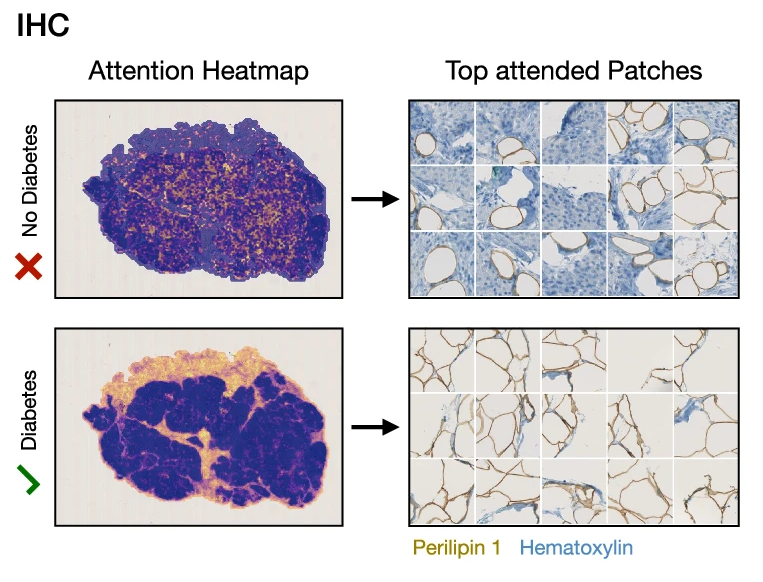
What tissue structures in the pancreas play a role in type 2 diabetes? And how do they change as the disease progresses? Researchers are now able to answer these questions with the aid of explainable artificial intelligence (XAI).
Currently, it’s difficult to reliably draw conclusions about a person’s glycemic status based on conventional histopathological examinations. Many subtle morphological changes associated with impaired insulin secretion and the loss of beta cell function are barely visible to the naked eye. This challenge has hindered a deeper understanding of the disease’s development and potential treatments.
Researchers from several partner institutions of the German Center for Diabetes Research (DZD), working with international colleagues, have developed a recent approach to visualize subtle tissue changes in the pancreas in type 2 diabetes. The results, recently published in ‘Nature Communications,’ offer new insights into the origins of type 2 diabetes.
Deep-Learning Models Distinguish Between Tissue Samples From People With and Without Type 2 Diabetes
To address this diagnostic gap, the research team created an extensive dataset from pancreatic tissue sections donated by living donors. The samples were processed using chromogenic and multiplex immunofluorescent staining techniques, then captured in high resolution using gigapixel microscopy.
Using this data, scientists trained deep-learning models that could reliably differentiate between tissue samples from individuals with and without type 2 diabetes. The models were able to accurately predict diabetes status and, for the first time, pinpoint which tissue structures play a central role in the disease—including changes in the islets of Langerhans, alpha cells, neuronal axons, and the proximity of fat cell clusters to islet structures. The findings could lead to earlier and more accurate diagnoses.
The identified features were analyzed, quantified, and described as potential biomarkers using explainable AI. This AI-supported evaluation provides new clues about early and previously difficult-to-detect changes in type 2 diabetes.
What is Explainable AI?
Explainable AI – similarly known as Explainable AI (XAI) – encompasses methods and processes that build it understandable for users why an AI model arrived at a specific conclusion. This ensures transparency and traceability, particularly in complex models.
(mkl/BIERMANN)
