

“It all starts with passion, excitement, and enthusiasm.” That’s how actress Indra Roga described Aksels Aizkalns, a rising star in Latvian theater who is quickly gaining recognition for his intense and captivating performances.
Aizkalns graduated from the Latvian Academy of Culture’s Dramatic Theater Acting program in 2021, studying under Roga and Mihails Gruzdovs. Shortly after, the Valmiera Drama Theater welcomed him with open arms, taking in his entire graduating class.
If a category existed for “heroic role portrayer” in 21st-century theater terminology, Aizkalns would undoubtedly be a frontrunner. He’s taken on challenging roles such as Osvalds in Alvinga kundzē, Alexei Kirilov in Nelabie. Pēc Dostojevska (The Bad Ones. After Dostoevsky), Ignasio in Liesmojošā tumsā (Blazing Darkness), Orin Menons in Sēras piestāv Elektrai (Mourning Becomes Electra), and Jāzeps in a production of Rainis’s classic work. He’s too played the resonant role of Joahims, the cousin of Hans Castorp, in Burvju kalns (The Magic Mountain), and Dan in Tuvāk (Closer). These characters are often portrayed as disruptors, truth-seekers, and uncompromising figures who grapple with profound questions.
However, Aizkalns also possesses a strong sense of humor, wit, and self-awareness, allowing him to embody a diverse range of characters, including the naive and persistent suitor in Ļaunā gara (The Evil Spirit). This versatility highlights his growing range as an actor in a thriving Latvian theater scene.
A recent interview focused on Aizkalns’s latest role – Aaron, a model – in director and scenographer Reiņa Suhanova’s production of Egomaniaki. The play centers on a man attempting to salvage his relationship with his ex-wife, or at least film a fresh video for his Instagram account. The two actors, portraying a couple locked in a tense struggle, deliver a performance that is both emotionally raw and playfully theatrical. The production is particularly notable for Aizkalns’s monologue, a powerful outburst consisting entirely of variations on a single expletive.
“I hope we’ll be playing this present regularly, but no more than two performances in a row,” Aizkalns admitted at the start of the interview.
Why? Is the role of Aaron and the play as a whole more demanding than others?
“The sheer volume and concentration required are significant. It’s challenging, but not emotionally draining. There’s a exceptionally precise blueprint for the role. The character is more symbolic than realistic, so a standard approach doesn’t work. Different muscles are engaged. It’s somewhat unusual, which is perhaps why it requires so much energy.”
“The play is very clever. We, of course, have amplified it so that people can see the absurdity more vividly,” says Aksels Aizkalns about the new work Egomaniaki. In the photo – his Aaron with ex-wife Kortnija (Anna Nele Āboliņa) on a “relationship improvement” hike. Photo – Matīss Markovskis
The play is also very fast-paced physically, almost like a sprint.
“Yes. Amerikāņu bizons (American Bison) was the closest in terms of physicality. A lot of text, very quick transitions. You have to grab the turns very quickly. Egomaniakos adds a constant dialogue (with Anna Nele Āboliņa’s Kortnija – U. A.). It’s effortless to fall out. If you disconnect, you immediately slip.”
How can you help each other?
“Pockets full of jokes and a fine mood, and 100 percent commitment. If someone messes up the text, there’s not much you can do. You can prompt them, but it’s so obvious, it’s practically impossible.”
During the dress rehearsal, you had a moment of complete blankness, but you played it off so cleverly that it almost seemed intentional. But it wasn’t intentional, was it?
“It was one of those theater miracles. Not for nothing is a copy kept on the side, because we realize that we might get mixed up, and Neli and I, as if we’re allowed to step aside and quickly say – what was that, what are we doing now? Conceptually, it’s our third layer of identity, that we are also an actor and actress. In this play, it’s even necessary, and we play with it.”
That suits the theatricality, the moments of alienation, and the winking at the audience, which are gracefully implemented in Reiņa Suhanova’s direction and your performance. At one moment the audience is your machine, at another – a pile, so to speak – of living scenery.
“We quickly realized that it was a kind of Brechtian alienated way of playing, if you can call it that. As if we’re playing theater, but not entirely. And sometimes we even exaggerate it too much. The whole play is like a distorted reality, and our faces are literally distorted. As if everything is in its place, but with a slight shift. I think it all fits together very well.”
Original plays don’t approach to theaters all that often. As an actor, is there a difference – playing a play by Blaumaņa or Dīcis? What interests you about original dramaturgy?
“It’s great! I really like this play! I find it witty and intelligent in its dramatic construction. Well, I don’t have much expertise to talk about dramaturgy. The play itself is a big metaphor. We quickly understood that. One of the victories is that I really like this play. I said at the premiere speech – paradoxically, but to play this play, you have to put your actor’s ambitions and ego aside. I have to think about how I can highlight the symbol or metaphor that is in the play. Good dramaturgy plays itself, we must not ignore it. I hope that Rein, Nele and I have succeeded.”
“I’m somewhat secondary here, I wish the play to move forward. They ask me – how did I come up with the character? It’s all already written! Maybe I add something cool? It really helped that Artūrs Dīcis read his play to us himself. The fact that the author reads it creates a personal experience. He trusts us. We must not waste that.”
Why, in your opinion, is it so tricky for people in romantic relationships to lower their guard and abandon some misguided self-importance, your characters seem to be on the verge of a fight, but could fight again, who sees whom less and who is more hurt…
“I don’t think I’m in a position to preach about this topic… It’s hard to talk about. I think it really is a problem, and I somehow recognize that code, that pattern that is there and goes around in circles. The ending is so attractive! ‘I will no longer let anyone hurt you,’ they sing as if it were a reconciliation song, and then the old record starts playing again! Unfortunately, that’s how It’s. People in relationships can’t break out of those patterns. They don’t realize that they have to sacrifice something of themselves. It’s ego death. You have to sacrifice for the other person in order to break out of that stupid black hole. The play is very clever. We, of course, have amplified it so that people can see the absurdity more vividly.”
You and Anna Nele Āboliņa brilliantly embody very infantile adults who hope that the other will heal their traumas and complexes, so they constantly blame and demand something from each other. Often people get stuck waiting for the other to open up and drop their wounded, but inflated ego.
“Chicken or egg, who goes first? Who is more tired, or who has more right to be tired, and who is allowed not to wash the dishes. It’s like everyday life, it’s a small thing, but that’s where it all develops. Giving a shoulder, doing something for the other, just hugging… I’m not saying I’m perfect, but seventy percent of the problem is solved by recognizing it.”
You have a very interesting and original task in this play – you sing songs written specifically for the play by Fiņķis, and Anna Nele Āboliņa – songs by the rapper Viņa (Zelma Jēgere). Inform me about this experience. Was rap on your personal music playlist before?
“Working with Fiņķis was really great. We quickly found professional friendship. We trusted each other very quickly. Fiņķis felt that he could trust me with his kitchen. I, in turn, unreservedly trusted him, because he is a specialist and is at the top. Fiņķis is genuine in what he does. Above all, it was a huge, one of the biggest challenges in recent times. I also told Fiņķis that he should expect the best result from me, to set the highest standards. We are going for excellence. I realized that only in this way could I even slightly approach how Fiņķis performs music. I tried to touch this genre of art honestly and with a clear conscience.”
Does music help the actor in the play?
“In the context of this play, we wanted to achieve a feeling that when the song comes on, it doesn’t feel like ‘go away, go away, it’s time to sing.’ Rather – ‘Yes! Now I have to sing!’ It just helps to rest the mind in that huge amount we go through with Neli. The songs are like islands of safety or rest. It’s like theater, but not quite, like art, but in a different genre, a different discipline, and that somehow relaxes you. But that doesn’t mean it’s easy to perform.”
Can you draw any parallels with the play Tuvāk, where two couples rotate in a similar circle?
“I would say that these are incomparable plays. Yes, You’ll see relationships, perhaps a similar theme, but Patrika Mārbera’s play offers a look at the cause-and-effect relationships associated with lies and the inability to trust a partner in a more general context. In connection with this play, you can even ask the question – what does it mean to love and whether anyone in Tuvāk actually loves anyone? I think Dīcis has a more subtle weave. He dissects a very specific code. But Tuvāk can also be read as one big symbolic metaphor.”
Even Jāzeps’s internal conflict is largely related to overcoming self-importance and ego, of course, on a different scale. Can you draw something from your Jāzeps for the role of Aaron?
“I think definitely, even though there aren’t any specific correlations. Jāzeps feeds me as a person and as an actor. Those ideas! Everything I go through in each play, it’s multiplied by four. It’s essential to understand that Aaron’s role is, in a sense, an archetype. And as an actor, you realize that you are a symbol – all men in one person. Older men comment – ‘I don’t know such men.’ Maybe I don’t either, but I think everyone will find a familiar moment in Aaron’s life. When creating any role, you have to have your own opinion on the topic. You don’t have to play it, but you have to know what you would do in that situation, only then can you start speculating about how the character might act. It has to be really smart to play a really stupid person. I just said that I’m really smart. (Laughs.) In other words – you have to know how a smart person would act in order to understand that you have to do the opposite.”
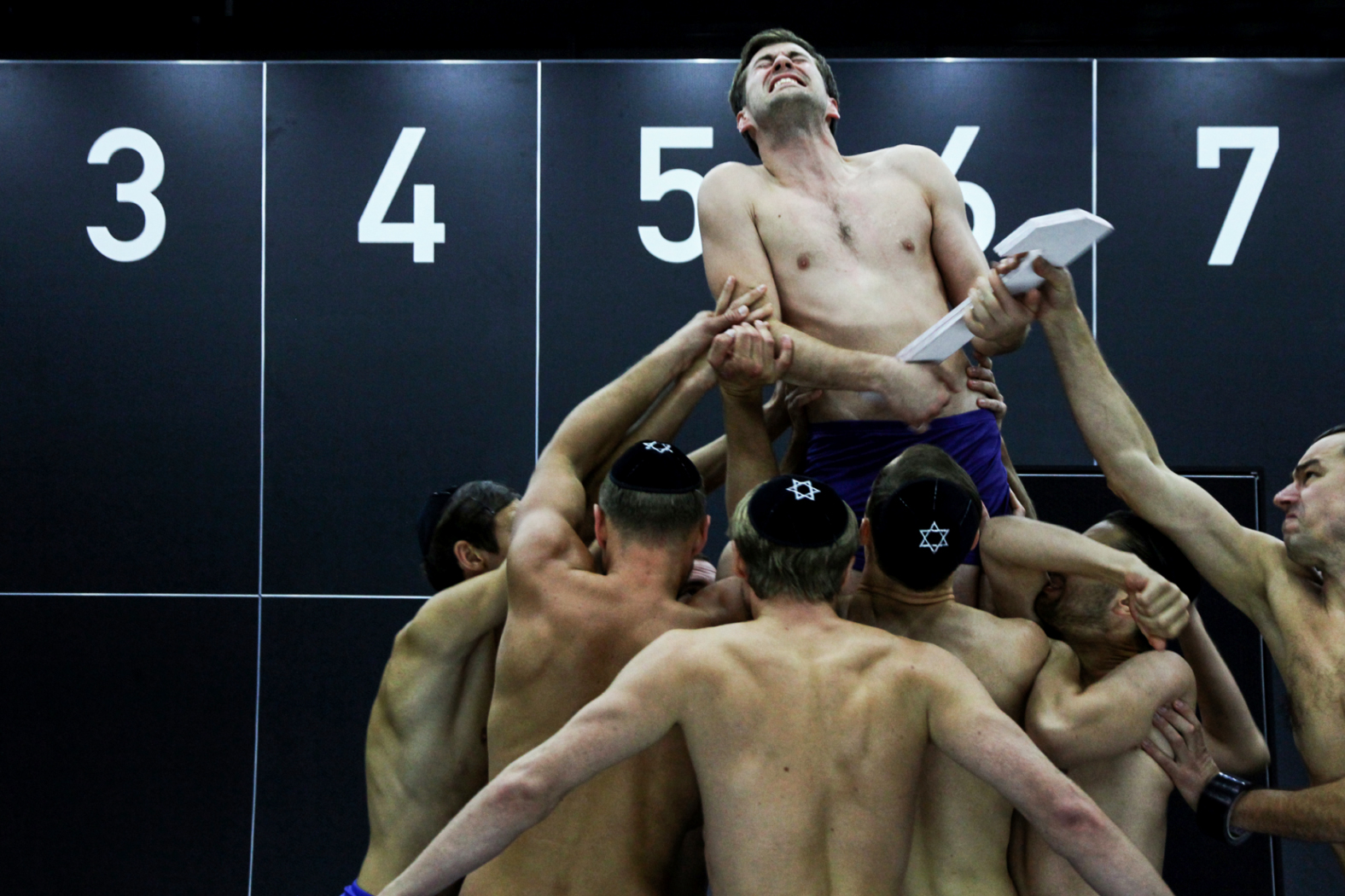 “I can’t say that I was born as an actor exactly when I played Jāzeps. But now, with a clear conscience, I can say – yes, I am an actor and I play in the theater,” emphasizes Aksels Aizkalns. In the photo – a scene from director Ineses Mičules’s production of Jāzeps un viņa brāļi (Joseph and His Brothers). Photo – Krista Vindberga
You wanted to be both an archaeologist and a pilot. Can you combine those two dreams in your current profession as an actor in the theater?
“I would like to fly more often, but there have been flights when you fly in a role. Yes, you could compare the actor’s work to archeology, because you dust off the past until you find something for the role.”
You are a class of actors who had the privilege of entering the theater together. How is it to work with classmates now, professionally, on a creative wavelength, and in a renovated and comfortable theater? How do you feel the shoulder of your classmates?
“It’s a gift and a curse at the same time. (Laughs.) Sometimes it feels like you know everyone so well that everything seems stale. But it’s a huge gift. It’s important how you tune yourself in. How you come to work, how you wipe your feet, how you understand that we are all people and everyone has their bad days… I hope there won’t be a day when I say that I hate everything and why I chose this at all. I am extremely grateful to Indra Roga and Mihails Gruzdovs for giving me so many close people, basically – another family. And not just the class. We have blended very well with the troupe of the Valmiera Drama Theater. Everything is frighteningly good.”
Grab tickets for the remaining performances of the season in a few moments. Shouldn’t you be careful not to let it go to your head, so to speak?
“That’s something everyone is responsible for, isn’t it? I attempt to preserve myself quite grounded. It’s nice, in a way, it’s also a merit of marketing and the theater. The fact that people want to see us. That’s a huge compliment and means we’re doing something right. What keeps you grounded is the thought that any actor without an audience is a real weirdo.”
Which role would you most like your teacher Mihails Gruzdovs to have seen?
“I have a feeling he’s seen them all anyway. It’s a strange feeling. When you think about it, it seems like he’s always somewhere nearby. I would definitely like to hear his feedback on Jāzeps. I think he would tell me very precisely – here, that’s how it is, not like this! If there was such an opportunity, I would like to hear some word about any role… It doesn’t matter, as long as we could talk after the performance. Yes, I miss Gruža…”
You called him – Gruzis?
“Yes, and not because of dust or grit.”
