
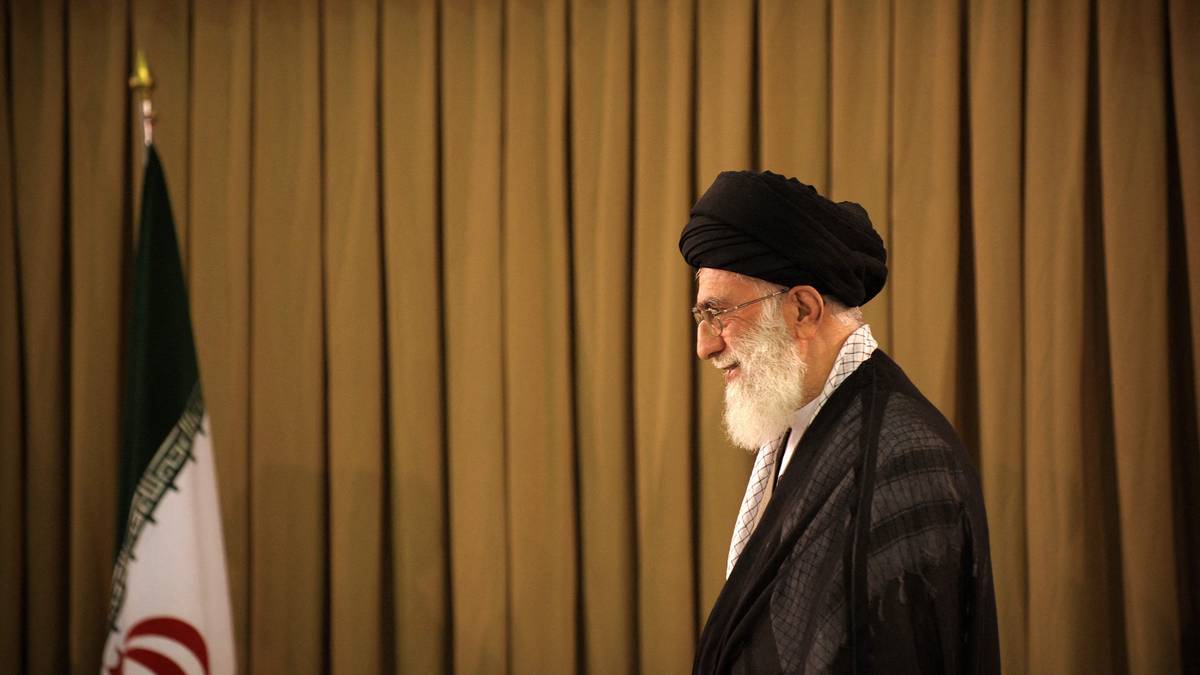
Ali Khamenei, the 86-year-aged Supreme Leader of Iran, has died, Iranian state television confirmed early Sunday, March 1, 2026. The announcement marks the end of a 36-year reign characterized by both staunch conservatism and pragmatic governance, and comes amid heightened regional tensions following reported attacks on Iranian soil.
Khamenei was described as an uncompromising politician who defended the principles of the Iranian Revolution. He reportedly remained at his office in Tehran in the morning hours on Saturday, February 29, 2026, before being killed in attacks attributed to the United States and Israel.
According to early reports, Khamenei’s daughter, grandson, daughter-in-law, and son-in-law were also killed in the same attacks on Saturday. Iran has declared 40 days of national mourning.
“A historic epoch in Iranian history is over,” historian Eirik Kvindesland told NRK.
Khamenei vinker til folkemengden under fredagsbønnen i juli 1989, noen dager etter at Ruhollah Khomeini døde. En automatvåpen er synlig like ved mikrofonene.
Khamenei assumed the position of Iran’s Supreme Leader 36 years ago, in 1989, following the death of Ruhollah Khomeini, considered the father of the Iranian Revolution. He inherited a challenging period and was tasked with solidifying the new Islamic Republic.
“Khamenei had huge shoes to fill,” said Kvindesland.
He is a postdoctoral fellow at the Austrian Academy of Sciences’ Institute for Iranian Studies. The historian noted that Khamenei was instrumental in transforming Iran into a functioning state after the 1979 revolution.
“Although he is seen as an Islamist dictator in the West, he was also a reformer,” Kvindesland said.
Prepared Secret List
Recent months have seen Khamenei face the biggest crisis of his 36-year rule, according to Reuters. He has brutally suppressed widespread protests in Iran and resisted U.S. Pressure to relinquish Iran’s ballistic missile program.
The pressure reportedly grew so intense in recent months that Khamenei identified potential successors, compiling a list of three individuals, according to The New York Times.

Ali Khamenei på vei mot et stemmelokale i Teheran. Det var imidlertid aldri folket som valgte Khamenei som sin leder.
Foto: AP
Reported Speech That Never Came
Following hundreds of airstrikes against Iran on Saturday morning by Israel and the United States, it became clear that the countries aimed to

Svart røyk stiger opp fra Khameneis kompleks i Irans hovedstad Teheran.
Foto: Pleiades Neo (c) Airbus DS 2026 / Reuters / NTB
Reports from Iran indicated that Khamenei had been moved to a safe location before the attack.
Around 4:00 PM local time on Saturday, Iranian state television station al-Alam announced that Khamenei would address the nation shortly.
Hours passed without a speech, and four hours later, Israeli Prime Minister Benjamin Netanyahu took to the podium.
He stated there were many indications that Khamenei “is no longer with us.”
Later on Saturday, U.S. President Donald Trump wrote on Truth Social that Khamenei, “one of the most evil people in the world,” had died.
Survived Previous Assassination Attempts
Khamenei has survived assassination attempts before.
In 1981, Khamenei was targeted in a bombing while delivering a speech at a mosque in Tehran. A bomb detonated in a tape recorder placed in front of him.
Khamenei was hospitalized for months and lost the use of his right arm.
The assassination attempt helped to strengthen his political position, according to Store norske leksikon. In 1981, Khamenei became President of Iran.

Ali Khamenei da han var president i Iran i 1986, her på et møte i Zimbabwe. I bakgrunnen Yasir Arafat.
Foto: Luc Novovitch / Reuters / NTB
Seven years later, he became Supreme Leader, without holding the highest religious title. In what appeared to be a humble speech the same year, Khamenei said he was merely a simple man.
“I am aware that I am an individual with many flaws. I am, in truth, a simple religious student. But a responsibility has been placed on my shoulders and I will use all my abilities and all my faith in the Almighty to manage to bear this heavy responsibility,” Reuters. But by forming an extensive security apparatus, he secured his power. Five years after becoming Iran’s Supreme Leader, he also obtained the religious title.
Over the years, he has strengthened his own position and marginalized the role of the president and parliament.
In the last 20 years, Khamenei has worked hard to concentrate power in his own hands, says Kvindesland.
“And thus move power away from the democratically elected system in Iran.”

Postdoktor Eirik Kvindesland er ekspert på Iran.
Foto: Privat
“He is also responsible for countless human rights violations and had many Iranian lives on his conscience, both in the recent demonstrations and throughout his time in power,” says Kvindesland.
Khamenei is described as a principled leader, whose authoritarian regimes rest on two principles:
He refuses to implement political and social changes that could diminish his power, and an embittered and hostile attitude towards the U.S., writes The New York Times.
“If you look at it through Western eyes, Khamenei was a Shia Muslim principled leader. If you look at it from the Iranian political system, he was a rather pragmatic power politician. A power politician with a turban,” says Kvindesland.
He points out that Khamenei has made compromises in family and cultural policy and opened up to American investment in Iran.

Khamenei på offisielt statsbesøk i Kina i 1989. Siden den gang har han holdt seg i Iran.
Foto: Edward Nachtrieb / Reuters / NTB
Reportedly Shown Image of Khamenei’s Body
In December, Khamenei said that Iran can stand firm against corrupt, oppressive and arrogant powers.
“He expects to become a martyr,” Vali Nasr told The New York Times a few weeks ago.
On Saturday, it was reported that President Donald Trump and Prime Minister Benjamin Netanyahu were shown an image of Khamenei’s body.

Israels president Benjamin Netanyahu og USAs president Donald Trump.
Foto: AP
Publisert Oppdatert
