
手段
Some products don’t aim to reinvent the wheel, but rather solve a specific problem. In the case of the Amazon Echo Dot, that problem has historically been simple: a great Alexa experience, but lackluster audio. The Amazon Echo Dot Max arrives with a clear goal: maintain the “put it anywhere and forget it” philosophy, but significantly upgrade the sound quality and become a serious digital home hub thanks to its integrated controller (Zigbee, Matter, and Thread border router).
We tested it in a typical setting – background music while working, podcasts, timers, light routines, quick questions, and the usual “Alexa, play…” – and two things immediately stood out: the surprisingly robust sound for its size, and Alexa’s responsiveness, which encourages more frequent use. The rest of this review focuses on living with the device, seeing what it offers, and helping you decide if the extra cost is worthwhile compared to a cheaper Echo.
What is the Echo Dot Max and Why Does It Exist?
Table of Contents
- What is the Echo Dot Max and Why Does It Exist?
- Basic Specs: A Quick Reference
- What’s in the Box and What It Offers
- Setup and Daily Use: Living with It
- Sound Quality: Why It’s a Step Up (and Where It Has Limits)
- Real-World Testing: Making a Decision
- Alexa: Speed That Encourages More Use
- A Simplified Smart Home Experience: The “Max” Difference
- Connectivity: What Matters If You Have a Wi-Fi-Packed Home
- Multiroom and TV Integration: Extras That Add Value If You’re Already in the Amazon Ecosystem
- Privacy
- Small Details That Enhance the Experience
- Which to Choose Based on Your Use Case?
- Price and Purchase
- Frequently Asked Questions
- Conclusions and Verdict
- It’s a compact smart speaker with Alexa.
- It’s designed to sound better than a standard Dot, thanks to a more serious speaker configuration: a tweeter + woofer (highs + lows, to put it simply).
- It also incorporates a digital home hub to connect compatible devices without needing an additional bridge.
- And it includes sensors (temperature, light, presence) for automated routines without constant voice commands.
Basic Specs: A Quick Reference
What’s in the Box and What It Offers
Setup and Daily Use: Living with It
Installation: Straightforward and Familiar
Plug it in, use the Alexa app to connect it to your network, and you’re done. If you already have an Amazon account and other Echo devices, it recognizes everything and gets up and running quickly.
Design and Controls: Discreet and Practical
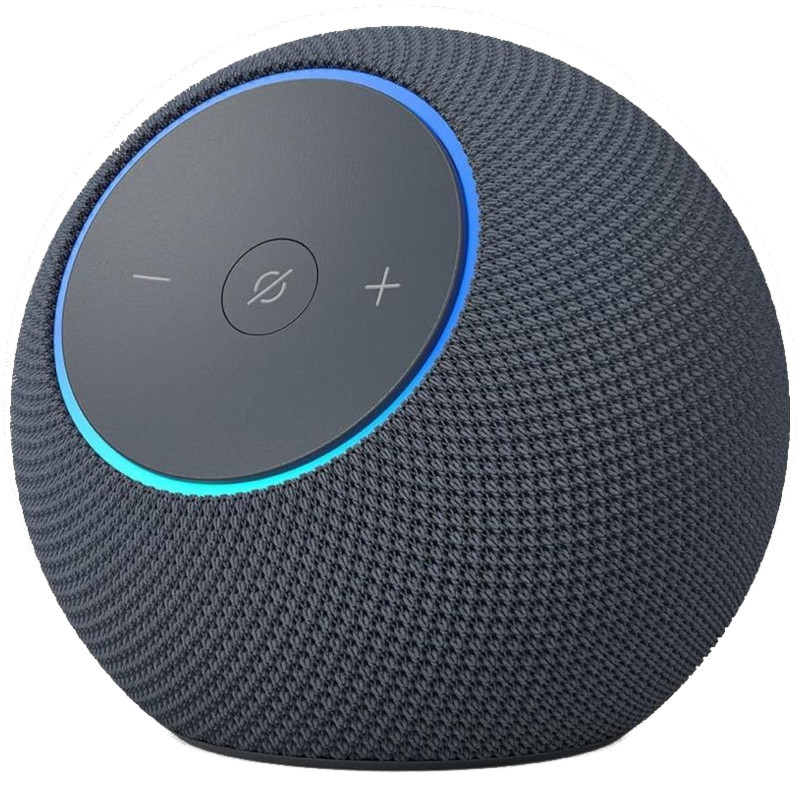
The device is a fabric-covered sphere that blends well into most spaces – bedside table, bookshelf, desk, kitchen… The top features volume buttons and a mute button (to disable the microphones). That mute button might seem minor, but it’s a valuable privacy feature, especially in a home office or bedroom.
Echo Dot Max
The light ring also serves a purpose beyond aesthetics – it visually indicates when the device is listening and responding.
Where It Fits Best in Your Home
The ideal location depends on your needs. Based on size and performance, the Dot Max is particularly well-suited for these areas:
Sound Quality: Why It’s a Step Up (and Where It Has Limits)
If you’re upgrading from an older Echo Dot, the difference is noticeable. It doesn’t turn your room into a concert hall, but it no longer sounds like a small speaker struggling to perform.
What you’ll notice in everyday use
- Clearer Vocals: Podcasts, radio, videos – spoken content is easier to understand without cranking up the volume.
- Richer Music: The bass is more present, without needing to max out the volume.
- More Room-Filling Sound: At moderate volumes, it provides a more immersive listening experience.
Amazon highlights a significant improvement in bass response compared to other Dot models. In practice, the result is simple: yes, there’s more low-end punch and it’s more enjoyable.
Real-World Testing: Making a Decision
We didn’t run lab tests; we used it as you would. Here are the scenarios that best illustrate the device’s strengths:
Music While Working (Medium Volume)
This is where the Dot Max shines. It provides pleasant background music without requiring you to constantly adjust the volume to “feel” it.
Podcasts or Radio (Spoken Word)
The Dot Max handles voice content well – it’s clear and easy to understand without being overly loud. This is particularly useful in the kitchen or while multitasking.
Music with Bass
It’s not a subwoofer, but it does have a noticeable low-end presence that’s missing in more basic models.
Amazon claims “three times more powerful bass” compared to the Echo Dot (2022 model). That’s marketing speak, but it aligns with the real-world experience: the Max has more muscle and it shows.
Important Clarification: It’s Mono
It’s important to be aware that the Dot Max doesn’t offer true stereo sound out of the box. While the sense of spaciousness is good, it’s mono. If stereo is a priority, pairing two units is the way to go. For everyday music and smart home control, one unit is sufficient.
Alexa: Speed That Encourages More Use
Alexa responds quickly. The Echo Dot Max is equipped with an AZ3 processor with AI acceleration, and in practice, this translates to:
- Fewer repetitions
- Routines that execute instantly
- Chained questions without lag
- More immediate control of lights and plugs.
A Simplified Smart Home Experience: The “Max” Difference
While sound quality is a key feature, the smart home integration is what justifies the higher price tag.
What It Includes Exactly
The Amazon Echo Dot Max integrates a digital home hub: Zigbee, Matter, and Thread border router. This means you can connect and control many compatible devices (bulbs, plugs, sensors, locks…) without purchasing an additional hub.
What Does This Mean in the Real World?
Primarily, three things:
- Less clutter and complexity: If you’re getting into home automation, it’s easy to end up with “the bulb bridge,” “the hub for the sensor,” “the app from the brand…” The goal here is to simplify.
- Routines that don’t rely on voice commands: Voice control is good, but what you really want is a home that anticipates your needs.
- A system that can grow: You start with two lights and a plug, and a month later you’re thinking, “and now the hallway…”

Echo Dot Max
Omnisense Sensors: The Ones You’ll Actually Use
Amazon highlights temperature, light, and presence sensors. When used effectively, this enables very practical routines:
Connectivity: What Matters If You Have a Wi-Fi-Packed Home
The Dot Max includes Wi-Fi 6E and Bluetooth Low Energy 5.3. If your home has many connected devices (phones, laptops, TVs, vacuums, smart plugs…), modern connectivity typically translates to fewer issues and greater stability.
Amazon also details Bluetooth compatibility for streaming and control (A2DP/AVRCP), with typical limitations (e.g., compatibility issues with certain speakers or systems).
Multiroom and TV Integration: Extras That Add Value If You’re Already in the Amazon Ecosystem
If you already have other Echo devices, setting up music in multiple rooms (multiroom) is easy. And if you have a compatible Fire TV, there are options to link speakers and improve the TV’s audio simply.
We wouldn’t recommend buying it solely for these features, but if you’re already invested in Amazon’s ecosystem, it’s a bonus.
Privacy
This is important for any smart speaker.
- Physical button to turn off microphones (direct control).
- Options to review and delete voice recordings from the settings/privacy portal.
- Guaranteed security updates for at least four years.
Small Details That Enhance the Experience
Where to Place It for Optimal Sound
Three quick rules that make a difference:
- Don’t box it in between books or inside a closed cabinet.
- Corners with caution: they can provide more bass, but sometimes make it sound “boomy.”
- Give it some air: on a shelf or desk, having some space around it usually works best.
These are simple tips, but they make a difference with compact speakers.
Which to Choose Based on Your Use Case?
Price and Purchase
As of the lead-up to the holidays, you can purchase the Echo Dot Max for $87.99 (originally $109.99). The price dictates our recommendation:
- If you want it for sound + smart home integration, it’s a reasonable purchase when on sale.
- If you just want basic Alexa functionality, a cheaper Echo Dot or Echo Pop is usually a better value.
Frequently Asked Questions
What’s in the box?
Echo Dot Max (2025 model), 22W power adapter, and quick start guide.
Is it stereo?
No, it reproduces mono bidirectional audio. For true stereo, the idea is to pair two identical units.
Does it work as a smart home hub without buying anything else?
It integrates Zigbee, Matter, and Thread border router, so you can connect and control many compatible devices without an additional hub.
What sensors does it include?
Ambient temperature sensor, ambient light sensor, and presence detection (in addition to an accelerometer).
Is Alexa faster than on other Echo devices?
In everyday use, it feels very agile and the device features an AZ3 processor with AI acceleration.
How long will it receive security updates?
Amazon indicates at least four years after it’s discontinued.
What music services can I use?
The product description mentions popular services such as Amazon Music, Apple Music, and Spotify (among others).
Conclusions and Verdict
The Amazon Echo Dot Max is the Dot that moves beyond being “just for Alexa” and becomes a compact speaker that you’ll actually want to use for music. It sounds surprisingly good for its size, Alexa is incredibly responsive, and the integrated smart home hub simplifies connected home setup. It’s a particularly good value when on sale and if you plan to take advantage of the sound and smart home features.
Quick Verdict
- We recommend it if you listen to music daily and want Alexa as your primary assistant, or if you’re interested in smart home automation and want to get started without extra hubs.
- It’s not the best purchase if you only want an Alexa for alarms, time, and a few basic commands: a cheaper Echo will do almost as much for less.
The Best / The Worst
The Best
- Sound quality is significantly better than expected for its size.
- Alexa feels fast and daily use is smoother.
- Integrated smart home hub + sensors: automations that are actually useful.
The Worst
- Price: it’s a much better deal when on sale.
- It’s not stereo out of the box: if you’re a serious music listener, a significant upgrade comes with two units.
- If you’re not going to use smart home features, part of the value is lost.
For Whom / Not For Whom
For Whom
- Those who want “real” music in a room without a large speaker.
- Those who want a simple hub for lights/plugs/sensors and automated routines.
- Those who use Alexa a lot and value speed.
Not For Whom
- Those who only want basic Alexa functionality.
- Those who want a large-room sound from a single compact device.
- Those who prefer another ecosystem and don’t want to rely on Alexa.
★ ★ ★ ★
☆
Rating: 8.5/10
It does very well what it promises: it sounds great, Alexa is fast, and it simplifies smart home setup. The only thing holding back the score is the price when it’s not on sale and the fact that you need two units for true stereo sound.
Read More

Read More

Read More

