
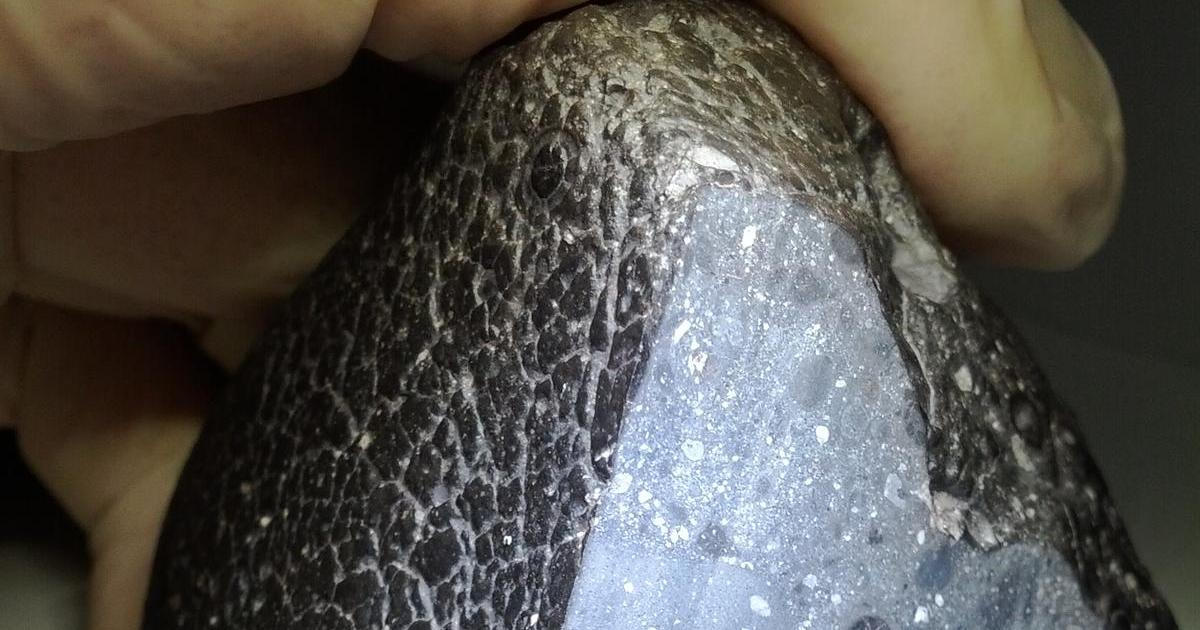
A Martian meteorite discovered in Morocco in 2011 is revealing surprising details about the Red Planet’s potential for past habitability. Officially designated NWA 7034, and nicknamed “Black Beauty” for its dark, coal-like appearance, the rock is estimated to be at least 4.4 to 4.5 billion years old, making it the oldest known Martian meteorite.
Researchers have now mapped the distribution of water within the meteorite using neutron scanning – a technology similar to CT scans, but utilizing neutrons instead of X-rays. This non-destructive technique allows scientists to analyze the sample without damaging it, a significant improvement over previous methods that required removing and destroying slight fragments. The findings, detailed in a preliminary scientific study, indicate that water makes up approximately 0.6% of the meteorite’s mass.
For a roughly 300-gram meteorite, this equates to an amount of water comparable in size to a human fingernail – significantly more than earlier estimates suggested. The ability to map water distribution within a Martian rock without destruction represents a key advancement in planetary science, offering new avenues for understanding the potential for past life on Mars.
Most of the water is contained within tiny fragments of iron oxyhydroxides, which form when iron reacts with water under high pressure, such as during a meteorite impact. “The distribution and character of hydrated minerals are crucial to understanding the habitability of Mars, its climatic and geological evolution, and potential traces of ancient life,” researchers stated. “That is why identifying hydrogen-containing phases in the Martian crust is extremely critical.”
The discovery aligns with a growing body of evidence suggesting that Mars was once a much wetter planet, potentially with oceans and flowing water similar to Earth. While much of that water has since disappeared, some remains in the form of ice beneath the surface, in mountainous regions, or in extensive subsurface reservoirs.
Interestingly, the iron oxyhydroxides found in “Black Beauty” are similar to those discovered by the Perseverance rover in Jezero Crater, suggesting that similar water reservoirs may have been common on early Mars, even near the surface.
The meteorite’s significance is further amplified by NASA’s recent cancellation of a planned mission to bring Martian samples back to Earth. Meteorites like NWA 7034, which arrive on our planet naturally, remain the only way to directly study Martian rocks and water. According to scientists, “Black Beauty” could play a key role in understanding when and how Mars lost its water – and whether life could have once existed there.
Sources: Cornell University, Phys.org, LiveScience, Universe Today
