
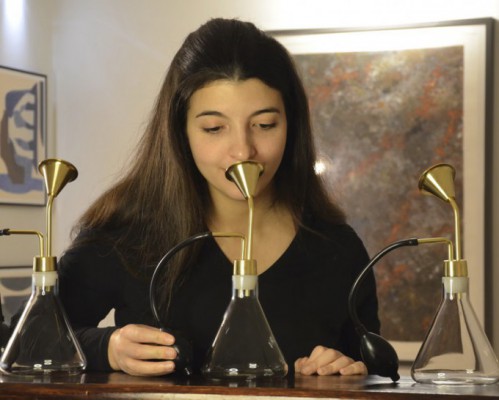
A scent landscape experience device to be exhibited at UCL’s 200th-anniversary exhibition, ‘London Intersections.’ Provided by Smellscapes
A growing field of “olfactory archaeology” is bringing the past to life by recreating historical scents. This emerging area leverages advances in biochemical technology to identify and reproduce aromas from ancient artifacts, offering a new dimension to historical understanding.
On February 28, 2026, the British newspaper The Guardian reported that a team led by Dr. Barbara Huber, a postdoctoral researcher in archaeochemistry at the Max Planck Institute for the Science of Human History, successfully chemically analyzed residue from ancient Egyptian embalming materials dating back to around 1450 BC, recreating lost fragrances. Dr. Huber described the recreated scent as a “time machine for the nose.”
For over a decade, archaeologists have been increasingly focused on “sensory archaeology,” which aims to reconstruct not just the appearance of artifacts, but also the tactile sensations, sounds, and smells of past environments. This shift moves beyond a visually-centered approach to encompass the full sensory world experienced by people in the past. Recent advancements in biochemical analysis of organic residues have led to the rise of “olfactory archaeology” as a distinct research field, capable of identifying and recreating scents from ancient materials.
The research team identified a variety of aromatic compounds in the residue from the Canopus jars, including crystalline compounds of coumarin – with notes of beeswax, pine resin, and vanilla. They then collaborated with perfumers to reconstruct the fragrance, ensuring both chemical accuracy and safety for public exposure. The recreated scent is described as a warm, honey-like aroma with subtle hints of earthy spices.
An exhibition in Denmark featuring ancient Egypt displayed scent cards and ceramic vessels containing scent cartridges, allowing visitors to experience the recreated aromas firsthand. The scent cards were also distributed to elementary and middle school students learning about ancient civilizations and will be used in a Canadian exhibition starting in June.
“It can make history experience remarkably real,” said Dr. Huber. “The past wasn’t sterile, or quiet. It was a sensory, vivid, and sometimes intense world.”
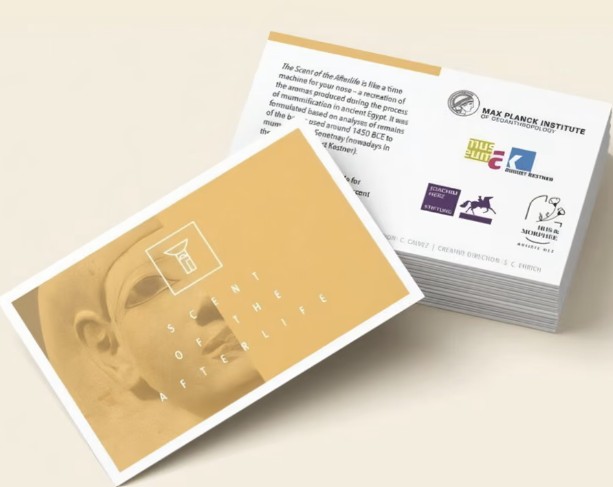
Scent cards from the ‘Scents of the Afterlife’ project. SC Ehrich, C Calvez, CE Loeben, U Dubiel, S Terp Laursen, B Huber provided
This isn’t the first attempt to recreate ancient smells. The Jorvik Viking Centre in York, England, has been recreating the scent landscape of a Viking-era city since the 1980s. Liam Findlay of AromaPrime has even recreated the breath of a Tyrannosaurus Rex, based on fossil evidence and consultation with paleontologists.
However, recent approaches differ from earlier experiential recreations by relying on chemical analysis, literature research, and interdisciplinary collaboration.
“Jorvik was pioneering, but it was largely experiential, entertainment, or about startling visitors,” Dr. Huber explained. “Today, scent in museums is shifting from theatrical staging to research-based storytelling.”
A team led by Dr. Cecilia Bembibre, a researcher at the University College London (UCL) Institute for Sustainable Heritage, plans to unveil the scents of St. Paul’s Cathedral library and Queen Elizabeth II’s Rover P5B vehicle at ‘London Intersections,’ a UCL 200th-anniversary exhibition beginning on March 26, 2026. The scent of the Queen’s vehicle was recreated through a combination of historical research, chemical analysis of the vehicle’s interior air, and interviews with classic car collectors.
“Heritage interpretation remains visually driven, but using smell as a tool for understanding can raise new questions about how we look at the past and uncover overlooked facets of our heritage,” said Dr. Bembibre.
Dr. Huber is currently embarking on a new project to recreate the scents of various regions of the Roman Empire.
Copyright Ⓒ 동아사이언스. All rights reserved. 무단 전재, 재배포 및 AI학습 이용 금지
