
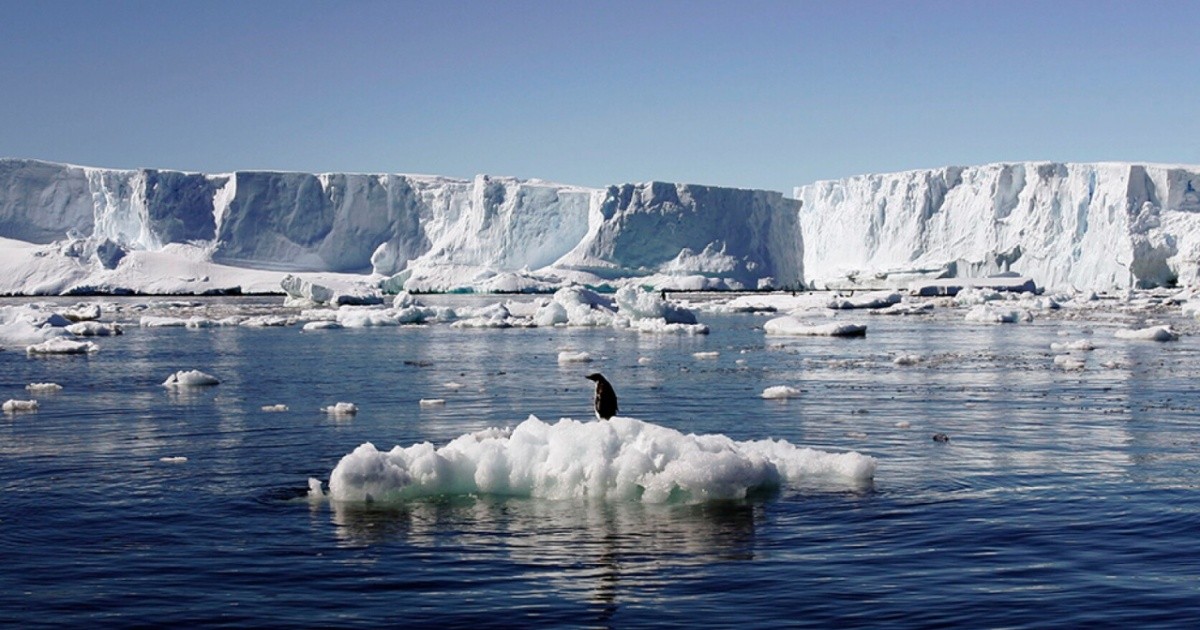
Scientists have pinpointed the cause of a massive “gravity hole” in the Ross Sea, Antarctica, where sea levels are approximately 418 feet (128 meters) lower than the global average.
The Antarctic Geoid Low (AGL), a region of weaker gravity, has long been known to exist, but its origins remained a mystery until now. Researchers have determined the AGL is the result of incredibly slow movements of rock occurring over millions of years.
Approximately 70 million years ago, less dense rock accumulated beneath the Antarctic continent, weakening the force of gravity. The gravity anomaly initially began as a little depression and rapidly increased in strength between 50 and 30 million years ago.
Glišović and Forte (2025) reconstruct the Cenozoic evolution of the Antarctic Geoid Low and indicate that its rapid mid-Cenozoic reorganization provides evidence for an episode of True Polar Wander. Their models indicate that although a geoid depression persisted near Antarctica for… pic.twitter.com/pUEpQW2F0P— Tami Camarata (@Kitsune_in_VA) December 21, 2025
According to reporting from the British publication Daily Mail, the research team combined seismic recordings from around the world with a computer model of the planet to map how the AGL formed. By analyzing how seismic waves travel through varying rock densities, they were able to construct a map of the planet’s internal structure.
Understanding the origin of the AGL could provide valuable insights into how Earth’s interior shapes gravity and sea levels, potentially impacting the growth and stability of large ice sheets. Researchers are now working to establish a causal link between the gravity hole and ice sheet development through novel mathematical climate models. This research highlights the complex interplay between geological forces and climate systems.
The Antarctic Geoid Low isn’t the only massive gravitational anomaly on Earth. The “Indian Ocean Geoid Low” similarly exhibits a weak gravitational pull, causing water levels to drop 340 feet (103 meters) below the surrounding areas.
