

Daftar Isi
Jakarta –
Apple unveiled its latest silicon, the M5 Pro and M5 Max chips, on March 3, 2026, powering a new generation of MacBook Pro laptops. The company positions these chips as the most advanced available for professional laptops, with significant advancements in AI performance, graphics capabilities, and power efficiency.
A core innovation behind the new chips is the “Fusion Architecture,” which combines two third-generation 3nm dies into a single system on a chip (SoC) using advanced packaging techniques. This approach aims to deliver substantial performance gains while maintaining Apple’s focus on energy efficiency.
The chips integrate an 18-core CPU, a next-generation GPU with Neural Accelerators, a new Media Engine, a faster 16-core Neural Engine, a unified memory controller, and Thunderbolt 5 support. This integration is designed to dramatically boost performance without sacrificing power efficiency – a hallmark of Apple silicon.
SCROLL TO CONTINUE WITH CONTENT
“M5 Pro and M5 Max represent a major leap forward for Apple silicon, leveraging our new Fusion Architecture to scale Apple silicon while maintaining our core principles of integration, power efficiency, and unified memory,” said Johny Srouji, Senior Vice President, Hardware Technologies at Apple.
“These chips underscore our relentless pace of innovation, through the integration of the world’s fastest CPU, next-generation GPU with Neural Accelerator, faster Neural Engine, and high-bandwidth unified memory architecture – delivering an unparalleled blend of performance, efficiency, and incredible AI capabilities on the MacBook Pro.”
|
M5 Pro and M5 Max are designed to simplify processing large datasets in applications like MATLAB. Photo: Apple
|
M5 Pro
The M5 Pro is targeted towards professionals including data modelers, sound designers, and STEM students. It combines an 18-core CPU with a next-generation GPU featuring up to 20 cores, each equipped with a Neural Accelerator.
At the heart of the M5 Pro is a new 18-core CPU configuration with six “super cores” and 12 new “performance cores.” The super cores are claimed to be the fastest single-threaded CPU cores in the world, thanks to increased front-end bandwidth, a new cache hierarchy, and enhanced branch prediction. The combination of core types delivers a significant performance boost for multithreaded tasks.
The chip supports up to 64GB of unified memory with a bandwidth of 307GB/s. For AI performance, peak GPU compute reaches 4x that of the M4 Pro and 6x that of the M1 Pro. Graphics performance is also improved by 20% thanks to enhanced shader cores with second-generation dynamic caching, and ray tracing applications see up to a 35% graphics boost compared to the M4 Pro.
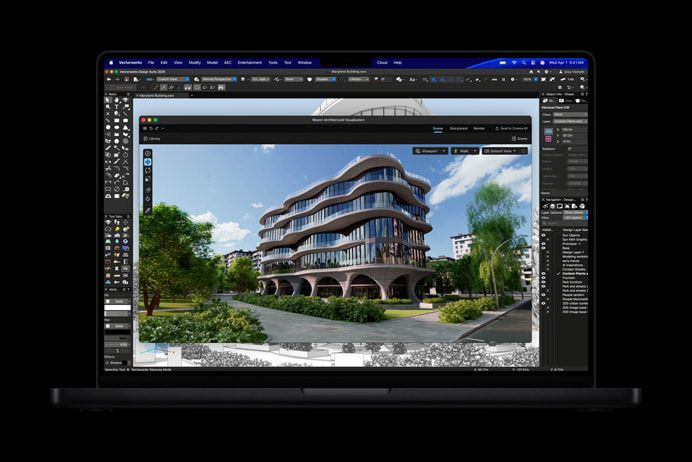 With the third-generation Apple ray-tracing engine in the M5 Pro and M5 Max, users experience up to 35% graphics improvements compared to the previous generation when rendering complex 3D designs with incredible detail. Photo: Apple With the third-generation Apple ray-tracing engine in the M5 Pro and M5 Max, users experience up to 35% graphics improvements compared to the previous generation when rendering complex 3D designs with incredible detail. Photo: Apple |
M5 Max
For users with extreme needs, such as 3D animators, application developers, and AI researchers, the M5 Max offers a step up. It doubles the GPU core count of the M5 Pro to up to 40 cores, paired with the same 18-core CPU.
Its key advantage lies in support for up to 128GB of unified memory with a staggering 614GB/s of bandwidth. This enables users to work with complex 3D scenes, massive datasets, and token generation for Large Language Models (LLMs) at incredible speeds.
CPU performance offers up to a 15% increase for multithreaded workloads compared to the M4 Max. For AI performance, the M5 Max achieves 6x the performance of the M1 Max. Graphics performance is also 20% faster than the M4 Max, and ray tracing applications see a performance jump of up to 30%.
Both chips also feature a faster 16-core Neural Engine, a new Media Engine with hardware-accelerated AV1 decode support, and Memory Integrity Enforcement security features. Notably, the MacBook Pro with these chips will be the first devices in the industry to implement the most capable Thunderbolt 5, thanks to a custom-designed controller within the chip.
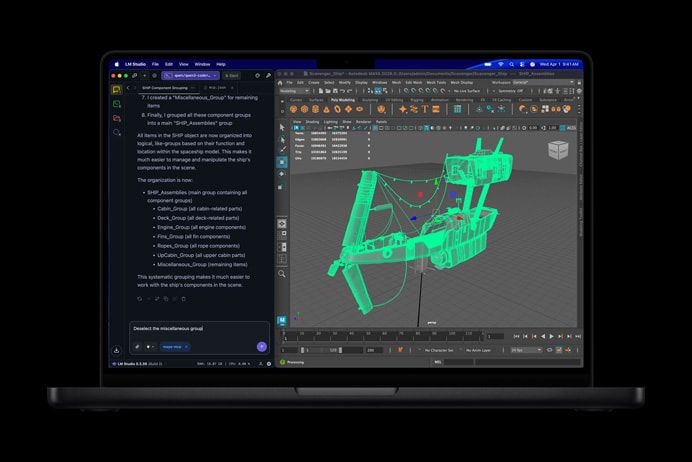 M5 Pro and M5 Max maximize the full potential of LLMs in LM Studio. Photo: Apple M5 Pro and M5 Max maximize the full potential of LLMs in LM Studio. Photo: Apple |
Considering the specifications, the M5 Pro and M5 Max represent more than just incremental updates. Apple is aggressively reinforcing the MacBook Pro’s position as a mobile workstation for the age of AI. The new chips promise not only speed but also intelligence.
The MacBook Pro with M5 Pro and M5 Max is available for pre-order starting March 4, 2026, and will be available in select countries soon.
(afr/afr)
