
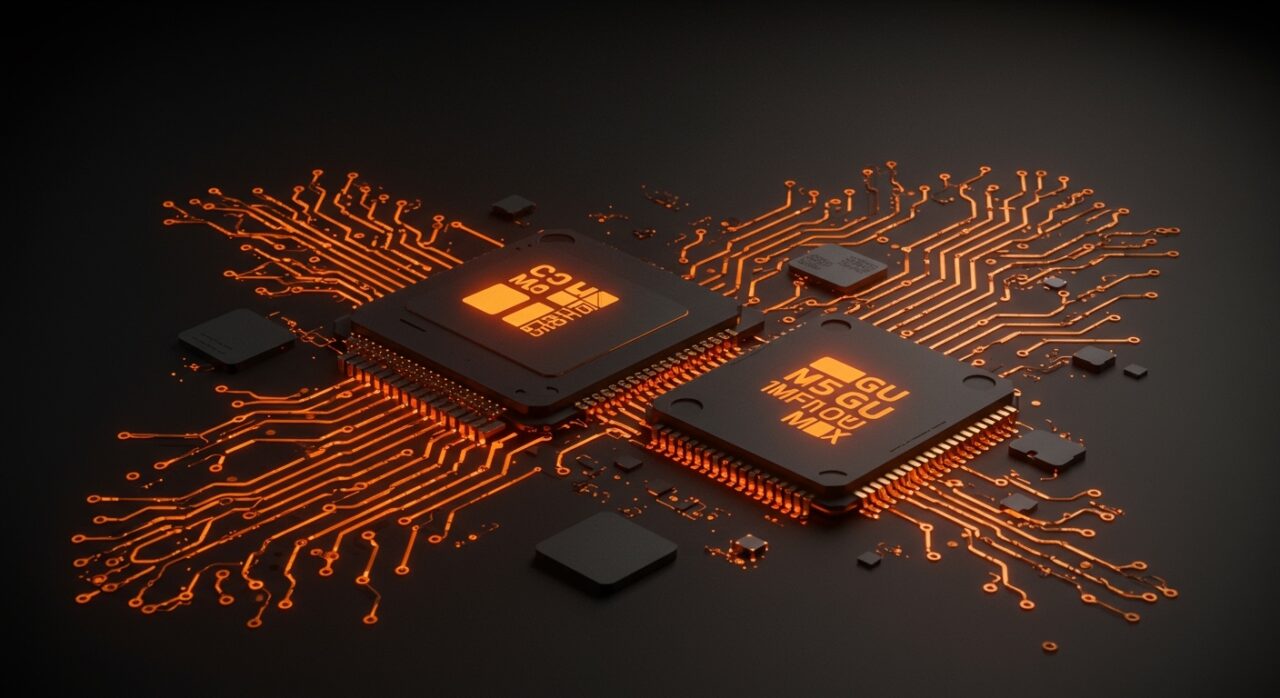
Apple Unveils Next-Generation M5 Pro and M5 Max Chips with Innovative Architecture
Apple has officially introduced its M5 Pro and M5 Max chips, marking a significant leap in performance and efficiency for professionals. A key highlight of this launch is the introduction of the Fusion Architecture, an advanced packaging design that integrates multiple dies into a single, high-performance system on a chip (SoC).
This fresh architecture represents an evolution from traditional InFO packaging toward a 2.5D approach based on SoIC MH (System-on-Integrated-Chips Multi-Height), which allows for superior thermal management and eliminates bottlenecks in demanding tasks like 3D rendering, AI model training, and professional video editing. The advancement underscores Apple’s commitment to pushing the boundaries of silicon design and performance.
Technical Specifications: Power for Professional Workflows
Manufactured by TSMC using third-generation 3-nanometer lithography, the M5 Pro and M5 Max chips offer configurations designed to maximize performance in demanding environments:
Apple M5 Pro
- CPU: 18 cores (12 performance + 6 efficiency)
- GPU: 20 cores with integrated neural accelerators
- Neural Engine: 16 cores dedicated to AI
- Unified Memory: up to 128 GB configurable
- Bandwidth: approximately 273-350 GB/s
- Hardware Acceleration: H.264, HEVC, ProRes, AV1 and ray tracing
Apple M5 Max
- CPU: 18 cores (similar configuration to Pro)
- GPU: up to 32 cores (24 in base configuration)
- Neural Engine: 16 cores
- Unified Memory: up to 128 GB
- Bandwidth: over 300-350 GB/s
- SSD: up to 2x faster than previous generations
Both chips support up to 8 TB of SSD storage, ideal for professionals handling large volumes of data, multimedia projects, or training machine learning models locally.
Fusion Architecture: Redesigning Thermal Efficiency
The Fusion Architecture isn’t merely cosmetic. This technology fuses two dies into a single SoC using 2.5D packaging with SoIC Multi-Height, enabling:
- Increased Heat Dissipation: reducing thermal throttling under sustained loads
- Optimized Parallel Operations: neural accelerators in each GPU core work in conjunction with the Neural Engine
- Extreme Bandwidth: faster data flow between CPU, GPU, and unified memory
This approach positions Apple at the forefront of semiconductor design, raising the bar against competitors like Qualcomm and Intel in the ARM ecosystem.
Performance: How Much Faster Than M4 and M3?
Improvements compared to previous generations are significant, especially for AI and visual processing tasks:
- CPU: up to 20% more multi-core performance vs. M4
- GPU: up to 1.6x faster in professional applications and gaming
- On-device AI: image generation 8x faster, video effects 4x faster (compared to M1 Max)
- SSD: 2x faster speeds, reducing load times in heavy projects
- Bandwidth: 153 GB/s in base M5 vs. Over 300 GB/s in M5 Max
These improvements are particularly relevant for professionals working with local language models, 8K video editing, large code compilation projects, or 3D rendering with ray tracing.
MacBook Pro: The Hardware That Embraces These Chips
The M5 Pro and M5 Max chips power the new MacBook Pro models in 14- and 16-inch sizes, which include:
- Liquid Retina XDR Display: ProMotion 120 Hz, up to 1600 nits in HDR
- Battery Life: up to 24-26 hours
- Connectivity: Thunderbolt 4/5 (up to 40 Gb/s), Wi-Fi 7/6E, Bluetooth 6/5.3, HDMI, MagSafe 3
- Camera: 12MP with Center Stage
- Storage: SSD up to 8 TB
The new MacBook Pros are available starting at 1,829-1,929 euros for the base configuration (M5), with Pro and Max options available at higher prices. The devices are now available on apple.com and authorized retailers.
On-device AI: The Differentiating Value for Startups
One of the most relevant advantages for the startup ecosystem is the ability to run AI locally without relying on cloud services:
- Cost Reduction: eliminates or reduces the use of external APIs (OpenAI, Anthropic, etc.)
- Privacy: sensitive data never leaves the device
- Speed: instant inference without network latency
- Agile Development: training and fine-tuning of models on portable hardware
The integrated neural accelerators in each GPU core, along with the 16-core Neural Engine, allow professionals to experiment with language models, computer vision, and content generation directly on their MacBook Pro.
Analyst Reactions and Market Impact
The industry has received the announcement with optimism, highlighting the focus on thermal efficiency and local AI. Analysts emphasize that the Fusion Architecture and 2.5D/SoIC MH packaging raise the standards in semiconductor design, pressuring competitors to adopt similar approaches.
For startups, this launch democratizes access to high-performance hardware: a MacBook Pro with M5 Pro offers capabilities previously reserved for desktop workstations, in a portable form factor with all-day battery life.
Impact on the Semiconductor Market
The launch reinforces TSMC’s dominance in 3 nm chip manufacturing and pressures ARM manufacturers like Qualcomm and Intel to accelerate their roadmaps. The adoption of 2.5D packaging marks a trend that we are likely to see in future high-complete processors from other manufacturers.
For the Latin American startup ecosystem, this means access to professional tools that level the playing field against competitors in more mature markets. A founder in Mexico City, Buenos Aires, or Bogotá can now train ML models, edit professional content, and develop complex tech products with the same hardware as teams in Silicon Valley.
Conclusion
The Apple M5 Pro and M5 Max chips with Fusion Architecture represent a significant advancement in performance, thermal efficiency, and on-device AI capabilities. For tech founders, this hardware removes barriers: reducing cloud costs, accelerating development workflows, and offering real autonomy to work from anywhere.
The combination of an 18-core CPU, a GPU of up to 32 cores, bandwidth exceeding 300 GB/s, and integrated neural accelerators makes these chips the most competitive option for professionals building scalable tech products. With immediate availability and prices starting at 1,829 euros, Apple consolidates its leadership in the professional segment and reaffirms its commitment to innovation in semiconductors.
Want to delve deeper into how other founders are implementing hardware and AI to scale their startups? Join our Hispanic tech founders community for free.
Sources
- https://techcrunch.com/2026/03/03/apple-unveils-m5-pro-and-m5-max-chips-with-new-fusion-architecture/ (original source)
- https://ecosistemastartup.com/macbook-pro-m5-pro-y-m5-max-ia-on-device-para-founders/
- https://www.elnacional.cat/es/tecnologia/apple-presenta-nuevos-macbook-pro-con-chips-m5-pro-m5-max_1600601_102.html
- https://www.applesfera.com/nuevo-chip-m5-informacion
- https://www.geeknetic.es/Noticia/37502/Apple-prepara-un-cambio-importante-en-el-empaquetado-del-M5-Pro-y-M5-Max-para-que-el-calor-deje-de-ser-el-invitado-pesado.html
- https://support.apple.com/es-es/125405
