
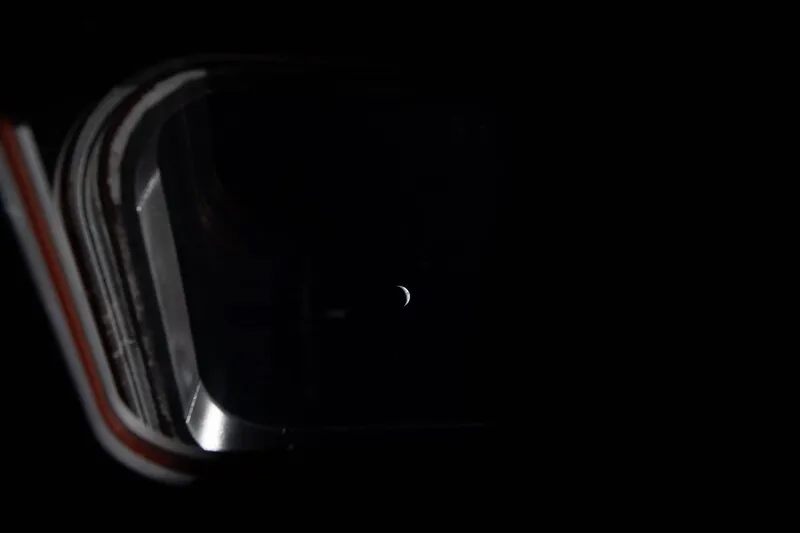
NASA’s Artemis 2 mission is on the verge of a historic milestone as it prepares to navigate the far side of the moon, potentially setting a novel record for the farthest humans have ever traveled from Earth. The crew of four is currently executing a precision “U-turn” maneuver to loop around the lunar far side before beginning their return journey home.
The mission reached a critical juncture on April 6, 2026, with confirmation of the spacecraft entering the moon’s gravitational sphere at 12:41 AM. This transition indicates that the spacecraft is now more strongly influenced by lunar gravity than by Earth’s, signaling the start of the most intense phase of the journey. Following a precision engine burn to refine its trajectory, the crew began active lunar observations at 2:45 AM on April 6, 2026.
The mission’s climax occurs as the spacecraft swings around the lunar far side. At 6:44 PM on April 6, 2026, Artemis 2 will pass behind the moon, resulting in a total communication blackout for approximately 40 minutes. This occurs because the moon’s dense mass acts as a physical barrier, blocking the line-of-sight radio waves required to communicate with ground control on Earth.
During this window, the crew will reach their closest point to the lunar surface—approximately 6,550 km—at 7:02 PM on April 6, 2026. This proximity allows for a six-hour window of high-resolution observation. The crew has identified 30 specific lunar targets for photography and visual study, utilizing advanced imaging technology used for the mission to capture the lunar terrain.
The primary scientific focus of Artemis 2’s approach to the lunar far side is the Orientale Basin. Spanning 930 km in diameter, this basin is one of the largest and most recent impact craters formed during the “Late Heavy Bombardment” period roughly 4 billion years ago. Studying such “lunar scars” provides critical data on the early history of the solar system.
Beyond the scientific data, the mission carries immense symbolic and human value. For the first time in 58 years since the Apollo 8 mission, humans will once again witness an “Earthrise” from the lunar perspective. The crew has already shared recent visual updates from the crew, including video calls describing the spectacular view of Earth as they move further into deep space. This journey follows a series of early sightings of the spacecraft from high-altitude aircraft shortly after its April 1 launch.
This mission represents a pivotal leap in deep-space navigation, testing the endurance of both human crews and communication systems in the most isolated regions of our celestial neighborhood. By successfully navigating the lunar far side, NASA is refining the operational blueprints necessary for future permanent lunar settlements.
