
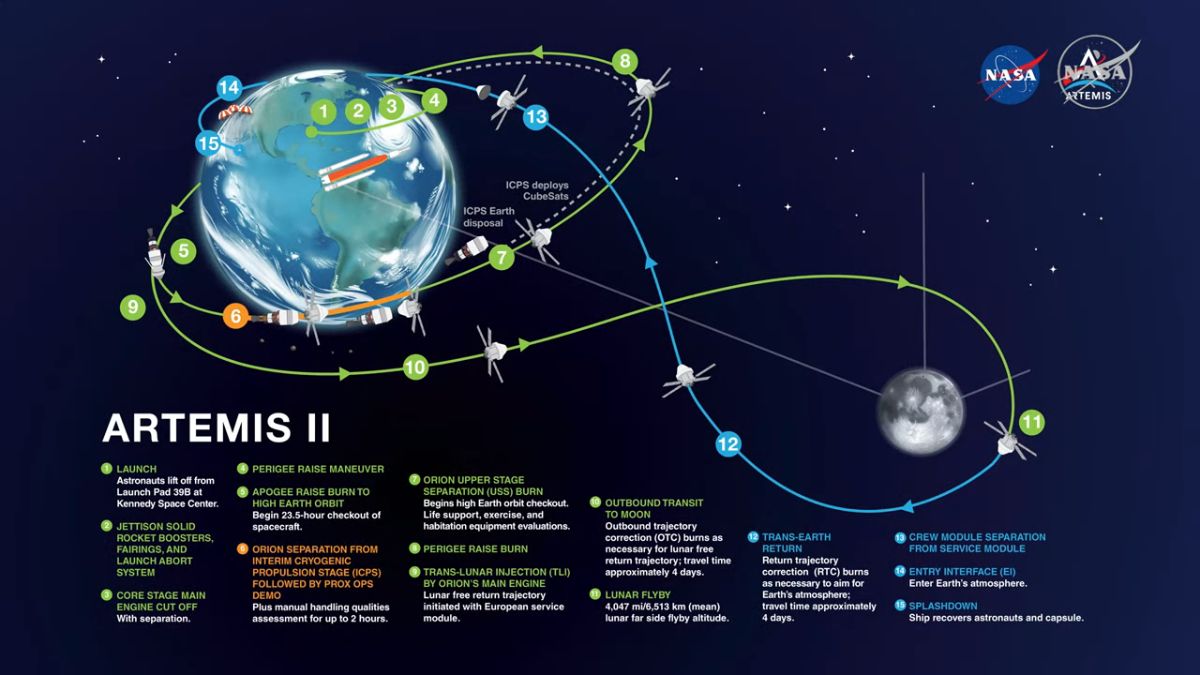
After more than five decades, a crewed mission is once again en route to the Moon. On April 1, 2026, the Artemis II mission departed Earth’s orbit and began its journey to the lunar satellite, marking a pivotal moment in space exploration. This mission represents a significant step towards establishing a sustained human presence beyond Earth, and is being closely followed by the tech and scientific communities.
The Artemis II mission aims to orbit the Moon with a crew of four astronauts – Reid Wiseman, Victor Glover, Christina Koch, and Jeremy Hansen – during a ten-day voyage. This flight serves as a crucial test of the spacecraft and systems that will eventually carry another crew to the lunar surface. The launch was a global event, analyzed by experts and journalists from multiple outlets, including a special program featuring astronauts Pedro Duque and Sara García, as well as reporters from EL PAÍS, Cadena SER, and Huffpost.
Astronaut Sara García, currently in the European Space Agency’s reserve, expressed her excitement about the mission, stating, “I would love to perceive the force of the SLS at the Kennedy Space Center, but I will have to follow it on television from Spain.” García highlighted the awe-inspiring nature of rocket launches, recalling accounts from those who witnessed the Saturn V launches, describing the sensation as if “the ground of the Earth was sinking beneath your feet.”
According to a report in Canarias7, García views Artemis II as “the gateway to a continued human presence beyond Earth orbit.” She emphasized the importance of this mission for her own training as an astronaut and its potential impact on future space endeavors.
The mission included a key maneuver on April 3, 2026, as Orion headed towards the Moon, a moment described by the crew in their first interview from space as “a fairly tense moment.” This successful injection burn is a critical step in the mission’s trajectory. The Artemis II mission is a collaborative effort led by NASA, and signifies a renewed international commitment to lunar exploration.
A special program on Cadena SER featured interviews with astronauts Pedro Duque and Sara García, along with live updates from EL PAÍS’s special correspondent, Nuño Domínguez. The program delved into the details of the mission, its risks, the participants, and the scientific experiments planned for the voyage. This mission builds on the legacy of the Apollo program, which concluded 54 years prior, and represents a new era of lunar exploration.
