
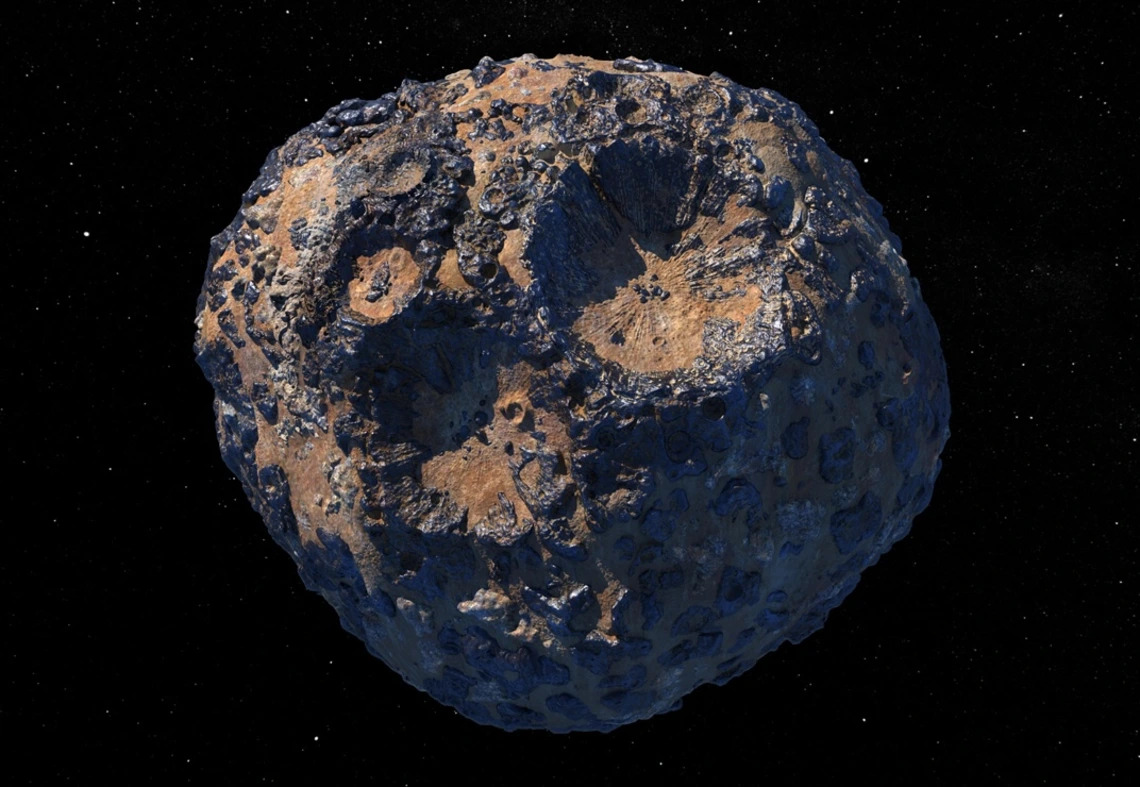
NASA’s Psyche Mission: Unlocking the Secrets of an Exposed Planetary Core
NASA is venturing deep into the solar system to investigate the asteroid Psyche, a mission that could fundamentally rewrite our understanding of how terrestrial planets form and evolve. By studying the asteroid’s unique composition and impact craters, scientists hope to determine if the celestial body is actually the exposed metallic core of a protoplanet.
The quest to uncover these cosmic origins began on October 13, 2023, when the Psyche spacecraft launched from the Kennedy Space Center. The mission utilized a SpaceX Falcon Heavy rocket, marking the first time this specific launch vehicle has delivered a payload into a heliocentric orbit. This partnership underscores the growing reliance on private aerospace innovation to facilitate complex, deep-space trajectories.
At the heart of the mission is the mystery of Psyche’s composition. Whereas some popular rumors have suggested the asteroid is “covered in gold,” scientific data classifies it as an M-type asteroid, meaning We see primarily composed of metal. This distinguishes it from other common asteroid categories, such as S-type asteroids, which consist mainly of silicate rocks and water ice, or C-type asteroids, which are rich in carbon compounds and water ice.
The scientific community is particularly interested in Psyche because it may represent a “planetary fossil.” Most terrestrial planets, including Earth, are structured with a distinct crust, mantle, and a dense metallic core consisting largely of iron and nickel. However, these cores are typically hidden deep beneath the surface. Psyche is believed to be the remnant of a planetary core that had its outer crust and mantle stripped away during the early, violent stages of the solar system’s formation.
To verify this theory, the spacecraft will analyze the asteroid’s surface and impact craters. This approach provides a rare, direct window into the internal processes of planet formation that are otherwise inaccessible on Earth. The mission follows in the footsteps of other significant asteroid explorations, such as JAXA’s Hayabusa, which studied S-type asteroids, and the OSIRIS-REx and Hayabusa2 missions, which targeted C-type asteroids like Bennu and Ryugu.
By analyzing whether Psyche’s impact craters reveal the characteristics of a bare planetary core, NASA aims to solve one of the most enduring questions in planetary science. This effort highlights the continued investment in space exploration to decode the chemical and geological history of our cosmic neighborhood.
