
-
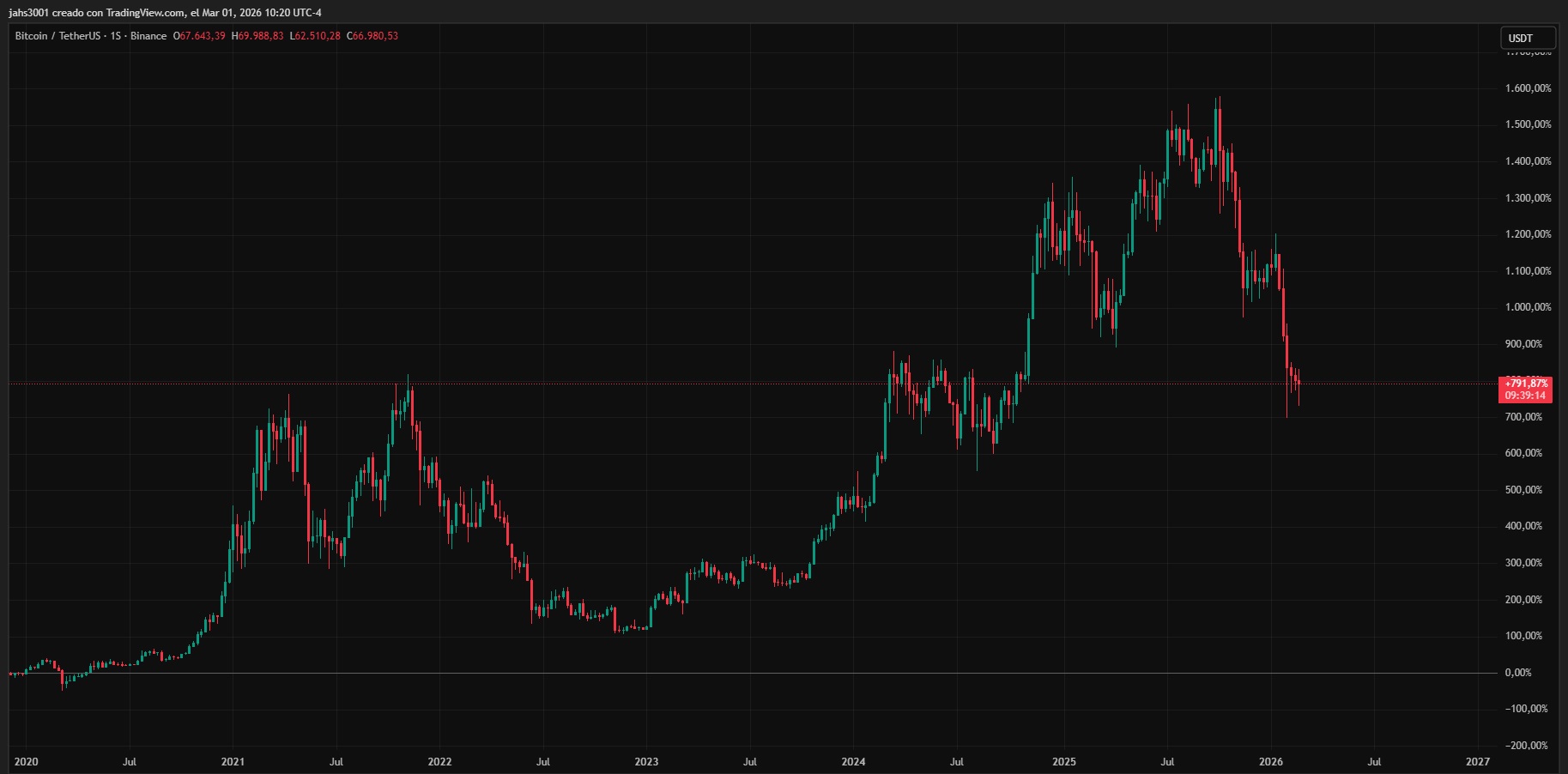
The cryptocurrency has risen 790% since 2020, when the U.S. Designated a high-ranking Iranian official.
-
BTC has proven to be a store of value that has withstood recent historical moments.
Bitcoin (BTC) and digital asset markets are currently in a phase of assessment following the confirmation of the death of Ayatollah Ali Khamenei in Iran. This event, a turning point in the geopolitics of the Middle East, has reignited discussion about BTC’s resilience amid armed conflict. Bitcoin’s performance is being closely watched by investors as a potential indicator of risk sentiment.
Historically, bitcoin has demonstrated an ability to not only survive periods of war, but often to experience significant gains as the traditional financial system shows signs of instability.
According to historical market data, bitcoin tends to strengthen in the months following military conflicts. Since 2020, when the United States designated a high-ranking Iranian official, the digital currency has experienced growth of over 790%, as shown in the graphic below. This has reinforced its narrative as a scarce asset and its decoupling from traditional financial systems controlled by states in the medium and long term, although it may react with short-term downward volatility, particularly when conflicts occur on weekends when traditional markets are closed.
This increase likely reflects a need for individuals to move assets out of conflict zones in a convenient, portable, and, crucially, censorship-resistant manner. This proves important to note, however, that correlation does not necessarily imply causation in market analysis.
Bitcoin price movements are multi-causal and cannot be attributed exclusively to military conflicts. Factors such as the monetary policy of the U.S. Federal Reserve, global liquidity, market cycles, and increasing adoption also play a fundamental role in its valuation.
Bitcoin’s Performance During Conflicts Since 2020
Following the death of Khamenei, the price of BTC experienced volatility. It rose 3% to $68,000 after initial reports of the Iranian leader’s death. The price then decreased to remain above USD $66,000 at the time of writing, according to the CriptoNoticias Price Calculator.
However, the overall trend for BTC has been upward for the past six years, despite ongoing military conflicts.
For example, during the escalation between the United States and Iran in January 2020, following the death of Qasem Soleimani, the price of bitcoin rose from approximately $7,000 to $9,300 in just one month, representing a 34% increase.
This pattern repeated in February 2022 with the Russian military invasion of Ukraine. At that time, the digital currency was trading near $37,000 and, 30 days later, was at $44,000, a bullish increase of 18%.
Subsequently, the outbreak of the conflict between Israel and Hamas in October 2023 showed a similar trend. The digital asset began the period of hostilities around $27,000 and climbed to $35,000 in one month, a 32% increase.
Even in more recent events, such as the 12-Day War between Iran and Israel in early 2025, the price of BTC rose from $108,000 to $119,000, maintaining an appreciation of 10% despite the magnitude of the crisis.
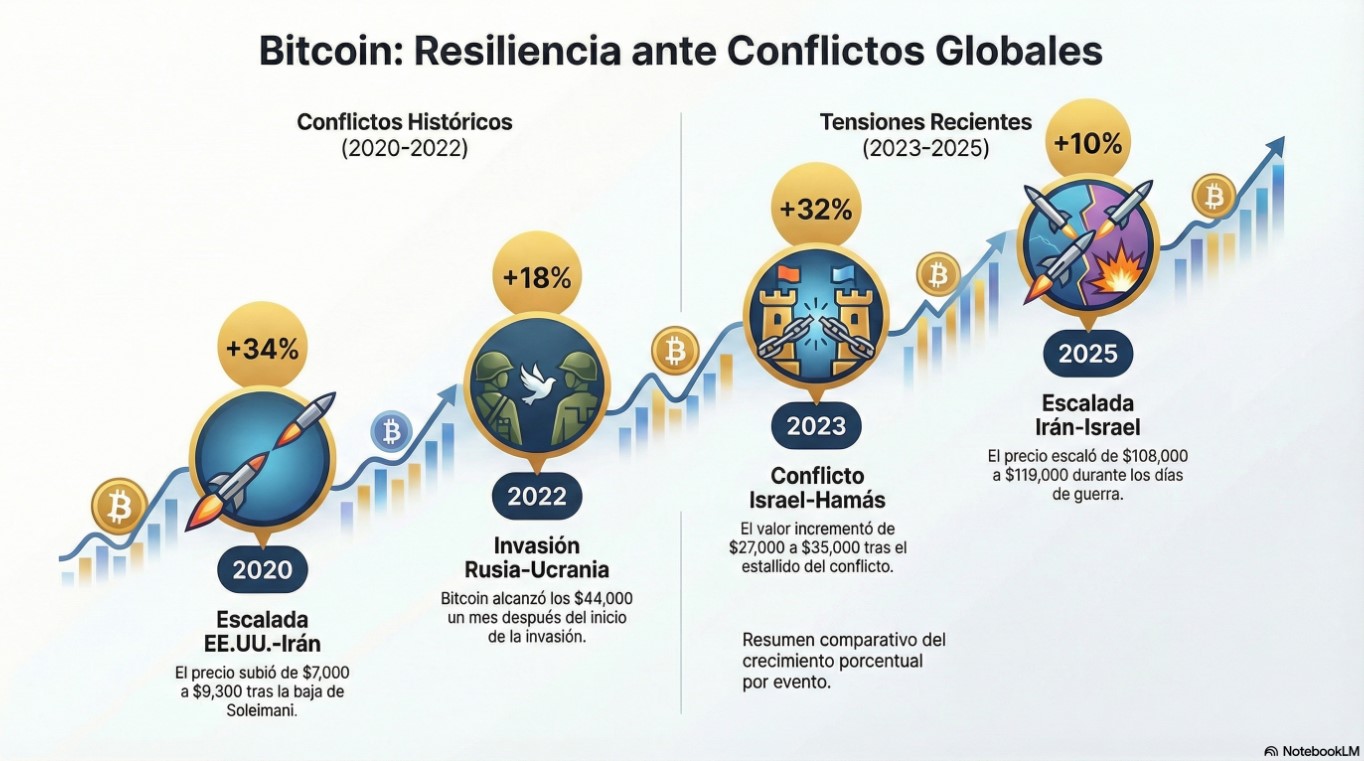
These figures suggest that, far from collapsing, bitcoin is increasingly perceived by the market as a tool for preserving wealth when national currencies are threatened by political instability. The recent events underscore the growing role of digital assets in a volatile global landscape.
, regardless of who holds power in conflict nations, the Bitcoin protocol remains unchanged, offering mathematical certainty in a world of geopolitical uncertainty.
