
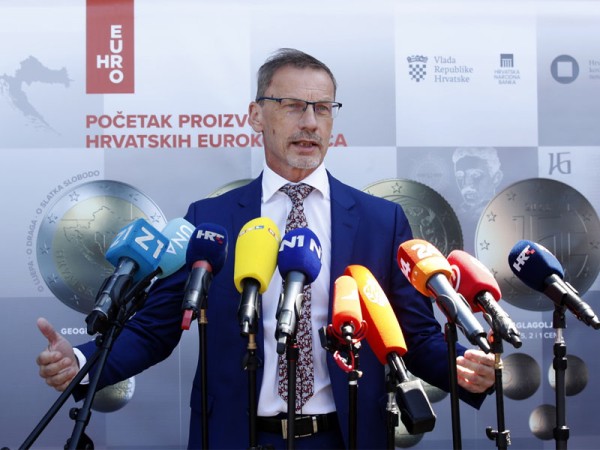
Brussels – Eurozone finance ministers have endorsed Croatian National Bank Governor Boris Vujčić as the next Vice President of the European central Bank (ECB), a key appointment as the institution navigates a period of economic uncertainty and leadership transition[[1]]. Vujčić is slated to succeed Luis de Guindos when his term expires in May, pending approval from the European Council, Parliament, and the ECB’s Governing Council.The choice signals continued emphasis on integrating new member states-Croatia adopted the euro in 2023-amid broader upcoming changes to the ECB’s Executive Board, including the eventual succession of current President Christine Lagarde[[3]].
Boris Vujčić, the governor of Croatia’s national bank, has been selected to succeed Luis de Guindos as Vice President of the European Central Bank (ECB).
Eurozone finance ministers on Monday backed Vujčić for the position, which will become available when de Guindos’s term ends in May. The decision was announced by Eurogroup President Kyriakos Pierrakakis during a press conference.
The appointment still requires approval from the European Council, the European Parliament, and the ECB’s Governing Council in the coming months.
Vujčić, 61, has served as governor of the Croatian National Bank (HNB) since 2012. He played a key role in Croatia’s adoption of the euro in 2023, guiding the country through the process of joining the single currency area.
“The Eurogroup has decided to support Boris Vujčić, governor of the Croatian National Bank,” Pierrakakis stated.
Croatia was one of six Eurozone member states to nominate a candidate for the Vice President role, alongside Portugal, Latvia, Estonia, Finland, and Lithuania.
The selection process is being closely watched as it precedes the expiration of terms for three of the six members of the ECB’s Executive Board in 2027, including that of current President Christine Lagarde. This upcoming reshuffle is expected to generate significant interest and competition for key positions within the central bank.
The appointment of Vujčić signals a continued focus on integrating new members into the Eurozone and maintaining stability within the monetary union. The ECB’s leadership transition comes at a critical time for the European economy, as policymakers navigate ongoing challenges related to inflation and growth.
