
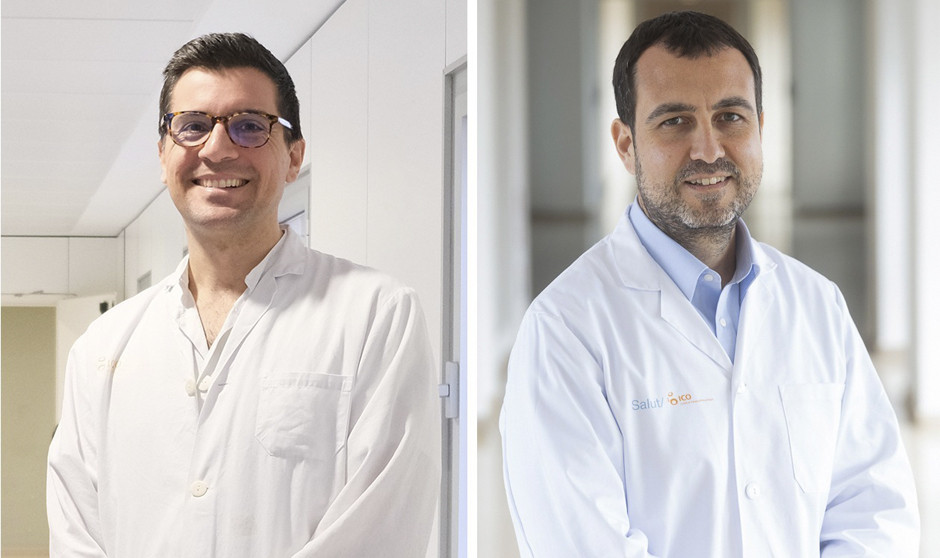
Alberto Mussetti, head of the CAR-T Unit at the Catalan Institute of Oncology (ICO) in L’Hospitalet; and Juan Martín Liberal, oncologist at the same center.
There isn’t a single explanation for this phenomenon. In fact, the key may lie in the social impact of the disease. “I think people need to hear good news regarding cancer since it’s a disease that has a considerable impact on society and any ray of hope, anything that seems positive, I think gets a lot of discussion,” reflects Juan Martín Liberal, an oncologist at the Catalan Institute of Oncology (ICO).
The Media Spotlight on Cancer
Adding to this is the fact that cancer is a “very sensitive” topic for the public. “Practically everyone has a family member or acquaintance with cancer, and I think people are very sensitized to the issue. Any positive news gets a lot of discussion,” says Martín Liberal. From the field of Hematology, the same pattern is observed. However, the scientific context helps to understand part of the recent attention. This is expressed by Alberto Mussetti, head of the ICO’s CAR-T Unit in L’Hospitalet, who assures that “until now, the issue of vaccines had never demonstrated great efficacy, except against the human papillomavirus and uterine tumors.” But now, that has changed, and “these more modern studies have emerged where the issue of these vaccines working is clearer.” The “scientific novelty” also weighs heavily, he adds, because they are “brilliant results for very aggressive diseases at an oncological level and that look good for the next phases of clinical research.” “Before, studies like these with such brilliant results were unknown, they didn’t exist,” he points out. He also remembers that the factor of novelty also influenced in 2019 when Spain received approval for the first CAR-T therapies, a moment when media coverage “was much greater” because “there was more clinical data and different studies confirming that it worked.” Martín Liberal believes that the way science is communicated can influence the visibility of other advances in Oncology and Hematology, being a matter of “lack of awareness” for not doing “a little more publicity” or not moving so much “in the media.” “Maybe we should learn to advertise a little more the good things we do, which is a lot,” he says.
Spain, Beyond the Headlines
Both specialists agree that our country has a strong research ecosystem in Oncology and Hematology that has allowed it to develop a notable capacity in clinical trials, cellular therapies and academic networks of immunotherapy, consolidating the country as a European reference. “Spain has a network of centers that are a reference for CAR-T therapy. This is a fairly pioneering structure at the European level,” says Martín Liberal, who emphasizes that “advanced therapies in Spain” are being organized “very well, also in tumor-infiltrating lymphocytes (TILs).” Mussetti also distinguishes “a unique ecosystem in Europe” of different oncohematological centers that are developing their own CAR-T therapies. These include the Hospital Clínic of Barcelona, the Hospital de la Santa Creu i Sant Pau, or the Virgen del Rocío of Seville, which “lead programs of production, and trial.” “The national network is very solid and collaborative, something that few European countries have,” he points out. This leadership in academic CAR-T demonstrates that “Spain has real muscle in immunotherapy,” says Mussetti, adding that “if vaccines confirm efficacy, they can be integrated as another powerful tool, complementing what is already being done with cellular therapies and advanced antibodies.” Martín Liberal concludes that “the combination of new immunotherapies with vaccines, along with Spain’s ability to recruit patients for clinical trials, could transform cancer treatment in the coming years.” This combination of scientific strength and accumulated experience provides a solid foundation for integrating new tools, even as evaluating the efficacy of vaccines in solid tumors, “a new modality of immunotherapy” that is beginning to be used but which, although “we cannot yet say it will change clinical practice,” assures Martín Liberal.
The information published in Redacción Médica contains statements, data and declarations from official institutions and health professionals. However, if you have any questions related to your health, consult your corresponding health specialist.
