
Carnivorous plants, long captivating for their ability to trap and digest insects, owe their unique skillset to a concrete evolutionary process: survival in nutrient-poor soils. An international study published in Nature Ecology & Evolution has revealed how different species across continents share similar genetic mechanisms in developing this behavior.
The research, led by the National Institute for Basic Biology and with participation from the University of Barcelona, examined three representative species: Cephalotus follicularis, Nepenthes alata and Sarracenia purpurea. Despite evolving in geographically distant locations, these plants utilize comparable evolutionary pathways to capture and digest prey. This discovery offers insights into how organisms adapt to extreme environments, a key area of study for biologists, and ecologists.
The primary driver of this adaptation is the scarcity of nutrients in their habitats. Many carnivorous plants thrive in swamps, bogs, or acidic soils where nitrogen and phosphorus are limited. To compensate, they’ve transformed their leaves into structures capable of attracting and utilizing nutrients from insects.
When prey falls into these traps, it’s immobilized in digestive fluids that break down its body and exoskeleton, allowing the plant to extract essential minerals unavailable in the soil. This process enables them to survive in conditions where other plant species cannot.
Convergent Evolution at Play
A key finding of the study is that carnivory in plants arose independently in different lineages – a phenomenon known as convergent evolution. This demonstrates that unrelated organisms can arrive at similar solutions when facing the same environmental challenges. In this case, various plant families repurposed genes originally involved in defense or cellular digestion, transforming them into enzymes capable of breaking down insects.
Genetic analysis confirms that, despite being separated by thousands of kilometers, carnivorous plants share a similar molecular “machinery” for digesting their prey. This explains why species from Asia, Australia, and the Americas employ similar feeding strategies.
Evolutionarily Designed Traps
To capture insects without movement, these plants have developed a variety of trap types. Some utilize sticky leaves, like those of the Drosera genus, which immobilize insects with viscous substances. Others have created pitcher-shaped structures, where prey slips and falls into digestive liquids, as seen in many Nepenthes species.
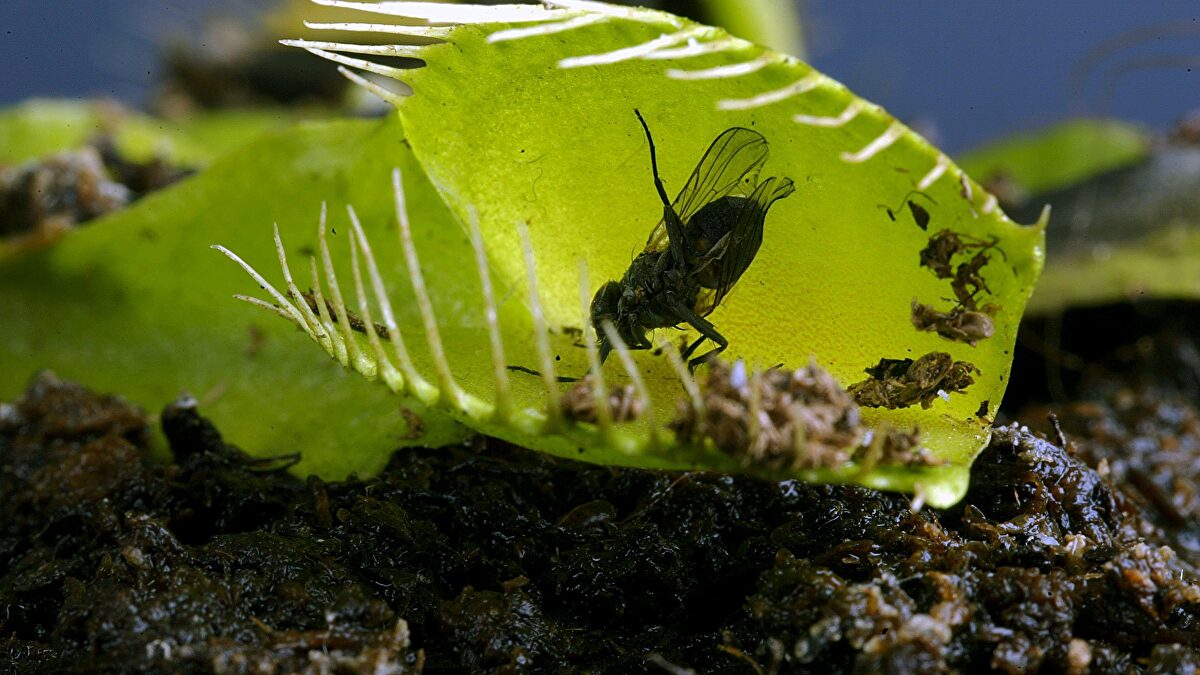
Perhaps the most well-known is Dionaea muscipula, commonly called the Venus flytrap. This plant employs a rapid-closure mechanism triggered when an insect touches its sensory hairs. If the stimulus repeats within seconds, the trap snaps shut to prevent escape.
Suction traps also exist in aquatic species, alongside other tubular structures that ensnare insects with no escape. Each system addresses the same fundamental need: obtaining essential nutrients in resource-scarce environments.
Photosynthesis Remains Key
Despite consuming insects, carnivorous plants remain fundamentally plants, deriving their primary energy from the sun through photosynthesis. Insects don’t provide calories, but rather serve as a supplemental source of minerals. Some species reduce trap production when soil nutrients are sufficient, conserving energy.
This strategy highlights the delicate balance these plants maintain with their surroundings. Even in attracting prey, they utilize visual and chemical signals mimicking flowers or emitting ultraviolet light perceptible to insects.
Balancing Predation with Pollination
Carnivorous plants face a significant evolutionary challenge: avoiding the capture of insects that assist in their reproduction. Many species resolve this by elevating their flowers on long stalks, keeping them distant from the traps. This ensures pollinators can fulfill their function without becoming prey.
Beyond nutrient acquisition, these plants also contribute to ecological balance, helping regulate insect populations and creating microhabitats within their traps for smaller organisms.
An Example of Extreme Adaptation
The evolutionary history of carnivorous plants demonstrates how organisms can adapt to seemingly impossible conditions. In environments offering minimal soil resources, these species transformed their leaves into sophisticated capture and digestion systems.
However, many depend on highly specific habitats, such as wetlands and bogs, which are currently threatened by human activity. Their survival serves as a reminder that even the most ingenious organisms in nature rely on fragile ecosystems.
carnivorous plants represent a striking example of biological adaptation. Their ability to turn an environmental limitation into an evolutionary advantage continues to fascinate scientists and illustrates the remarkable capacity of life to reinvent itself for survival.
