
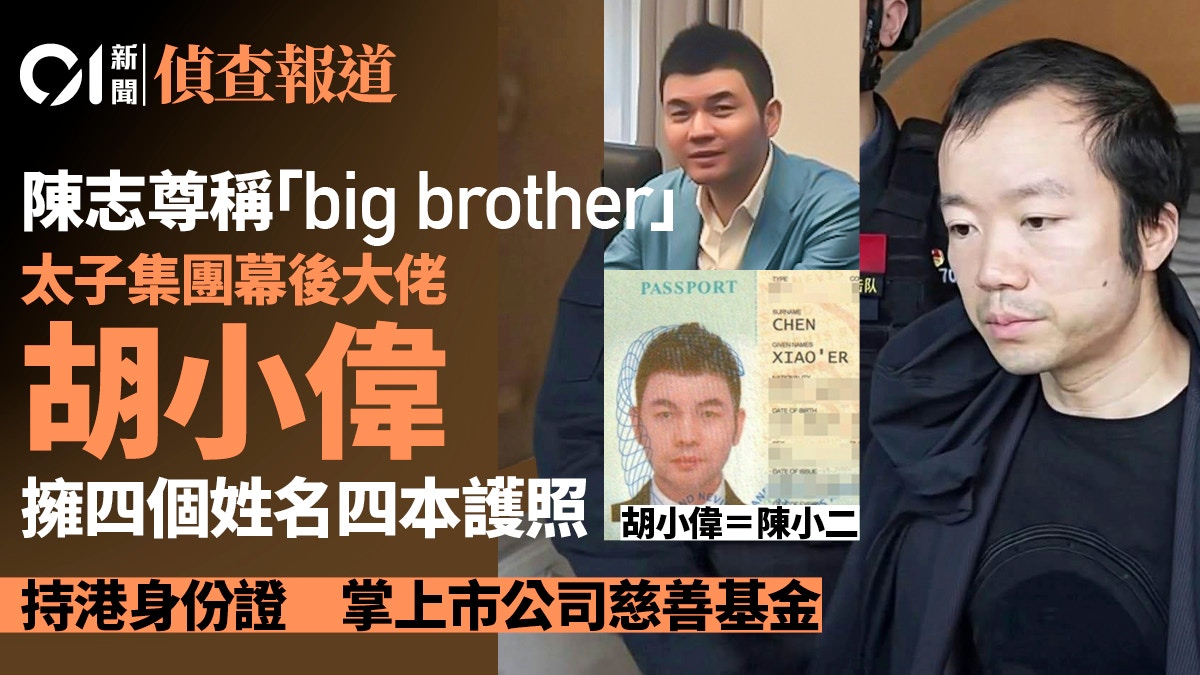
The alleged mastermind behind a network of scam operations in Cambodia, Chen Zhi, has been transferred to China after being arrested in Cambodia earlier this year, following sanctions imposed by the United States and the United Kingdom last year. The move highlights the increasing international pressure to dismantle transnational criminal organizations preying on vulnerable populations. Chen Zhi was implicated in a 2011 cyber gambling case in mainland China and fled with another key figure, Hu Xiaowei.
Teo Kang Yeow Cliff, a former high-ranking member of the Taiwanese-based Prince Group – currently wanted by authorities in Taiwan – revealed that Hu Xiaowei, Chen Zhi’s “Substantial Brother,” is the same individual identified as “Chen Xiaoer” on the U.S. Sanctions list.
Hong Kong 01 cross-referenced photos, passport data and identity card information, and conducted checks in Hong Kong, Singapore, and the United States, confirming that Hu Xiaowei repeatedly used the aliases “Chen Xiaoer,” “Hu Yanming,” and “Hu Shi.” He established companies in Hong Kong as early as 2011, and at one point controlled a publicly listed Hong Kong company before selling his stake.
Hu Xiaowei also co-founded a foundation with a Hong Kong businessman, and the businessman’s company later acquired Hu Xiaowei’s pharmaceutical research and development firm in mainland China. The Hong Kong businessman, responding through his lawyer, stated that all investments and commercial activities were conducted in strict compliance with all applicable laws and regulations, and declined further comment citing the sensitivity of the matter.
Involved in the 2011 “Knight Team” Case
The U.S. Sanctions against Chen Zhi’s Prince Group transnational criminal organization targeted 146 companies and individuals, with “Chen Xiaoer” listed first alphabetically. The U.S. Stated that Chen Xiaoer holds a passport from Saint Kitts and Nevis and is involved in Chen Zhi’s business dealings in Palau, but provided no further details.
A source familiar with the Prince Group’s operations told Hong Kong 01 that the Chen Xiaoer sanctioned by the U.S. Is Hu Xiaowei, who fled China in 2011 alongside Chen Zhi in connection with the “Knight Team” hacking case.
“He is the big brother”
Following the sanctions against Chen Zhi, Teo Kang Yeow Cliff, who previously oversaw the Prince Group’s operations in Taiwan and was later wanted by Taiwanese authorities on charges of fraud, told the Organized Crime and Corruption Reporting Project (OCCRP) in December 2023 that the Chen Xiaoer sanctioned by the U.S. Is the former Hu Xiaowei.
Teo Kang Yeow Cliff said Hu Xiaowei played a crucial role in Chen Zhi’s career, stating, “Hu Xiaowei brought Chen Zhi into the online gambling industry. He was a ‘big brother,’ as Chen Zhi always called him. He always showed him great respect, definitely.”
The OCCRP published a copy of Chen Xiaoer’s Saint Kitts and Nevis passport and compared it to old photos of Hu Xiaowei, confirming they are the same person.
Hong Kong 01 also compared photos of Chen Xiaoer’s passport with a photo from a 2016 press release announcing Hu Xiaowei’s donation to his former high school, Jiangsu Suyuan Middle School, and confirmed the individuals are one and the same.
Four aliases, four passports, and a Hong Kong identity card
Hong Kong 01’s investigation revealed that Hu Xiaowei possesses passports from China, Cambodia, Cyprus, and Saint Kitts and Nevis, as well as identity cards from mainland China and Hong Kong. In addition to operating companies and a foundation in Hong Kong under his birth name, “Hu Xiaowei,” he used three other aliases: “Chen Xiaoer,” “Hu Yanming,” and “Hu Shi.”
|
Names |
HU Xiaowei CHEN Xiaoer WU An Ming HU Shi |
|
Passports |
China Cambodia Cyprus Saint Kitts and Nevis |
|
Identity Cards |
Mainland China Hong Kong |
First registered a company in Hong Kong in 2011
Using these aliases and multiple documents, Hu Xiaowei established various companies in mainland China, Hong Kong, and Singapore. His presence in Hong Kong dates back to 2011, when he registered “Halian Engineering Investment Limited” under the name “Chen Xiaoer” using his Jiangsu Suyuan Middle School identity card. He later added his Hong Kong identity card and Saint Kitts and Nevis passport information.
Acquired a controlling stake in a Hong Kong-listed company in 2018
In August 2018, Hu Xiaowei, using the name “Chen Xiaoer,” acquired a controlling stake in a Hong Kong-listed company and subsequently became its chairman and CEO, registering with his Hong Kong identity card.
The stock exchange announcement described Chen Xiaoer as a 37-year-old with extensive experience in investment and corporate management, and chairman of “Jiuxi Cloud (Chongqing) Financing Leasing Co., Ltd.” and “Chongqing Kunji Property Development Co., Ltd.”
In 2020, “Chen Xiaoer” changed his name to “Hu Yanming,” and in April 2021, he sold all of his shares.
Invested in Evergrande Property Services
According to a Hong Kong stock exchange announcement, in August 2020, an investment fund with Hu Yanming as a partner invested 1 billion Hong Kong dollars for a 1.194% stake in Evergrande Property Services (6666), which was not yet listed at the time.
Established a biotechnology company in Beijing and a charitable foundation with the same name with a Hong Kong businessman
Meanwhile, in August 2016, Hu Xiaowei established a biotechnology company in Beijing under his own name. In November 2018, he co-founded a charitable foundation with the same name as the biotechnology company, using his passport and Chinese ID. The foundation’s board of directors included Hu Xiaowei’s company executives and another Hong Kong businessman.
Changed name to HU Shi, shared name and passport number with Chen Zhi’s Singaporean company
Hu Xiaowei later changed his name to “HU Shi” in the foundation’s board of directors information, using a Cypriot passport. A comparison of the data revealed that the name and passport number matched those of the initial shareholder of “Alphaconnect,” Chen Zhi’s Singaporean private investment company.
In January 2024, the charitable foundation was deregistered, with “HU Shi” and the Hong Kong businessman remaining directors until the end. Financial statements show the foundation was inactive, with only 5,000 Hong Kong dollars spent on audits over three years.
In July 2024, the Hong Kong businessman’s company acquired 100% of the shares in the Beijing biotechnology company with the same name as the foundation.
Hong Kong businessman’s lawyer responds: Always strictly comply with the law, the matter is highly sensitive and it is not appropriate to comment
Hong Kong 01 contacted the Hong Kong businessman regarding his business and cooperative relationship with Hu Xiaowei. Through his lawyer, he responded that the businessman always strictly complies with all relevant laws and regulations when investing and participating in commercial activities in a personal capacity, and declined to comment further citing the sensitivity of the matter and ongoing legal proceedings.
Served as an advisor to the Cambodian National Assembly President
Like Chen Zhi, Hu Xiaowei also cultivated connections with high-ranking political figures in Cambodia. In 2020, he became a Cambodian citizen under his own name, and in 2022, he was appointed as an advisor to then-Cambodian National Assembly President Heng Samrin, a position equivalent to a ministerial level.
Purchased an independent house in Tsuen Wan “Star Shore” and used 130 million yuan to buy jewelry
In 2018, Hu Xiaowei purchased an independent house in Tsuen Wan’s “Star Shore” under the name “Chen Xiaoer,” with a transaction price that was not publicly disclosed but estimated at around 140 million Hong Kong dollars.
After changing his name to “Hu Yanming” in 2020, he mortgaged the independent house to purchase 130 million Hong Kong dollars worth of jewelry, repaid it in 2025, and sold the independent house for 62 million Hong Kong dollars that same year, resulting in a loss of half its value.
Purchased luxury mansions worth hundreds of millions of yuan in the UK
The OCCRP also reported that Hu Xiaowei purchased super luxury homes in several countries. In March 2022, he purchased a luxury mansion adjacent to Holland Park in London’s most expensive area for 30 million pounds (approximately 320 million Hong Kong dollars) under the name “Hu Yanming.” He also acquired the Imperial College sports ground through a British Virgin Islands (BVI) company for 3.5 million pounds (approximately 37.3 million Hong Kong dollars) that same year.
