
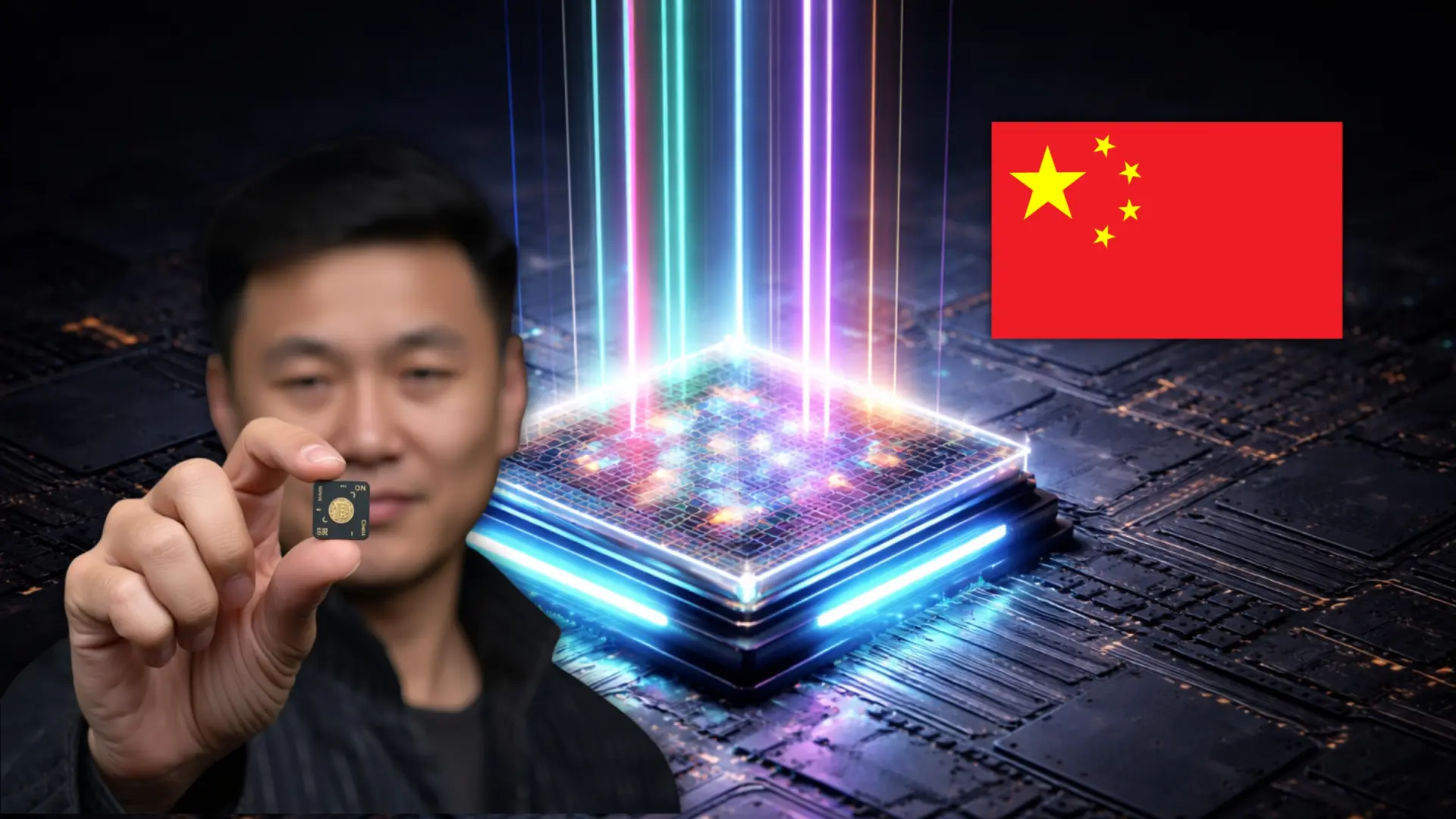
A new photonic processor developed in China, dubbed LightGen, is demonstrating performance exceeding that of the Nvidia A100 GPU by more than 100 times in certain tasks, according to research published this week.
The breakthrough, a joint project between Shanghai Jiao Tong University and Tsinghua University, utilizes light instead of electricity to process information, potentially paving the way for significantly faster and more energy-efficient artificial intelligence systems. This development arrives as demand for powerful AI processing continues to surge, driving innovation in chip design.
Researchers detailed their findings in the journal Science, noting that LightGen achieves a superior calculation-to-energy consumption ratio compared to traditional GPUs. The chip employs light pulses to manipulate data, eliminating electrical friction and enabling a greater scale of processing.
Photonic Chip Mimics Neural Networks
Unlike conventional processors that rely on transistors, LightGen substitutes them with “photonic neurons.” These units manipulate light beams to perform the operations typically executed by electronic circuits in a neural network. The goal is to leverage the speed and reduced heat dissipation of photons to improve efficiency in high-volume computing scenarios.
The prototype is designed as a platform for optical computing in AI, specifically targeting generative models used for creating and transforming images, video and 3D scenes. Engineers have integrated over two million artificial neurons onto a chip measuring approximately one-quarter of an inch square, using 3D packaging techniques.
This density represents a significant advancement over previous optical processors, which typically contained only a few thousand neurons, limiting their capabilities to simpler classification tasks. With this increased density, the chip is now capable of handling complex tasks like high-resolution video generation and 3D model processing, traditionally performed on GPU farms.
The system also introduces the concept of an “optical latent space,” a compressed representation of information used in generative models. In LightGen, this representation is directly manipulated with light, utilizing ultra-thin metasurfaces and fiber matrices to compress and process multidimensional data without fragmentation, preserving data structure and reducing processing steps.
Current Limitations and Future Potential
Researchers acknowledge several limitations, including the system’s reliance on external lasers for signal generation and control, which complicates assembly and increases costs. Manufacturing the chip also requires specialized processes not currently integrated into standard semiconductor industry practices.
Integrating LightGen into real-world data centers would necessitate addressing challenges related to scalability, cost, integration with existing hardware, and long-term reliability. The researchers present the chip as a promising research direction, rather than an immediate replacement for current GPUs.
If these designs are successfully refined, a key impact could be a reduction in energy consumption for AI generative tasks. Training and running large AI models currently demands significant power, and a more efficient accelerator could lower costs for data centers and make advanced model deployment more feasible. The development also demonstrates China’s exploration of alternative computing methods beyond traditional electronics.
According to Science, the team has demonstrated the feasibility of building a photonic chip capable of executing generative AI tasks with superior efficiency compared to electronic hardware. The transition from these prototypes to commercial products will depend on overcoming technical and economic hurdles in the coming years.
