
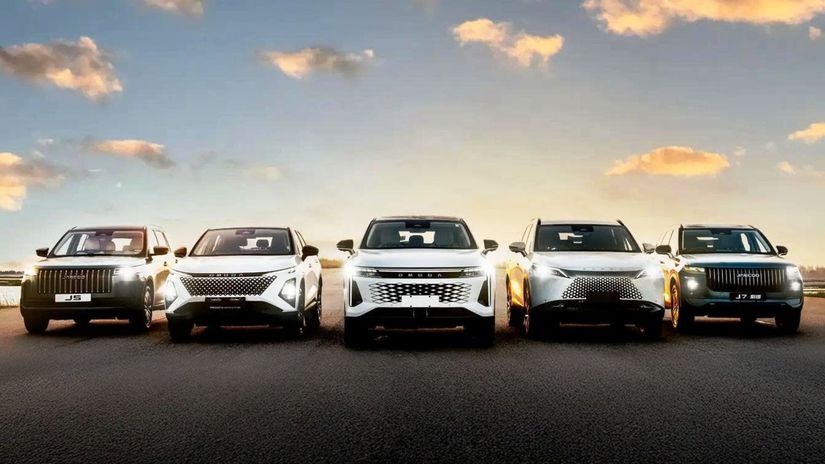
Low prices are attracting consumers to Chinese cars, but every coin has two sides. As a survey by British firm Carwow shows, the savings you make on the purchase price can easily be lost on expensive insurance. Some insurers even refuse to insure Chinese models altogether.
Insuring a Chinese car in Europe can be more difficult and expensive than many buyers anticipate, as insurers remain cautious about these emerging brands.
European car markets have seen a surge in Chinese brands in recent years. In 2024, approximately 811,000 novel car registrations across Europe, including the United Kingdom, Switzerland, and Norway, represented a 99% year-over-year increase and a market share of around 6.1%. Chinese automakers are attracting customers with aggressive pricing strategies, often undercutting established European, Japanese, and Korean competitors by thousands of euros. However, a recent study by Carwow reveals a potential hidden cost: insurance.
Carwow obtained insurance quotes for eight vehicles – four Chinese models and four from established brands – from ten leading British insurance companies: Admiral, Aviva, Direct Line, Hastings, LV, AXA, Ageas, AA, Esure, and Allianz. The Chinese vehicles included the Jaecoo 7, XPeng G6, Skywell BE11, and BYD Seal U, even as the comparison group consisted of the Volkswagen Tiguan, Kia EV3, Peugeot E-3008, and Toyota RAV4. The results showed that, with one exception, Chinese cars largely failed to compete on insurance costs. Several insurers outright refused to provide coverage for certain Chinese models.
For example, the average insurance premium for the XPeng G6 was £1,102 (approximately €1,267), compared to £827 (€952) for the Kia EV3. The highest quote for the XPeng, received from AA, reached £1,569 (€1,804). In contrast, the Volkswagen Tiguan could be insured for an average of less than £700 (€805), with only Ageas declining coverage. The Jaecoo 7, one of the best-selling cars in the UK this year, faced even greater challenges. Five of the ten insurers surveyed refused to offer coverage, and the average price from those that did was £858 (€986) – £165 (€190) more than insuring a Tiguan.
The BYD Seal U plug-in hybrid proved the easiest to insure. Only three insurers declined to offer a quote, with an average price of £645 (€742) among those that did. Surprisingly, the Toyota RAV4 emerged as the most expensive to insure among the comparison vehicles, averaging £1,188 (€1,366) – £543 (€624) more than the BYD. Three insurers too refused to quote for the Toyota.
 Čítajte viac Voľný pád Dacie: Predaj áut v Európe v januári klesol, čínske značky však prudko rastú
Insurers cited a lack of experience with the new brands, questions about repairability, the availability of spare parts, and the currently unknown level of reliability as reasons for their caution. LV= General Insurance, owned by Allianz, stated that it does not provide coverage for the XPeng G6, BYD Seal U, and Skywell BE11 models as it is still evaluating the insurance risks associated with these specific vehicles. “Chinese cars present a challenge for the insurance market, which is trying to keep pace with a rapidly changing landscape,” said Iain Reid, Carwow’s editorial director. “More new brands have entered the European market in the last 18 months than in the previous two decades combined.”
The situation could improve over time as Chinese brands become more established in Europe, mirroring the experiences of Japanese and Korean automakers in the past. However, Carwow advises anyone considering a new Chinese model to compare insurance options before purchasing to avoid high costs or the risk of being unable to secure coverage. A seemingly affordable car could ultimately prove more expensive than anticipated, and resale values for Chinese vehicles are also showing signs of rapid depreciation.
