
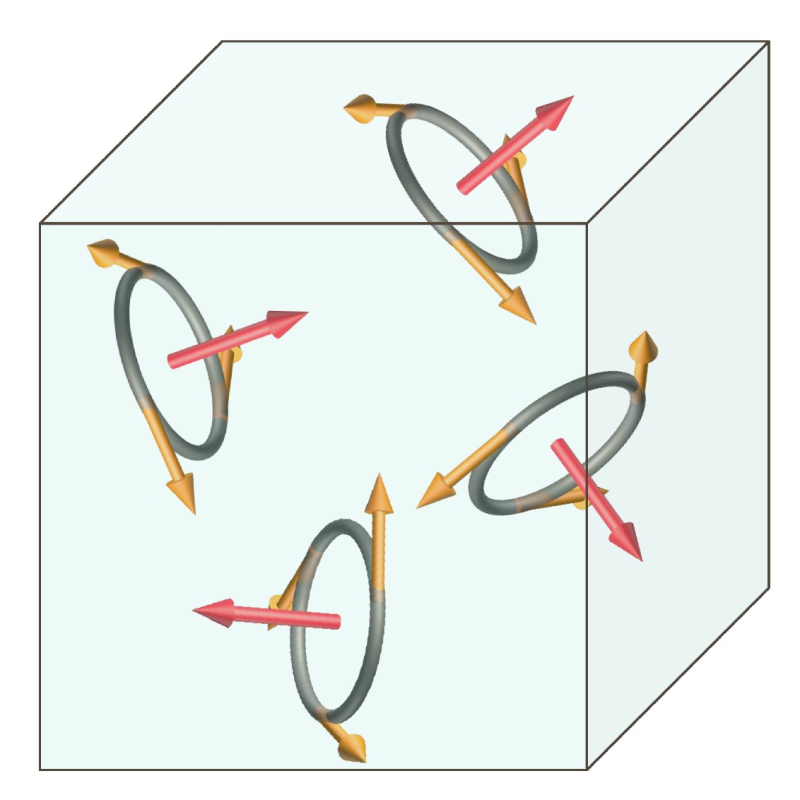
Researchers have achieved a breakthrough in controlling magnetic chirality at the molecular level, potentially paving the way for new advancements in spintronics and quantum technologies. The ability to manipulate the direction of magnetic vortexes within molecules could lead to more efficient data storage and processing, as well as novel magneto-electric devices.
Scientists at the Laboratoire National des Champs Magnétiques Intenses (National High Magnetic Field Laboratory), a joint research facility of CNRS, Univ. Grenoble Alpes, INSA Toulouse, and Univ. Toulouse Paul Sabatier, focused their work on a unique class of chiral compounds known as “single-molecule toroics” (SMTs). Unlike traditional magnets where magnetic moments align, SMTs exhibit magnetic moments organized in a closed loop, forming a magnetic vortex. This configuration generates a toroidal magnetic moment, resembling a tiny ring-shaped magnetic field.
Previously, synthesizing SMTs resulted in a mixture of two mirror-image forms, called enantiomers, each with opposite vortex rotation directions. Isolating a single enantiomer – one with a defined rotation direction – is crucial for harnessing the full potential of these magnetic vortexes.
To overcome this challenge, the team designed a pair of enantiopure molecules, built around a triangle of three dysprosium (Dy³⁺) ions connected by organic molecules called ligands. By utilizing chiral ligands, the researchers were able to impose a specific chirality on the spins within the molecule. This ensures the magnetic vortex adopts a single, predetermined rotation direction dictated by the molecule’s geometry.
Measurements using magneto-chiral dichroism (MChD), a spectroscopic technique sensitive to both chirality and magnetization, combined with theoretical calculations, confirmed the presence of the toroidal magnetic moment at low temperatures (below 4.5 K). The results demonstrated that all molecules within the crystal exhibit the same magnetic chirality at the scale of the crystal lattice.
The findings, published in Nature Chemistry, demonstrate that molecular chirality can be used to control magnetic chirality. This development could enable the creation of systems capable of generating a usable toroidal magnetic state for magneto-electric devices or chiral spintronics, where information is encoded not just in the orientation of a spin, but in the direction of a magnetic vortex. This represents a significant step toward molecular architectures that tightly couple magnetism and spatial asymmetry – two key components of future quantum and electronic technologies.
Editor: CCdM
