
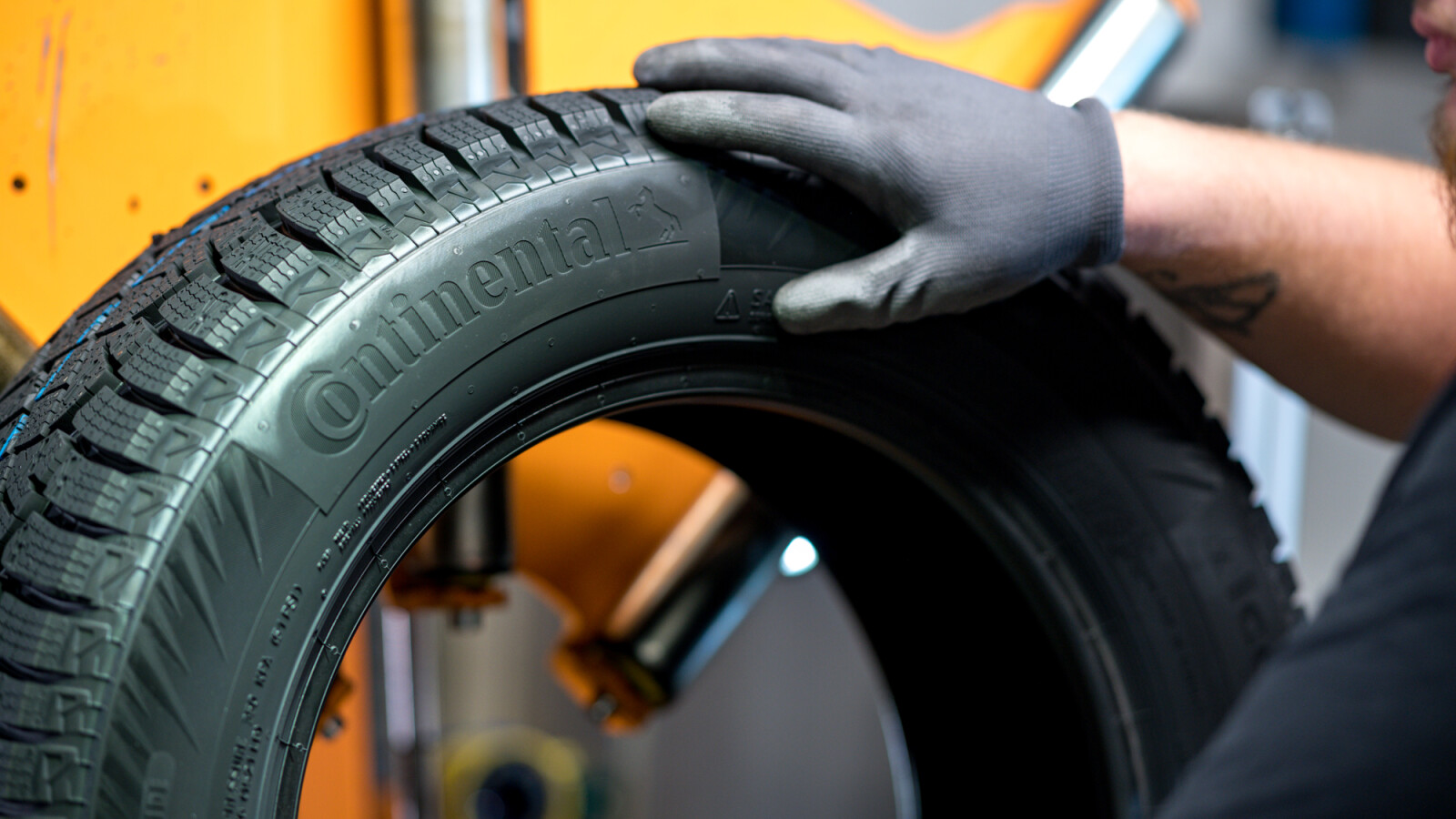
Continental is doubling down on sustainability, moving beyond rhetoric with innovative material choices in its tire production.
- Continental is investing significant research into environmentally friendly tires.
- The resulting material composition is already attracting attention.
- The approach is proving successful, with the tires achieving top performance ratings.
The wheel was invented around 3500 BC. Since then, it has undergone numerous revolutions, from wooden spokes to solid rubber tires and now to modern high-performance tires. But is further innovation possible? Most people believe of a tire as simply black, round and made of rubber. That perception is increasingly inaccurate.
What Continental is currently developing in its laboratories sounds more like science fiction than tire manufacturing in Hanover: silica from risotto rice husks, yarn from plastic bottles, carbon black from old tires, and, in the research lab, rubber from dandelions. Much of this is already incorporated into a production model that simultaneously achieves top ratings in wet braking performance. How is this combination possible?
Learn More:
- A Tire Manufacturer Reinvents Itself
- An Ingredient List Like From an Unusual Cookbook
- Certified, Not Just Claimed
- From the Lab to the Road: Where the Tires of the Future Are Created
- Smaller Than the Massive Ones, But More Profitable
- The Path to 100 Percent
A Tire Manufacturer Reinvents Itself
To understand where Continental is headed, it’s helpful to look at the bigger picture. The company is in the midst of the most profound restructuring in its 154-year history. In September 2025, the Automotive division was launched as an independent company named “Aumovio” on the stock exchange, and the sale of the ContiTech industry division is planned for 2026. What remains is a pure-play tire manufacturer. At the helm is fresh CEO Christian Kötz, a tire industry veteran aiming to make the company the “most progressive tire manufacturer in the world.”
What that means in practice is demonstrated by the UltraContact NXT. Introduced in 2023, this passenger car tire is considered an internal showcase project: up to 65 percent of the materials used come from renewable, recycled, or certified sources. In all 19 sizes, it achieves a triple-A rating in the EU tire label for rolling resistance, wet braking, and external noise. In the 2025 auto motor und sport test of sustainable, fuel-efficient summer tires (issue 07/25), it won the test with a rating of “outstanding,” including the shortest braking distances on wet surfaces. These are impressive figures. But what exactly goes into it?

An Ingredient List Like From an Unusual Cookbook
The material composition of the UltraContact NXT reads like a recipe where someone has mixed up the kitchen and the workshop. Rice husk ash, yarn from plastic bottles, carbon black from old tires, and in the research lab, rubber from dandelions are waiting to be used. Much of this is already in a production product that simultaneously achieves top values in wet braking.
- Old Plastic Bottles: 9 to 15 PET bottles per tire are processed into recycled polyester yarn, saving around 28% CO₂ compared to conventional polyester from crude oil. Continental calls this technology ContiRe.Tex and has been using it in series production since 2022.
- Rice Husk Ash: Silica is an important filler in tires, providing grip and low rolling resistance. Normally, it is produced energy-intensively from quartz sand. Continental instead obtains it from rice husk ash, a byproduct of rice processing.
- Used Cooking Oil: Conventional synthetic rubber is based on crude oil. Continental partially replaces this raw material with used cooking oil that would otherwise be disposed of.
- Resins from the Paper and Wood Industry: Resins provide the connection between the individual components in the tire. Instead of relying on petroleum-based variants, Continental uses renewable raw materials from the paper and wood industry.
- Pyrolysis of Old Tires: Recovered Carbon Black (rCB) is obtained from old tires through chemical recycling. This industrial carbon black replaces freshly produced carbon black from fossil sources. Since 2023, it has been used in all forklift tires at the Korbach plant.
Result: up to 65% sustainable materials, without compromising performance. The tire achieves a triple-A rating in the EU tire label.
Risotto Rice Husks: Grip from the Ash
Silica, also known as silicon dioxide, is one of the most important fillers in modern tires, providing optimal grip and low rolling resistance. Traditionally, it is extracted from quartz sand. Continental is taking a surprising detour: through the rice fields of Italy. The husks of the rice, a by-product of rice processing and Asian agriculture, are burned. High-quality silica can be extracted from the ash, which functions in tire mixtures just as well as conventionally produced silica. The process is more energy-efficient than conventional production and transforms a waste product into a high-performance raw material. This silica is manufactured, among others, by Solvay in Italy.
Continental was one of the pioneers in the use of silica in tires around 30 years ago. The technology revolutionized road safety and shortened braking distances by almost 50 percent. That the filler can now come from rice husk ash is the next logical step in this story.

PET Bottles: From the Recycling Machine to the Tire
What gives the tire its shape and stability are reinforcing materials made of steel and textiles, accounting for around 18 percent of a passenger car tire. Here too, Continental is looking for more sustainable alternatives.
The most striking is ContiRe.Tex. Together with textile manufacturer OTIZ, Continental has developed a process to produce high-quality polyester yarn from used PET bottles. Without chemical intermediate steps, the bottles are transformed into a durable textile cord that absorbs the forces of the internal pressure in the tire carcass. Depending on the tire size, up to 15 recycled PET bottles go into a single tire, reducing CO₂ emissions by around 28 percent, as confirmed by an independent assessment by SGS. The recycled bottles are sourced exclusively from regions where Notice no closed-loop bottle recycling systems, so as not to disrupt existing cycles.
Continental is increasingly relying on recycled steel in the reinforcing layers and bead cores of the tires. And with the COKOON adhesion technology, developed jointly with supplier Kordsa, textile reinforcing materials can be bonded to the rubber without the use of the questionable chemicals resorcinol and formaldehyde. COKOON was made available to the entire industry as a license-free open-source solution.

Carbon Black: Black from the Cycle Instead of Crude Oil
Carbon black accounts for up to 20 percent of the total weight of a passenger car tire and is crucial for the strength of the rubber. Traditionally, it is produced from crude oil. Continental relies on three alternatives: Bio-based carbon black is made from tall oil, a byproduct of the paper industry. Recycled carbon black is obtained from pyrolysis oil extracted from end-of-life tires. And in collaboration with specialist Pyrum Innovations, Continental is working to recover carbon black directly from old tires through pyrolysis for reuse in new tire production. Currently, this recovered carbon black is used in the production of forklift tires at the Korbach plant, with expansion to other tire types under consideration.
unusual ingredients flow into the rubber mixtures: synthetic rubber from used cooking oil and resins from bio-based waste materials.

And Then There’s: Dandelion
It’s not yet in the UltraContact NXT. But when Continental talks about the future of the tire, one name keeps coming up: Taraxagum. Since 2011, the company has been researching the extraction of natural rubber from Russian dandelion together with the Fraunhofer Institute IME, the University of Münster, and the Julius Kühn Institute. The unassuming plant produces rubber in its roots that is comparable to its tropical counterpart, but can be grown in temperate climates.
A 30,000 square meter research laboratory in Mecklenburg-Vorpommern, Anklam, has been established for this purpose, with around 35 million euros invested. Scientists from agricultural science, chemistry, and process engineering are working here to make large-scale cultivation possible. The first serial product has already been available since 2019: the “Urban Taraxagum” bicycle tire, produced at the Continental plant in Korbach, Germany. Production of a passenger car series is still pending. The project remains unique worldwide and was awarded the German Sustainability Award in 2021. If the leap into large-scale series production succeeds, Continental would be able to cover part of its natural rubber requirements independently of tropical plantations.

Certified, Not Just Claimed
To ensure that all these sustainable materials do not just exist in the laboratory, but are also demonstrably in series tires, Continental relies on independent certification. Eight tire plants now carry the ISCC-PLUS certification: all European locations as well as the plants in China and the USA.
The certification confirms the complete traceability of all sustainable raw materials used in the so-called mass balance approach. In this approach, fossil and sustainable materials are mixed in existing production processes and allocated exactly in terms of balance. This allows Continental to gradually increase the proportion of sustainable materials without having to rebuild the entire production infrastructure.

From the Lab to the Road: Where the Tires of the Future Are Created
To make such innovations ready for series production, more than just quality ideas are needed. The heart of tire research beats in Hanover-Stöcken, where around 1,000 researchers, designers and engineers develop up to 9,000 different tires. Continental employs around 3,500 people from 60 nations in research and development alone. The global network completes around 25 million test kilometers and over 67,000 individual tests annually.
Testing is carried out, among other places, at the Contidrom near Wietze, one of the most modern tire test grounds in the world, founded in 1967. The centerpiece is the world’s unique Automated Indoor Braking Analyzer (AIBA), which enables braking tests regardless of the weather. A driver-in-the-loop simulator also saves around 100,000 test kilometers and 10,000 test tires per year.
Extreme tests under real conditions are also carried out: in Arvidsjaur in northern Sweden, winter tires are tested at temperatures as low as minus 30 degrees Celsius. The Uvalde Proving Grounds in Texas offer North America’s largest wet pad for wet driving tests on 2,000 hectares. At the same time, Continental is investing heavily in Asia: the plant in Hefei, China, is being expanded from 14 to 18 million tire capacity, with over 300 million euros flowing into the plant in Rayong, Thailand.

Smaller Than the Big Ones, But More Profitable
With a market share of 6.9 percent, Continental is the clear number four in the industry, behind Michelin with 14.1 percent, Bridgestone with 13.6 percent, and Goodyear with 9.6 percent. The gap to the top is significant. However, Continental compensates with profitability and clear innovation priorities. The adjusted EBIT margin of 13.7 percent in 2024 is one of the strongest in the entire industry.

All the dandelion research, the rice husk experiments, and the recycling technologies cost money. In 2024 alone, the tire division invested 349 million euros in research and development, equivalent to 2.5 percent of the division’s sales. In comparison to the group, this figure seems manageable next to the 2.4 billion euros invested in R&D by the Automotive division. However, with the spin-off of Aumovio and the planned sale of ContiTech, all innovation resources will flow in one direction: tires. This is likely to increase the pressure to develop further.
Continental is setting itself apart from the competition, particularly in the area of sustainability. The UltraContact NXT, with 65 percent sustainable materials, achieves significantly higher values than Bridgestone’s Turanza EV with 50 percent or Michelin’s e.Primacy with 28 percent. Continental is also considered an industry leader in wet braking performance. And the company is at the forefront in terms of resource consumption: 55 percent less water consumption and 17 percent less energy consumption per ton of tires compared to the industry average.

The Path to 100 Percent
Currently, around 26 percent of the materials used come from sustainable sources. The goal is to increase this to at least 40 percent by 2030 and to 100 percent by 2050. 60 percent of this is to come from recycled end-of-life tires. An ambitious goal, but not an empty promise.
Continental has proven in recent years that sustainability in the tire business does not have to be a marketing slogan. The silica from rice husk ash, the ContiRe.Tex technology from PET bottles, the COKOON adhesion technology, and the UltraContact NXT are measurable, certified results of genuine research work. The triple-A rating in the EU label is not a self-awarded accolade, but an independent standard. And the ISCC-PLUS certification ensures that the origin of every single raw material remains traceable. If the dandelion rubber also makes the leap from bicycle to passenger car tires, that would be another breakthrough.
Whether the focus on rice husk silica, dandelion rubber, and all the other alternative materials will pay off in the long run remains to be seen. The foundations, however, have been laid. And the next milestone is already in sight: in March 2026, Continental will open the Tire Technology Expo in Hanover with a keynote speech on tires for autonomous driving. A black, round rubber tire? That may soon be the biggest understatement in the automotive industry.
Don’t miss the news
Subscribe to Netzwelt
