
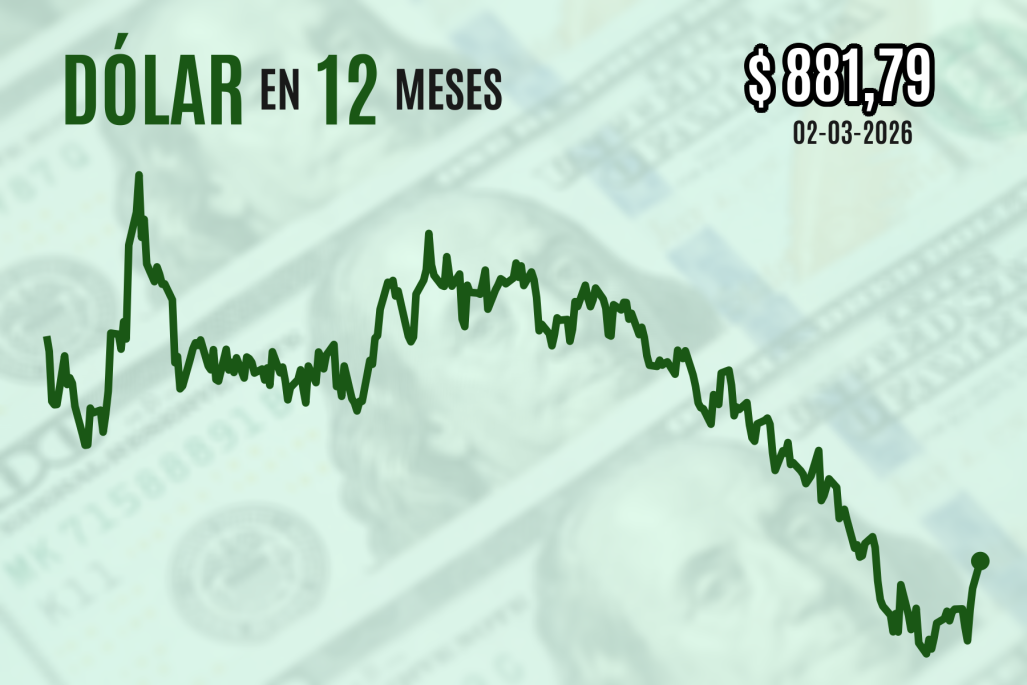
The Chilean peso experienced a significant surge against the U.S. Dollar on Monday, driven by heightened geopolitical uncertainty following escalating tensions between the United States and Iran. Investors sought the safety of the dollar, anticipating potential inflationary pressures and broader economic disruption.
The dollar-peso exchange rate closed at 881.8 pesos, an increase of 8.4 pesos, though it had earlier reached an intraday peak of 888.4 pesos, according to Bloomberg data. In just three days, the U.S. Dollar has risen 24.5 pesos.
The dollar index – a measure of the dollar’s global value – jumped 1% to 98.6 points, its highest level in five weeks, as investors flocked to safe-haven assets. Gold also saw modest gains, rising above US$5,300 per ounce. Meanwhile, Comex copper futures fell 1.9% to US$5.94 per pound, and several stock markets experienced sharp declines.
Global Risks
“An increase in geopolitical risk is putting pressure on oil price expectations and worsening terms of trade in the short term. The movement of the Chilean peso is primarily a response to increased global risk aversion and higher demand for dollars, with emerging market currencies tending to overreact,” said Patricio Jaramillo, director of Financial Risk at PwC Chile, to DF.
Brent crude oil surged 6.4% to US$77.5 per barrel, its highest price since mid-2025. Aramco halted operations at the largest refinery in Saudi Arabia following a drone attack. After Qatar was forced to interrupt a major plant, futures for benchmark natural gas in Europe soared nearly 40%.
“The exchange rate has risen due to safe-haven flows, but if this de-escalates, it could reverse, as it should align with levels closer to $870 and $880. Even as it’s challenging to see that happening in the midst of the current developments, historical evidence suggests these phenomena are transitory, and therefore our view on where the exchange rate should rebalance has not changed,” analyzed Sergio Lehmann, chief economist at Bci.
Sovereign interest rates also rose sharply, as debt is not becoming more attractive in this environment, which is accompanied by certain inflationary fears due to higher energy costs. The U.S. ISM manufacturing index surprised to the upside.
Rodrigo Cruz, an economist at Banco Santander, stated that “the magnitude and duration of all these movements will depend on how the conflict develops, both in terms of disruptions to supply chains and oil production, and in the deepening of the conflict itself. So far, prices appear to be incorporating a relatively quick resolution.”
Donald Trump said on Monday that the military operation would last between four and five weeks, but could be extended. According to the president, he seeks to prevent Iran from developing a nuclear weapon and thwart its long-range ballistic missile program.
As has been the case with previous alerts in the region, one of the main concerns of investors is that Iran could impose a blockade on the Strait of Hormuz, which would have significant consequences for global energy supply and prices. However, cargo ships are already avoiding the sector, pending further guarantees.
“The rise in oil prices will create winners and losers. The currencies of major oil importers, such as Peru and, in particular, Chile, could suffer more, while the new highs in gold and the stability of copper prices may help to limit the impact on the real exchange rate,” published the BBVA strategy team led by Alejandro Cuadrado.
U.S. And Israeli attacks reportedly killed Iran’s supreme leader, Ayatollah Ali Khamenei, and several other authorities in the country, including the top commander of the Revolutionary Guard.
The escalation of the military conflict in the Middle East comes after failed negotiations to reach a nuclear agreement with Tehran, and while Washington has explicitly called for a regime change. Ali Larijani, Secretary of Iran’s Supreme National Security Council, denied that the country was seeking to resume talks, as reported by U.S. Media.
The Chilean exchange rate was also rising due to concerns about Artificial Intelligence, a poor U.S. Producer price reading, and weak economic activity figures in Chile.
Published by the Central Bank this morning, the Imacec for January confirmed what had been indicated by the sectoral figures from the National Statistics Institute, as it was below analysts’ estimates.
