
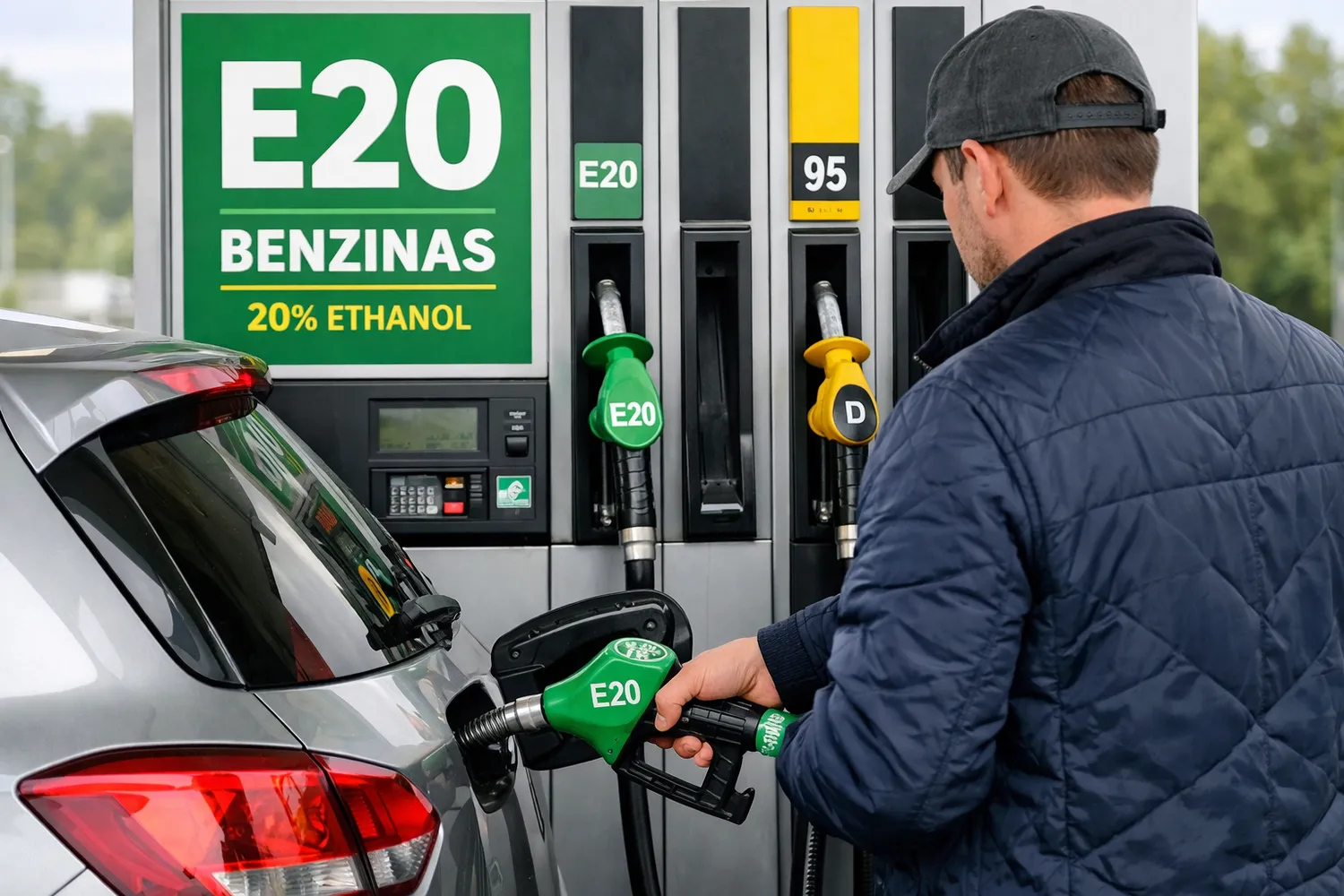
German fuel markets are bracing for a shift that could create confusion for drivers. A fresh type of gasoline is slated to appear at gas stations in the coming years, touted as a more ecological and affordable alternative. But, these promises come with stark warnings.
The fuel in question is E20.
The new blend is intended to help reduce CO₂ emissions and even ease the financial burden on motorists. However, experts emphasize that not every vehicle will be able to “digest” this fuel without consequences.
What Lies Behind the E20 Label?
Mixing bioethanol with gasoline is not new in Germany. “Super E10” fuel has been on the market for around 15 years and today accounts for approximately 30 percent of all gasoline sales. This figure is even higher in many other European Union countries.
E20 represents a further step in the same direction. The main difference is a bioethanol content of up to 20 percent – double that of E10 fuel. According to Chip.de, this fuel has already been undergoing testing in Mannheim. The project is presented as an attempt to find a compromise between traditional internal combustion engines and climate goals.
Appealing Environmental Promises
According to data from ADAC, using E20 could reduce CO₂ emissions by as much as 80 percent, depending on the bioethanol production process. If additional renewable components are added to the mixture, overall emissions can likewise be significantly reduced. What we have is a key argument in a country where climate policy is becoming increasingly stringent and emission taxes are becoming more burdensome.
However, environmental benefits are only part of the story.
Fuel Price – A Key Weapon
For many drivers, fuel price remains the deciding factor. And this is where E20 has the potential to generate significant interest. Industry experts calculate that E20 could be up to five cents per liter cheaper than E10. This is due to the tax system – the higher ethanol content is not subject to CO₂ tax.
The potential for cost savings could be a significant factor as European fuel markets face increasing pressure from new emissions trading schemes.
Danger Zone: Not All Engines Are Compatible
Despite optimistic forecasts, there are clear exceptions. Experts warn that certain gasoline engines may encounter serious problems with E20.
This is particularly risky for powerful two-liter turbo engines with outputs exceeding 300 horsepower. These units are installed in sporty versions, such as the Golf R or GTI Edition 50.
The problem is technical in nature. The higher ethanol content, under high pressure and temperature, can damage components of the fuel system, especially aluminum parts. Corrosion can develop over time, leading to leaks and, in extreme cases, serious engine failures.
Seals and rubber hoses are also vulnerable, as they may be more susceptible to the more aggressive fuel mixture.
Test Station Already Operational
The first gas station in Germany offering “Super E20” has been operating in Mannheim since October 2023. However, It’s currently part of a closed testing park.
Only selected vehicles participating in the project can refuel there. A wider rollout of E20 on the market is expected between 2027 and 2028.
Which means the change is no longer theoretical – it is approaching.
Manufacturers Preparing in Advance
Major automakers, such as BMW and Mercedes-Benz, are already adapting part of their model ranges to E20 fuel. This signals that the industry is taking the future of this fuel seriously.
However, for drivers, this means one thing – the require to check for compatibility.
How to Avoid Costly Mistakes?
Experts’ recommendation is simple and strict. E20 should only be used if the manufacturer explicitly permits it.
Compatibility can be checked on the fuel tank cap or in the vehicle’s owner’s manual. If the model is not approved for even E10, refueling with E20 could be a direct route to the repair shop.
According to the German Association of the Automotive Industry, around 99 percent of gasoline cars in the country could theoretically run on E20. However, “theoretically” is the key word here.
Each case must be assessed individually.
New Fuel, New Risk
E20 is presented as a cheaper and more climate-friendly alternative. However, it also serves as a reminder that fuel selection is no longer an automatic decision.
Incorrect fuel can mean not only poorer performance but also repairs costing thousands of euros.
Gas station pumps will soon offer more choices. The only question is whether your vehicle is ready for them.
