
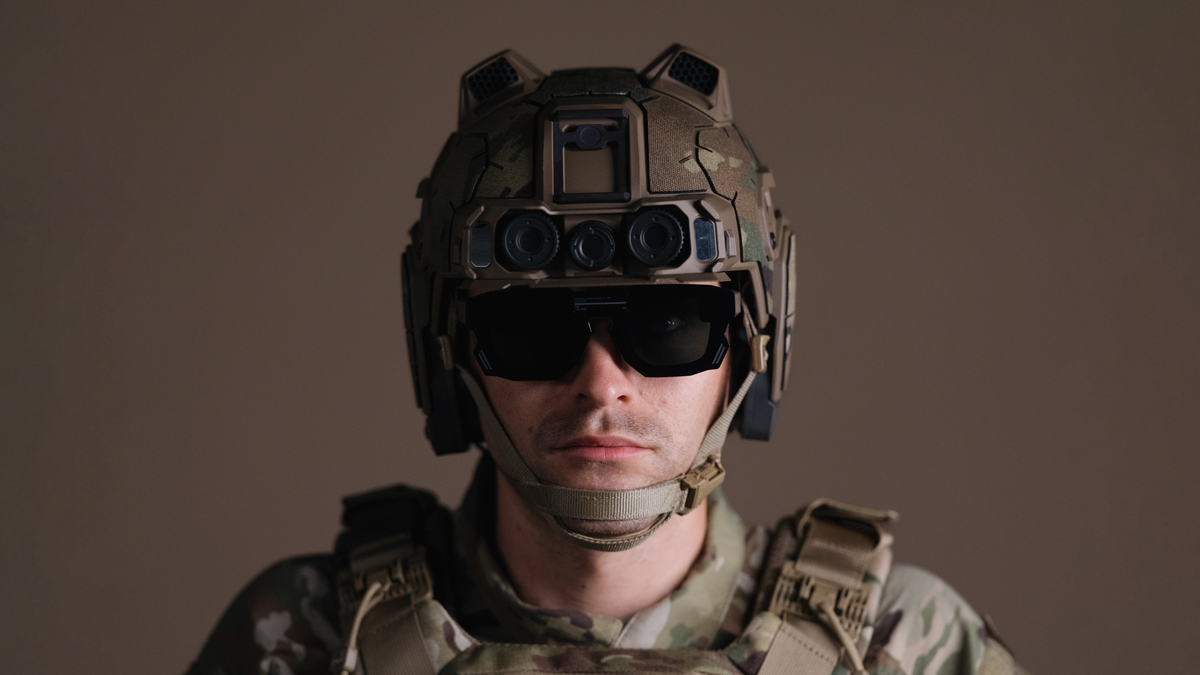
Anduril Unveils EagleEye Military XR Headset, Showcasing Advanced Battlefield Interface
Anduril, the defense technology company founded by Palmer Luckey, today revealed the design and interface of its EagleEye extended reality (XR) headset, intended to dramatically improve situational awareness for soldiers.
The EagleEye system features two modular display options: a transparent augmented reality module for daytime use resembling advanced sunglasses, and a full-face passthrough mixed reality module for nighttime operations. Both versions offer “beyond-full-cut ballistic protection and blast wave mitigation,” alongside spatial audio and radio frequency detection. The headset integrates with Anduril’s Lattice software, which compiles data from all available sensors – including drones and other headsets – to create a unified battlefield view, highlighting potential threats and friendly forces.
Mockups released by Anduril demonstrate a user interface that overlays a persistent compass and minimap onto the soldier’s field of view, identifying tracked assets with color-coded bounding boxes, even when obscured by physical objects. Soldiers can also view live feeds from drones, toggle between sensor views like low light and thermal imaging, and mark targets for actions like drone strikes. “We don’t want to give service members a new tool—we’re giving them a new teammate,” said Palmer Luckey in a prepared statement. “The idea of an AI partner embedded in your display has been imagined for decades. EagleEye is the first time it’s real.” This technology represents a significant shift in military technology, potentially altering how combat is conducted.
Anduril is partnering with Meta on core XR and AI technology, Qualcomm for chips, and Oakley and Gentex for eyewear and ballistic protection. The U.S. Army recently awarded Anduril $159 million to build and deliver hundreds of SBMC prototypes for field testing, with initial scaled delivery expected in 2027, according to DefenseScoop. The success of this program could determine the future of augmented reality in the military, following the cancellation of Microsoft’s IVAS program; learn more about the IVAS program here.
Officials stated that field testing of the SBMC system will begin shortly, and results will inform further development of the EagleEye platform.
Palmer Luckey’s Anduril revealed the design of its EagleEye military XR headset and showed clips depicting the interface soldiers see.
Anduril is the defense company that Palmer Luckey founded after being fired from Oculus by Facebook back in 2017. In February this year it emerged that Anduril had taken over the US Army AR headset program, called IVAS, from Microsoft, and four months ago Anduril announced that it was partnering with Meta on the evolution of IVAS called SBMC.
The goal of SBMC is to equip all company-level soldiers with an XR display system that vastly improves their situational awareness and ability to leverage autonomous platforms.
Palmer Luckey’s Anduril Partners With Meta To Build Military XR Devices
Palmer Luckey’s Anduril is teaming up with Meta to build XR products for US and allied militaries, starting with the EagleEye AR/VR helmet.
Luckey first announced EagleEye in February, a few days after the announcement of replacing Microsoft’s custom HoloLens solution, describing it as an “integrated ballistic shell” which entirely replaces a soldier’s helmet. He explained that EagleEye is powered by Lattice, Anduril’s networked software that autonomously integrates the data from all available sensors to build a unified view of the entire battlespace, while bringing attention to the most salient targets.
In May, while announcing the Meta partnership, Luckey also clarified that EagleEye is a modular helmet that can support “many different types” of display systems, not a singular design.
But we hadn’t seen a real image of EagleEye, nor a depiction of what its interface will look like to the wearer – until now.
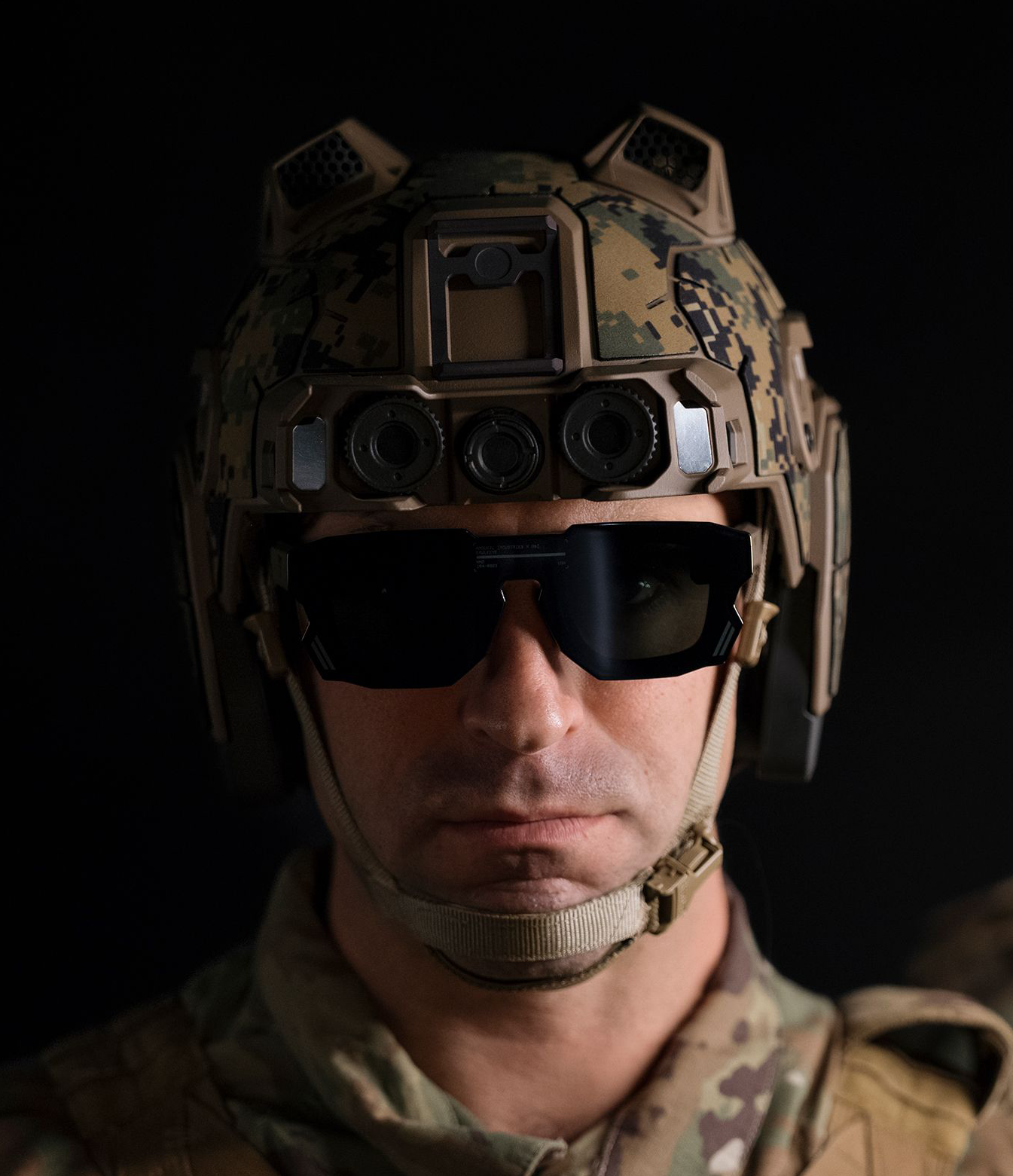
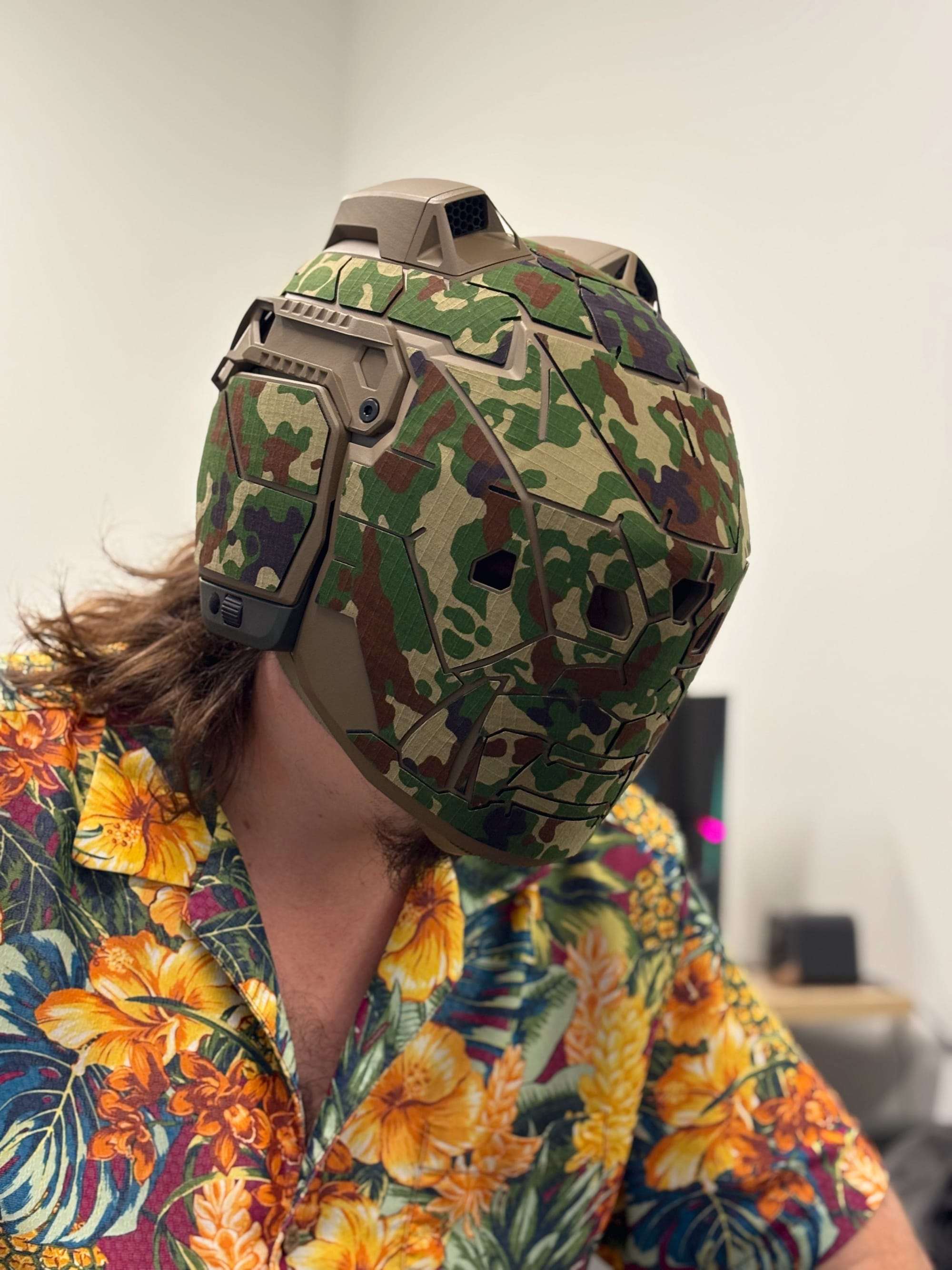
Transparent AR module (left), and passthrough MR display module in Japan’s camouflage (right).
Today, Anduril described and showed images of EagleEye with two of its possible display modules, transparent AR for daytime operations and VR-style passthrough mixed reality for nighttime, and showed mockups of the software experience.
Both embodiments of EagleEye have “beyond-full-cut ballistic protection and blast wave mitigation” as well as spatial audio and radio frequency detection, Anduril says, with at least an open-face helmet that covers the top, sides, and back of the head. They differ in what’s on the face, the display module.
The transparent AR module resembles thick sunglasses, while the passthrough MR module is a visually cohesive extension of the protective shell, resulting in a full-face headset that somewhat resembles a motorbike helmet.
Mockup of the view from EagleEye’s passthrough mixed reality display module.
Anduril depicts EagleEye’s software in a 48-second mockup video and two mockup screenshots.
The mockups show EagleEye giving soldiers a persistent compass and minimap in their field of view, with tracked friendly assets marked in blue and detected enemy assets in red. It also goes much further than just a fixed HUD, placing blue and red bounding boxes around people within the wearer’s view. When occluded by real-world geometry, these boxes contain skeletal representations of the person’s pose.
The source of these tracks is not simply the headset itself, which would be subject to significant occlusion and range limitations. The tracking is sourced from Anduril’s Lattice network, the unified sum of every sensor on the battlefield, including other headsets.
Mockup of marking a target in EagleEye.
As well as using a drone as a sensor data source for Lattice, Anduril also depicts EagleEye showing the soldier a live picture-in-picture feed from the asset, alongside details such as its heading and altitude.
The nighttime video shows the software letting the soldier toggle between various sensor views of the world, such as low light and thermal, and the daytime clips depict soldiers marking an objective and calling in a drone strike.
Mockup of calling a drone strike in EagleEye.
In addition to its partnership with Meta on core XR and AI technology, Anduril says it’s also partnering with Qualcomm for chips, as well as Oakley and Gentex for rugged eyewear and ballistic protection expertise.
“We don’t want to give service members a new tool—we’re giving them a new teammate,” Palmer Luckey said in a prepared statement. “The idea of an AI partner embedded in your display has been imagined for decades. EagleEye is the first time it’s real.”
Last month, the US Army awarded Anduril $159 million, and the Palantir-backed startup Rivet $195 million, to build and deliver hundreds of SBMC prototypes for field testing. With hundreds of units set to be tested, we should know whether Anduril’s EagleEye and Rivet’s Hard Spec fare any better in the field than Microsoft’s failed HoloLens IVAS.
At the time of the contract award, Luckey told DefenseScoop that the first “scaled delivery” of Anduril’s SBMC system should happen in 2027.
