
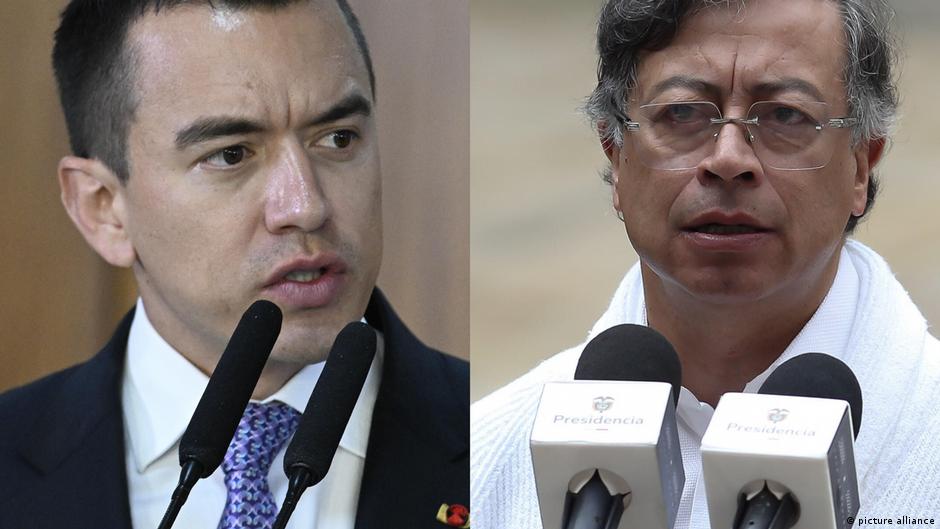
Tensions between Ecuador and Colombia are escalating, prompting a plea for diplomatic intervention from Colombian President Gustavo Petro to U.S. President Donald Trump. The dispute, fueled by a trade war and accusations of cross-border attacks, highlights the fragility of regional security and the increasing involvement of external actors in Latin American affairs.
On Monday, March 16, 2026, President Petro reported the discovery of an explosive device in the border region with Ecuador, on Colombian territory, a claim that is currently being investigated. He also referenced unreleased recordings and, on Tuesday, asserted that alleged bombings had “left 27 charred bodies.”
Petro directly appealed to President Trump for diplomatic assistance, stating, “I asked Trump: act, call the president of Ecuador, because we do not aim for to go to war.”
Ecuadorian President Daniel Noboa has denied Petro’s accusations, claiming that any military actions taken by his country’s forces have been directed solely against armed groups operating within Ecuadorian territory.
Tension Between Ecuador and Colombia Increased “Exponentially”
According to Glaeldys González Calanche, an analyst for International Crisis Group (ICG) specializing in the Andes region, “the tension between Ecuador and Colombia has increased exponentially in recent months.” She explained that Ecuador imposed tariffs, justifying the move by stating Colombia was not doing enough to combat criminal groups operating along their shared border.
“At the moment, we only know the versions of each of the parties. We have to wait for the picture to become clearer,” González told DW. “What we do know is that, in recent weeks, Ecuador has intensified its operations, jointly with the United States, through bombings on its territory, precisely on the border with Colombia,” she added, suggesting Petro’s statement is linked to these developments.
Víctor Mijares, a professor of Political Science at the University of the Andes in Colombia, explained to DW that “although there is not yet a technical report establishing the veracity of the facts, Petro preferred to get ahead and produce them part of his political discourse.” He continued, “There is an underlying conflict that has to do with the tensions between Noboa and Petro. Noboa is also trying to show himself as a closer ally to the United States, and, both are competing for Trump’s attention.”
Porous Border and Ideological Distances
“This demonstrates the complexity of the border areas between Colombia and Ecuador, making visible the weakness of bilateral relations, due to drug trafficking and, also, to the ideological distance between these two governments, in addition to trade disputes,” stated Christian Chacón, a professor of International Relations at the Jorge Tadeo Lozano University (UTADEO) in Bogotá, to this news outlet.
“The Petro government has had so many ups and downs with the United States government that now We see demanding this closeness from Trump, especially considering Noboa’s ‘trumpist’ style,” he added.
The fact that Colombia was not invited to be part of the Americas Shield is another key factor in this scenario, experts note.
Trade Dispute and Fight Against Drug Trafficking
The trade dispute between the two countries began in late January 2026, when Ecuadorian President Noboa imposed a 30% tariff on Colombian products, arguing a lack of action by its neighbor to combat drug trafficking. Petro responded with similar customs tariffs on dozens of Ecuadorian products, blocking the entry of others, and Ecuador, in turn, raised tariffs to 50% as of March 1st.
“These tensions also lead to the perpetuation of the trade war between both countries,” says Glaeldys González. “There has been no way so far to find channels for dialogue, and these measures affect not only the flow of goods on the border, but also the communities that depend on this economy, indirectly strengthening criminal groups that will now extend their smuggling operations.”
Víctor Mijares and Christian Chacón agree: the tariff dispute affects the population and businesses, both economically and in the supply of energy.
“The apparent lack of direct communication in terms of security between Bogotá and Quito reinforces the idea of a U.S. Hegemony in construction,” says Mijares, “which is beginning to demonstrate that it fully exercises functions of mediator in conflicts between Latin American countries.”
What Can Be Expected in the Development of This Crisis?
Ecuadorian Foreign Minister Gabriela Sommerfeld announced that Quito and Bogotá will resume dialogue through the Andean Community to seek a way out of the trade war, offering a glimmer of hope.
However, “reactions from both countries showing their teeth indicate a sensitive deterioration of bilateral relations,” says Víctor Mijares, a security expert at the University of the Andes, pointing to current Colombian military information about movements of the Colombian fleet in the maritime borders between Ecuador and Colombia.
“Both Petro and Noboa have been working very hard to combat organized crime,” notes political scientist Glaeldys González of the International Crisis Group, “although neither of the two countries has managed to curb these illicit activities.” She believes a breakdown in bilateral relations would also seriously affect regional security in the area, as organized crime could expand even further.
For Christian Chacón of UTADEO, the Andean Community could play a key role, at least to mediate in trade matters. Regarding Petro’s request for intervention from Trump, he warns, however, that “that could backfire on Petro, because Trump’s agenda on drug trafficking is much closer to Noboa’s.”
(rml)
