
Several foundational works of Spanish literature are being re-released this month, offering readers a renewed look at pivotal 20th and 19th-century texts.The collection includes a new edition of Juan Benet’s landmark 1968 novel,Volverás a Región,alongside rediscoveries of works by Gonzalo Suárez,Armando Palacio Valdés,and others. Publishers are revisiting these classics amid a growing interest in Spanish literary history and a desire to bring these influential voices to new audiences.
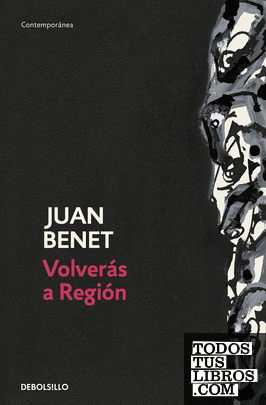
“From the publication of this novel, it is no longer possible to be foolish in Spanish literature.”
Eduardo Mendoza
Juan Benet’s debut novel, a perennial classic of Spanish literature, is being re-released.
The 1968 publication of Volverás a Región, the first novel by then-unknown writer Juan Benet, was a landmark event for Spanish letters. The book proposed new directions with an unusual level of demand. Benet’s creation of the mythical territory of “Región” served as a framework for a profound reflection on the inherent ruin of the human condition, a reflection that directly relates to the recent history of Spain, marked by the trauma of the Spanish Civil War. This re-release comes as publishers continue to revisit foundational works of 20th-century literature.
This edition is based on the latest manuscript version established by the author and includes reviews from 1969 by Rafael Conte and Pere Gimferrer.
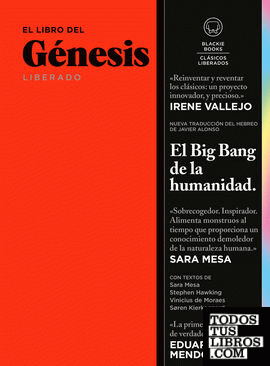
“The first source of true literature,” EDUARDO MENDOZA
Following the critical and commercial success of Odisea Liberada, the second classic released by Blackie Books is now available. El libro del Génesis (The Book of Genesis) is described as the great novel buried within the Bible. Featuring a new secular and direct translation from the Hebrew by Javier Alonso, it tells a disturbing and powerful story: the Big Bang of humanity. A sprawling and psychedelic saga, saturated with crimes and virtues, is finally liberated from prejudices of gender and race, and includes a new text by Sara Mesa, as well as contributions from Voltaire, Kierkegaard, Borges, Primo Levi, Stephen Hawking, Vinicius De Moraes, and Nick Cave, among others.
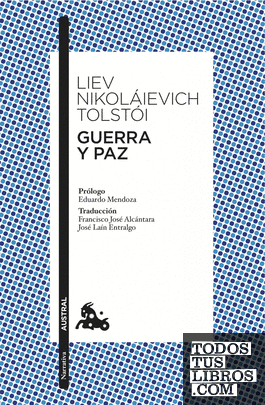
«This superhuman balance is the first thing that surprises the reader of War and Peace. This subtle balance, the secret of which escapes all formal analysis, allows the narrative to fluctuate continuously, to move from a salon to a battlefield, from an intimate dialogue to a plan for national regeneration, from a philosophical reflection to a cavalry charge, from a meeting of the French High Command to the bedside of a dying man, without abrupt transitions, without forcing the style and without the need for explanation or artifice.» From the introduction by Eduardo Mendoza

«Carmen Amoraga tells true stories, with wisdom and tenderness, without sentimentality. And she tells them well». Eduardo Mendoza
One day, Salomé receives a call from the funeral home in her hometown informing her that her mother, with whom she hadn’t had a relationship for twenty years, has died. At that moment, she knows she must confront the possibility that she was never a good daughter, just as her mother was never a good mother.
Despite herself, Salomé finds herself revisiting the ghosts of her past—her friends, first loves, the trail of her mistakes—and also uncovering some surprises. Ultimately, she learns that forming an authentic image of ourselves requires seeing ourselves through the eyes of others.
Carmen Amoraga, a finalist for the Premio Planeta and winner of the Premio Nadal, presents a novel that directly addresses the themes of motherhood and the “bad mother,” precarious employment and societal double standards, the construction of memories, guilt, prejudice, and, above all, love. The novel’s exploration of complex family dynamics is resonating with readers.
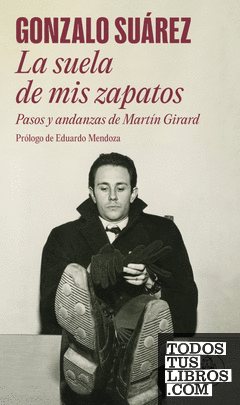
«These chronicles are sensational when read today». Eduardo Mendoza
The unforgettable chronicles of Gonzalo Suárez, vivid portraits of Barcelona in the 1960s, are being republished.
The brief existence—just eight years—of Martín Girard, the pseudonym of journalist Gonzalo Suárez, did not prevent him from leaving a lasting mark. This volume collects the work of a chronicler ahead of his time in La Vanguardia, the weekly Dicen, La Gaceta Ilustrada, and, above all, El Noticiero Universal.
Armed with an incorruptible lucidity, a distinctive style, and a restless gaze, he was able to portray a Barcelona and a Spain undergoing transformation. Interviews with Dalí, Di Stéfano, Buñuel, Pelé, Kubala, Cela, Miguel Mihura, Buero Vallejo, and Luis Suárez, pieces on Fernando Fernán Gómez, Charles Aznavour, Manuel Viola, Juan Antonio Bardem, José Bergamín, Paco Rabal, and other anonymous figures, compose a fascinating portrait of Spanish society at the time. This collection offers a valuable glimpse into a pivotal era.
A renovator of the Spanish novel and a bold film director, this volume also confirms Suárez’s status as a precursor to the so-called New Journalism.
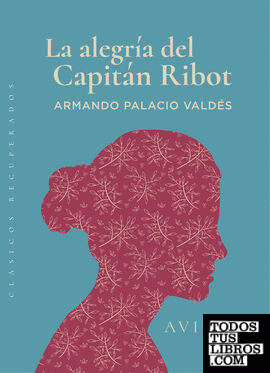
…in his novels, there occasionally appears an extravagant detail that redeems them from any possible anachronism. A point of madness, a humorous gust of wind, that pulls the story out of the framework of the naturalist novel, surprises the reader and gives the reading a moment of delirious authenticity. EDUARDO MENDOZA:
ARMANDO PALACIO VALDÉS (1853-1938), an Asturian writer and one of the most outstanding novelists of the 19th century, has created a remarkable work, with wonderful descriptions that transport us back to Spain of another era. In La alegría del capitán Ribot (The Joy of Captain Ribot), a protagonist with deeply rooted individual values finds himself entangled in a love triangle, within a bourgeois family in Valencia. Passion, deception, jealousy, betrayed friendship, sexual desire, and financial ruin disrupt the placid daily life of the protagonists. The orchard and the “alquería” (traditional Valencian farmhouse) of El Cabañal come to life and become characters in their own right. LEOPOLDO ALAS “CLARÍN” said of this novel, which AVIZOR is now re-releasing: …a work of art, of art mastered with skill; delicate and graceful composition, of a natural spiritualism, simple and sober… BLASCO IBÁÑEZ: Palacio Valdés is a true artist.
